
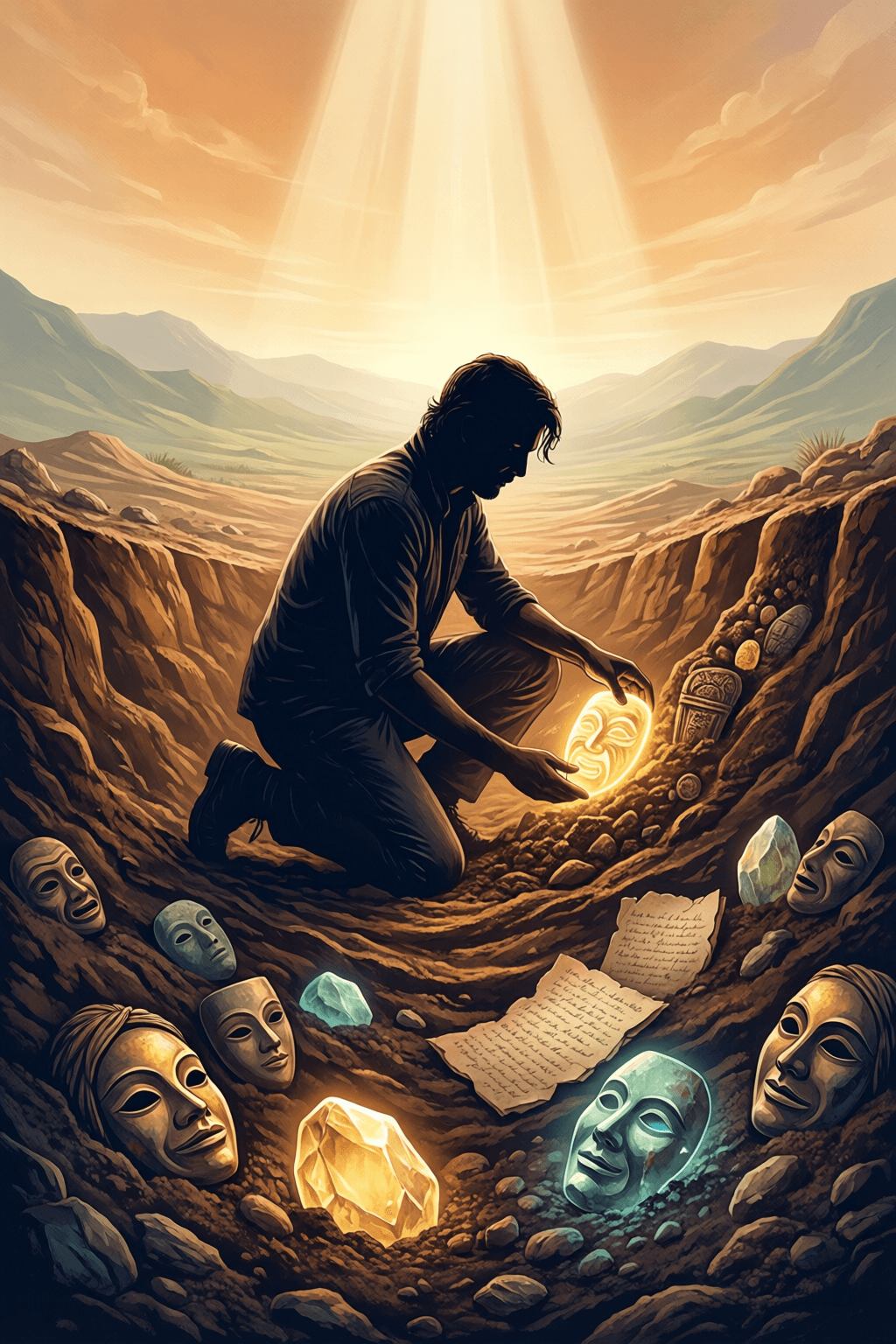
The artist is a sort of emotional archaeologist. Digging through the layers of the self is not just a process; it is a necessity for clarity. — bell hooks
—What lingers after this line?
The Metaphor of Emotional Archaeology
bell hooks frames the artist as an “emotional archaeologist,” and the image is striking because archaeology is never casual digging. It requires patience, method, and a willingness to uncover what time has buried. In the same way, the artist does not simply express feelings on the surface; rather, they excavate memories, wounds, desires, and contradictions that have settled into layers within the self. This metaphor also suggests that truth is rarely immediate. Just as an archaeologist brushes dust from a fragile artifact, the artist must carefully uncover buried emotions without destroying their meaning. hooks’s wording implies that creative work is inseparable from self-investigation, turning art into a disciplined search for what lies underneath appearance.
Why Digging Inward Becomes Necessary
From there, hooks moves beyond metaphor and insists that this inner digging is “not just a process; it is a necessity for clarity.” That distinction matters. A process can be optional, even stylistic, but a necessity points to survival, understanding, and integrity. For the artist, clarity does not arrive by avoiding discomfort; it emerges through confrontation with what has been hidden or ignored. In this sense, hooks aligns with a long tradition of introspective thought. Socrates in Plato’s Apology (c. 399 BC) declares that “the unexamined life is not worth living,” and hooks gives that philosophical claim an artistic dimension. The examined self becomes the ground from which honest creation can begin.
Layers of Identity and Memory
Moreover, the phrase “layers of the self” suggests that identity is not singular or transparent. It is built over time through experience, culture, trauma, love, and social expectation. An artist must therefore sort through these layers to understand which feelings are truly their own and which have been imposed by family, history, or power. What seems like a personal emotion may, on closer inspection, also carry collective meaning. This idea resonates with hooks’s broader body of work, especially in All About Love (2000) and Talking Back (1989), where personal life is inseparable from structures of race, gender, and domination. Thus, excavation is not narcissism; it is a way of discovering how the private self has been shaped by the public world.
Art as Recovery and Revelation
Once these buried layers are exposed, art becomes more than expression—it becomes recovery. The artist retrieves fragments of feeling that everyday life may suppress, then gives them form through language, image, sound, or gesture. In this way, creative work resembles the reconstruction of a broken artifact: the pieces may be incomplete, yet together they reveal a deeper human story. Toni Morrison’s Nobel Lecture (1993), for example, presents language as a living force that can recover what has been silenced. Likewise, hooks suggests that clarity arises not from perfection but from revelation. The artist sees more clearly by naming what was once obscured, and the audience, in turn, may recognize buried parts of themselves.
The Cost and Courage of Excavation
Still, hooks’s statement does not romanticize the task. Excavation can be painful because what lies beneath the surface is not always beautiful or coherent. To dig through the self is to encounter fear, shame, grief, and unresolved conflict. Yet this difficulty is precisely what gives the artist’s work moral and emotional force; without such risk, art may remain decorative rather than transformative. Here one might think of Frida Kahlo’s self-portraits, especially The Two Fridas (1939), where inner fracture is made visible rather than concealed. hooks’s insight similarly honors courage: clarity is purchased through honesty, and honesty often requires the artist to face what ordinary life encourages them to avoid.
Clarity as a Gift to Others
Finally, the clarity hooks describes is not only private. When artists excavate themselves truthfully, they often illuminate shared emotional landscapes for others. A deeply personal work can feel universal because it uncovers structures of longing, pain, resilience, and joy that many people carry but cannot articulate. The artist’s inward labor therefore becomes a public offering. In that sense, hooks presents art as both self-knowledge and connection. By digging through their own layers, artists create pathways for empathy, helping audiences see that their hidden lives are neither isolated nor unintelligible. What begins as a solitary excavation ends as a communal act of recognition.
Recommended Reading
As an Amazon Associate, we earn from qualifying purchases.
One-minute reflection
Where does this idea show up in your life right now?
Related Quotes
6 selectedYour soul isn't gone; it's just waiting for you to slow down and find it again. — Sam Keen
Sam Keen
Sam Keen’s line begins by refusing panic: the soul is not destroyed or stolen, only misplaced in the rush of living. That shift matters because it turns a story of permanent loss into one of possible return.
Read full interpretation →It is through the process of creating that we discover who we are, not by waiting for a finished masterpiece to tell us. — Twyla Tharp
Twyla Tharp
Twyla Tharp’s insight begins with a reversal of a common assumption: we often imagine that identity arrives fully formed and then expresses itself through art, work, or achievement. Instead, she argues that we come to kn...
Read full interpretation →We know what we are, but know not what we may be. — William Shakespeare
William Shakespeare
Shakespeare’s line captures a striking human tension: we feel certain about who we are now, yet remain unable to fully imagine who we might become. At first glance, the statement sounds simple, but it opens a profound ga...
Read full interpretation →Let yourself be gutted. Let it open you. Start there. — Cheryl Strayed
Cheryl Strayed
At first glance, Cheryl Strayed’s words sound brutal, yet their force lies in invitation rather than destruction. To be “gutted” is to be stripped of pretense, certainty, and emotional armor; however, Strayed immediately...
Read full interpretation →To find yourself, you must first be willing to lose the version of yourself you thought you had to be. — Alan Watts
Alan Watts
At first glance, Alan Watts’s statement sounds contradictory: how can losing yourself be the way to find yourself? Yet this paradox lies at the heart of his philosophy.
Read full interpretation →The delicate balance of mentoring someone is not creating them in your own image, but giving them the opportunity to create themselves. — Steven Spielberg
Steven Spielberg
At its heart, Spielberg’s remark reframes mentoring as an act of stewardship rather than control. A mentor may offer knowledge, discipline, and encouragement, yet the goal is not to reproduce a younger version of oneself...
Read full interpretation →More From Author
More from bell hooks →Deep breathing is a form of resistance against a world that demands you stay perpetually frantic. — Bell hooks
At first glance, bell hooks’s line turns an ordinary bodily act into a moral and political gesture. Deep breathing is not presented as mere relaxation, but as resistance to a culture that rewards haste, anxiety, and cons...
Read full interpretation →To love is to recognize that we are part of something larger than our own individual anxieties, a quiet web of belonging that holds us all. — bell hooks
bell hooks presents love not as a private feeling alone, but as a widening awareness that loosens the grip of self-absorption. In this view, to love is to realize that our fears and anxieties, while real, do not define t...
Read full interpretation →When we seek to understand each other rather than just being understood, we open the door to true belonging. — Bell Hooks
Bell Hooks shifts the focus of human connection away from self-assertion and toward shared discovery. Rather than framing belonging as something we earn by being accepted, she suggests it emerges when we genuinely try to...
Read full interpretation →Do not let the noise of the world drown out the quiet necessity of showing up for the people who matter most. — bell hooks
bell hooks frames love not as a vague feeling but as a deliberate act of presence. Her words suggest that the world is full of distractions—demands, anxieties, public performance—yet beneath that clamor remains a quiet m...
Read full interpretation →