
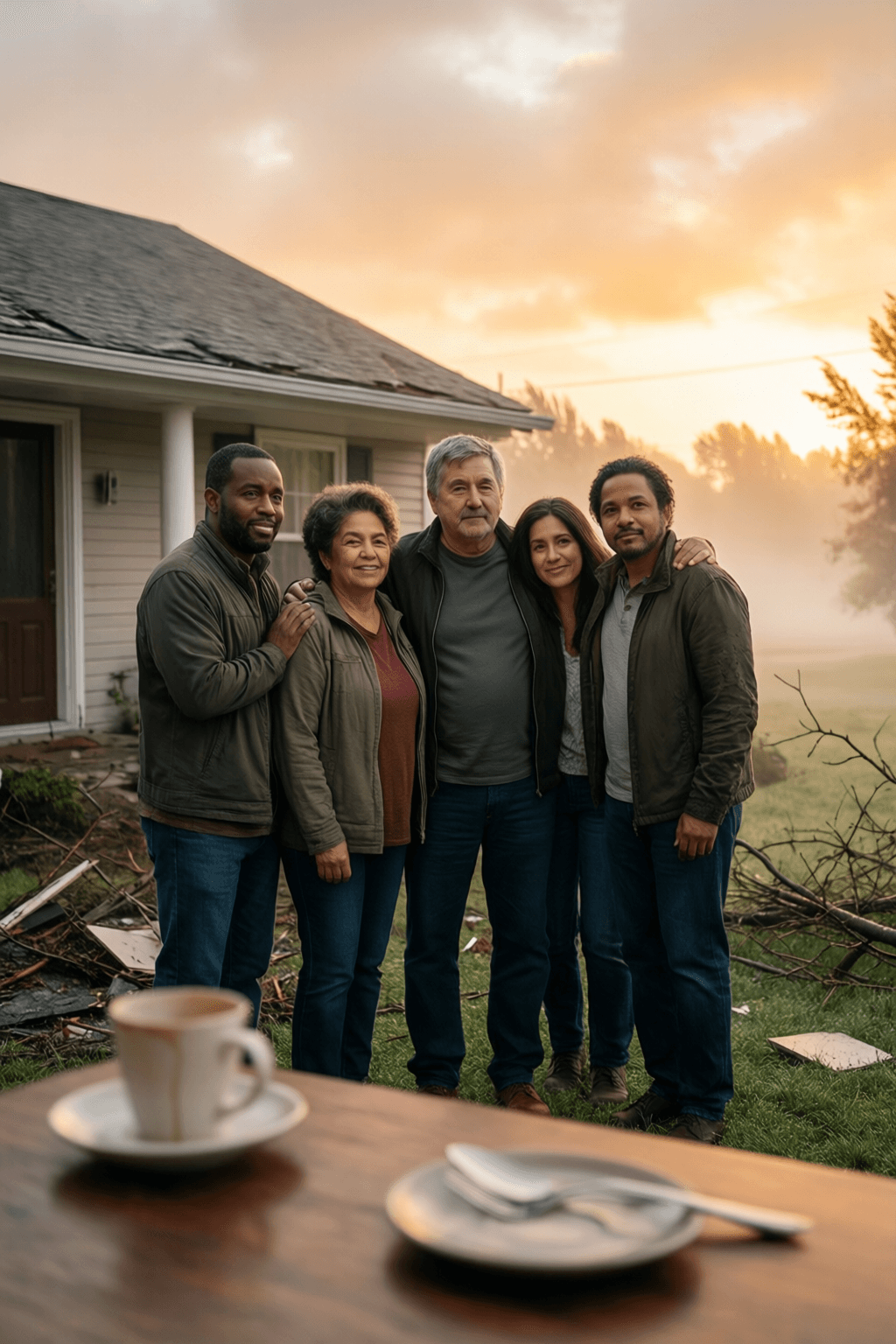
When everything goes to hell, the people who stand by you without flinching—they are your family. — Jim Butcher
—What lingers after this line?
Loyalty in the Worst Moments
Jim Butcher’s line defines family not by blood alone but by behavior under pressure. When life collapses, polite acquaintances often retreat, yet the people who remain steady without hesitation reveal a deeper bond. In that sense, crisis acts like a fire, burning away social pretense and leaving only what is durable. This is why the quote feels so immediate: it shifts attention from labels to presence. Rather than asking who is supposed to care, Butcher asks who actually does. The answer, he suggests, is family in the truest sense.
Beyond Biology and Obligation
From there, the quote opens into a broader understanding of kinship. Biological ties can be meaningful, of course, but shared DNA does not automatically guarantee courage, tenderness, or reliability. By contrast, a friend, partner, mentor, or neighbor who shows up in chaos may embody family more fully than a relative who disappears. This idea appears throughout literature and history. Homer’s Odyssey shows loyalty as something proven through endurance rather than declared by status, and that same principle shapes Butcher’s insight: family is demonstrated in action, especially when action is costly.
Crisis as a Test of Character
Moreover, hard times clarify relationships with brutal efficiency. Illness, loss, failure, and public disgrace tend to expose who can tolerate discomfort for another person’s sake. Someone who stands beside you ‘without flinching’ is not merely sympathetic; they possess emotional steadiness, moral courage, and the willingness to share a burden that is not theirs alone. In this way, adversity becomes a kind of revelation. Much as Seneca’s Letters to Lucilius (c. AD 65) argue that hardship discloses character, Butcher implies that catastrophe uncovers the hidden architecture of belonging.
The Meaning of Unflinching Presence
Just as important is Butcher’s phrase ‘without flinching.’ It suggests more than physical presence; it implies a refusal to recoil from another person’s pain, shame, or ruin. Many people can offer help from a safe distance, but fewer can remain calm when circumstances are ugly, frightening, or socially inconvenient. That unflinching quality carries emotional power because it tells a suffering person, ‘You are not too much for me.’ In trauma research, social support is often identified as a major factor in resilience, and Butcher gives that principle a strikingly human form: steadfast presence becomes its own kind of shelter.
Chosen Family and Modern Belonging
Consequently, the quote resonates strongly in modern life, where many people build ‘chosen families’ beyond traditional structures. For those estranged from relatives, living far from home, or shaped by communities of friendship, identity, or care, family is often created through loyalty repeatedly enacted. Shared meals, emergency phone calls, hospital visits, and late-night reassurances become the rituals that make belonging real. This modern reading does not reject traditional family; instead, it expands the concept. It honors the people who earn intimacy through constancy, showing that family can be inherited, but it can also be made.
A Standard for Our Own Relationships
Finally, Butcher’s statement works as both comfort and challenge. It comforts by reminding us that true family may already be visible in the people who have endured disaster with us. At the same time, it challenges us to ask whether we offer that same fearless loyalty to others when their lives unravel. Seen this way, the quote becomes an ethic of relationship. Family is not merely who claims us when life is easy, but who keeps claiming us when everything goes wrong—and, in turn, whom we choose to stand beside just as firmly.
Recommended Reading
As an Amazon Associate, we earn from qualifying purchases.
One-minute reflection
Why might this line matter today, not tomorrow?
Related Quotes
6 selectedA home isn't always the house we live in. It's also the people we choose to surround ourselves with. — TJ Klune
TJ Klune
At first glance, home seems easy to define: a house, an address, a fixed place on a map. Yet TJ Klune’s quote gently unsettles that assumption by suggesting that home is not limited to architecture or ownership.
Read full interpretation →We must take care of our families wherever we find them. — Elizabeth Gilbert
Elizabeth Gilbert
Elizabeth Gilbert’s line widens the definition of family beyond blood or paperwork, suggesting that kinship can be discovered in unexpected places and formed through lived connection. Rather than treating family as a fix...
Read full interpretation →The bond that links your true family is not one of blood, but of respect and joy in each other's life. — Richard Bach
Richard Bach
Richard Bach’s line begins by quietly overturning a default assumption: that family is primarily a biological fact. Instead, he proposes a relational definition—“true family” is recognized not by shared DNA but by the qu...
Read full interpretation →The most important thing in your life is not the noise of the world, but the quiet strength of the people you choose to call home. — Princess Diana
Princess Diana
Princess Diana’s line pivots our attention away from public commotion and toward a more intimate measure of meaning. Instead of treating status, trends, or constant stimulation as the center of life, she suggests that wh...
Read full interpretation →For you, a thousand times over. — Khaled Hosseini
Khaled Hosseini
Hosseini’s line, “For you, a thousand times over,” condenses an entire relationship into one unflinching promise. Uttered by Hassan in *The Kite Runner* (2003), it captures loyalty so deep that repetition—“a thousand tim...
Read full interpretation →I fight for my sake… and for the sake of those who believe in me. — Gaara, Naruto Series
Gaara, Naruto Series
Gaara’s words capture a turning point in his life: he no longer fights only to prove his existence, but also to honor those who have placed their trust in him. Originally introduced in the Naruto series as a lonely weapo...
Read full interpretation →More From Author
More from Jim Butcher →