
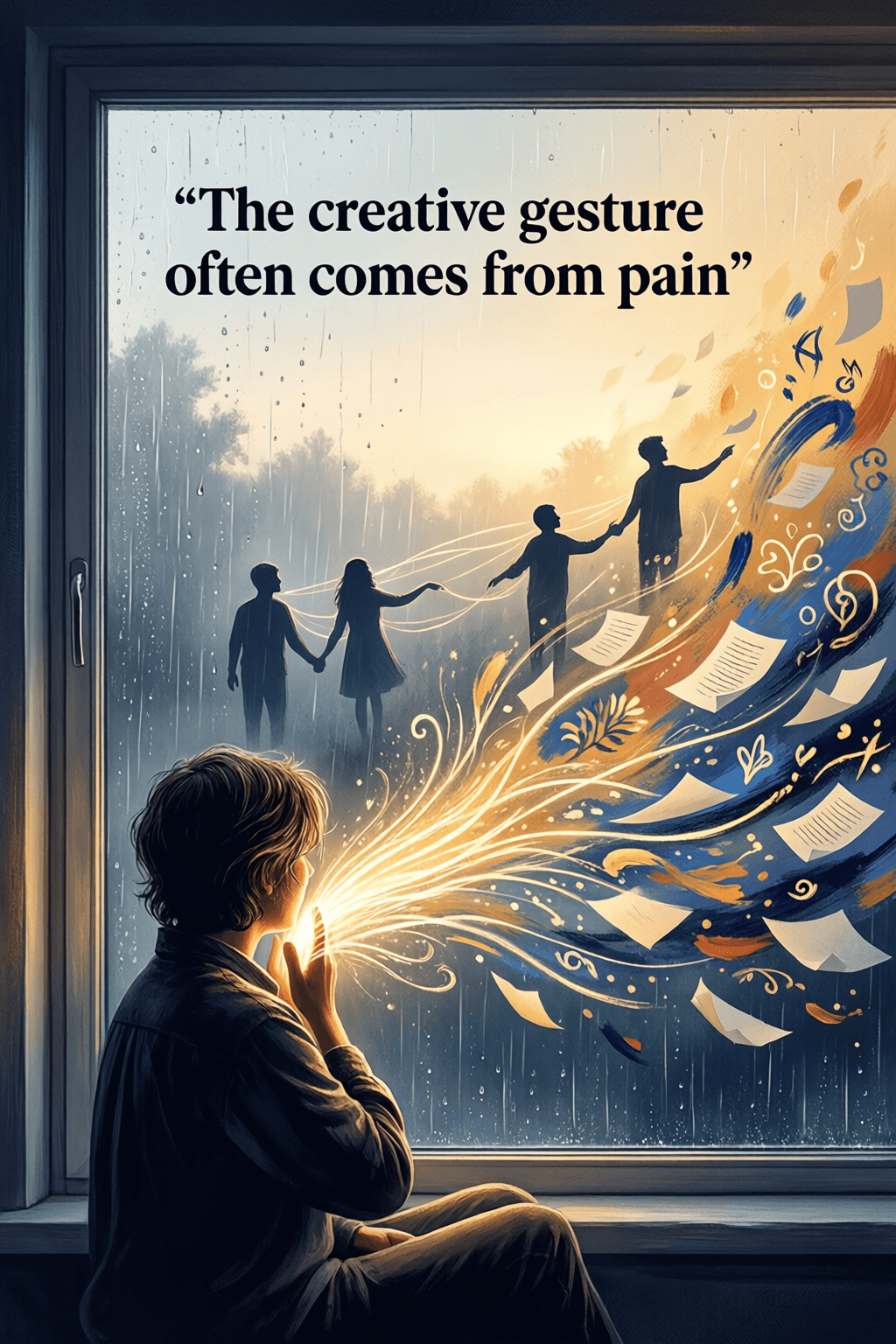
The creative gesture often comes from pain. Creating is great, sharing is better, and ultimately, our stories find their home in others. — Keanu Reeves
—What lingers after this line?
Pain as a Creative Spark
At its core, Keanu Reeves’s reflection suggests that creativity often begins not in comfort but in discomfort. Pain, whether grief, loneliness, failure, or confusion, can press inward so intensely that it demands expression. In that sense, the creative gesture becomes more than self-expression; it becomes a way of giving shape to what might otherwise remain overwhelming and unnamed. This idea has deep artistic roots. Frida Kahlo’s paintings, shaped by physical suffering after her 1925 bus accident, transformed private pain into arresting visual language. Likewise, Sylvia Plath’s poetry channels emotional intensity into crafted form. Reeves’s quote fits within that lineage, reminding us that art frequently starts where language first breaks under pressure.
Creation as Transformation
Yet Reeves does not stop at suffering itself; instead, he points toward what pain can become. Creating is “great” because it transforms raw feeling into something structured, whether a poem, film, song, journal entry, or quiet act of making. Through creation, chaos is not erased, but it is rearranged into meaning, and that process can be deeply restorative. In this way, the act of making resembles what psychologist James Pennebaker’s research on expressive writing (1980s onward) often suggests: articulating difficult experiences can help people process them. So while pain may ignite the work, creation becomes the bridge between wound and understanding. It is the first movement from isolation toward possibility.
Why Sharing Deepens the Act
From there, the quote advances to a more generous claim: sharing is better. That phrase shifts creativity away from a purely private triumph and toward relationship. A story kept entirely to oneself may heal the maker, but once it is shared, it gains the potential to comfort, provoke, accompany, or even change someone else. This is why memoir, music, and cinema often feel most powerful when they reveal vulnerability. Joan Didion’s The Year of Magical Thinking (2005), for instance, turns personal grief into a narrative countless readers have leaned on. Reeves’s insight is that creation reaches fuller significance when it leaves the solitude of the artist and enters the emotional life of others.
Stories Finding a Home
As the quote concludes, it offers its most moving image: our stories “find their home in others.” This suggests that meaning is completed not only in expression but in reception. A listener, reader, or viewer recognizes something of themselves in what another person has made, and suddenly a private experience becomes shared human ground. That dynamic helps explain why certain works endure. Toni Morrison’s Beloved (1987), while rooted in historically specific trauma, speaks to memory, loss, and survival in ways that resonate far beyond its immediate setting. Similarly, an ordinary person’s small confession can lodge deeply in a friend’s heart. The home of a story, Reeves implies, is not the page or screen alone, but the human being who receives it.
From Solitude to Community
Taken together, the quote traces a quiet but profound movement: pain leads to creation, creation leads to sharing, and sharing leads to connection. What begins as an inward struggle can become a communal bond. In that progression, art is not merely a product but a passage from loneliness into recognition. This is perhaps why creative communities matter so much, whether in theater groups, songwriting circles, or online spaces where people post work born from hardship. The individual voice starts alone, but it rarely ends there. Reeves’s words ultimately frame creativity as an act of reaching outward, proving that even wounded experiences can become sources of belonging.
A Compassionate Philosophy of Art
Finally, the statement carries an ethical undertone: it treats storytelling not as performance alone but as compassion. To create from pain is brave; to share it is generous; and to let it live in others is to trust that human beings are capable of mutual recognition. The quote therefore honors both the maker and the audience as participants in the same emotional exchange. Seen this way, art becomes a form of care. It says, in effect, “This hurt me, but perhaps it can help name something in you.” That sentiment echoes across literature and film, from Viktor Frankl’s Man’s Search for Meaning (1946) to intimate contemporary songwriting. Reeves distills that long tradition into a simple sequence: suffering can become expression, and expression can become home.
One-minute reflection
What's one small action this suggests?
Related Quotes
1 selectedMore From Author
More from Keanu Reeves →