
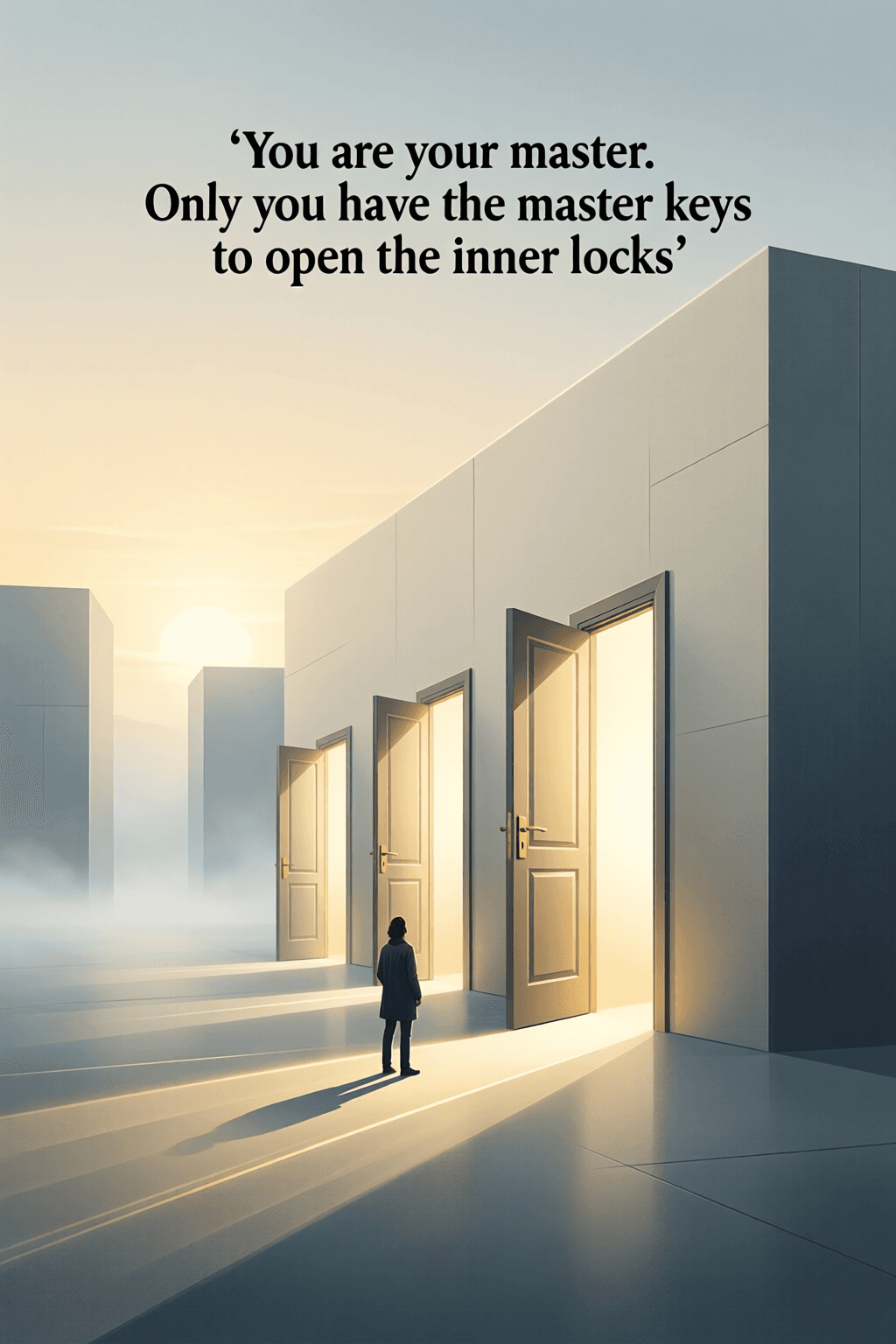
You are your master. Only you have the master keys to open the inner locks. — Amit Ray
—What lingers after this line?
The Claim of Inner Authority
Amit Ray’s line begins with a radical assertion: the deepest authority over one’s life lies within. By saying, “You are your master,” he shifts attention away from external approval, inherited rules, or social dependence and toward self-governance. In that sense, the quote is not merely motivational; it is a philosophical challenge to recognize that lasting change cannot be outsourced. From this starting point, the image of “master keys” becomes especially powerful. It suggests that the barriers we struggle against are not always imposed from outside but are often internal—fear, self-doubt, habit, or denial. Therefore, the first step in opening any “inner lock” is accepting that the hand holding the key is our own.
The Meaning of the Inner Locks
Once that inner authority is established, the metaphor of “inner locks” deepens the message. These locks can be read as emotional defenses, unconscious wounds, limiting beliefs, or even untapped capacities that remain sealed because we have not learned how to approach them. In modern psychology, Carl Jung’s writings on the shadow emphasize that hidden parts of the self often remain inaccessible until consciously explored. Consequently, the quote implies that self-discovery is less about acquiring something foreign than about unlocking what is already present. The obstacle is not a lack of worth or potential, but a lack of access. This makes the inward journey both difficult and hopeful: difficult because honesty is required, and hopeful because the treasure is already within.
Spiritual Echoes of Self-Realization
This idea resonates strongly with spiritual traditions that place awakening inside the individual. The Upanishads, composed roughly between 800 and 300 BC, repeatedly point seekers inward, suggesting that the deepest truth is discovered not through possession but through realization. Likewise, the Delphic maxim “Know thyself,” central to Greek thought, frames self-knowledge as the gateway to wisdom. In that light, Ray’s words sound like a contemporary restatement of an ancient teaching. The “master keys” are not magical privileges reserved for a few enlightened people; rather, they are practices of awareness, discipline, and reflection. Thus the quote connects modern self-help language to a long lineage of philosophical and spiritual inquiry.
Freedom Through Responsibility
However, the quote does not offer comfort without cost. If only you possess the keys, then you also bear responsibility for using them. This turns the message from passive inspiration into an ethical demand: one must stop waiting for rescue and begin the difficult work of confronting inner resistance. Viktor Frankl’s Man’s Search for Meaning (1946) similarly argues that even under severe conditions, human beings retain a final freedom in how they respond. As a result, inner mastery is inseparable from responsibility. It means acknowledging that while circumstances shape us, they do not fully define us. The lock may be stubborn, but the refusal to try the key becomes its own form of imprisonment.
Practices That Turn Metaphor Into Action
For that reason, the quote becomes most meaningful when translated into practice. Meditation, journaling, prayer, therapy, and deliberate solitude can all function as “master keys” because they help a person notice recurring patterns and loosen internal knots. A simple example is the act of writing honestly for ten minutes a day: what begins as scattered thought often reveals a hidden fear or desire that had quietly governed behavior. Then, once awareness appears, change becomes possible. The lock rarely opens all at once; more often, it clicks gradually through repeated attention. In this way, Ray’s metaphor is practical as much as poetic, reminding us that self-mastery is built through small, consistent acts of inward courage.
A Vision of Liberation From Within
Ultimately, the quote offers a vision of liberation that begins not in conquest but in recognition. To be one’s own master is not to dominate the self harshly, but to understand it deeply enough to guide it wisely. The inner locks are real, yet so is the capacity to open them. This balance gives the statement both gravity and hope. Finally, the enduring appeal of Ray’s words lies in their quiet insistence that the path inward is also the path forward. What we seek—clarity, strength, peace, direction—may not arrive from outside intervention alone. Instead, it emerges when we accept that the keeper of the door and the bearer of the key are the same person.
One-minute reflection
What does this quote ask you to notice today?
Related Quotes
6 selectedAwaken your inner warrior; let your passion be the sword that carves your destiny. — Unknown.
Unknown
This quote encourages individuals to harness their inner strength and resilience. Awakening the inner warrior signifies embracing one's power to overcome challenges and adversities.
Read full interpretation →The power is within you.
Unknown
This phrase emphasizes that true strength and capability come from within oneself rather than external sources. It suggests that individuals hold the potential to overcome challenges and achieve their goals.
Read full interpretation →Quiet people are not empty; they are contained. Their power does not seek attention—it waits. — Seneca
Seneca
At first glance, Seneca’s line overturns a common social assumption: that quietness signals absence, weakness, or lack of thought. Instead, he frames silence as containment, suggesting that some people hold their ideas,...
Read full interpretation →A magician is strong because he hurts more than others. He has learned to break the world that has tried to break him. — Haruki Murakami
Haruki Murakami
Murakami’s line begins with a striking reversal: the magician is not powerful because he is untouched, but because he has suffered more deeply than others. In this view, strength does not emerge from comfort; rather, it...
Read full interpretation →True confidence, like deep rivers, flows calmly and silently without the need for continual recognition. — Unknown (Wait: Skipping) -> My limits are not a debate. — Unknown (Wait: Skipping) -> Never bend your head. Always hold it high. Look the world straight in the eye. — Helen Keller
Helen Keller
Helen Keller’s line begins with a physical image, yet it quickly opens into a moral one: to hold one’s head high is to move through the world with unshaken self-respect. In that sense, true confidence does not beg for ap...
Read full interpretation →Talk is cheap. It is infinitely easier to write a manifesto about success than to practice one principle of self-mastery. — Leo Tolstoy
Leo Tolstoy
Tolstoy’s remark begins with a blunt contrast: speaking about success is easy, while living with discipline is hard. In a few words, he exposes a familiar human habit—mistaking eloquent intentions for actual achievement.
Read full interpretation →More From Author
More from Amit Ray →We are all so deeply interconnected; we have no option but to love all. — Amit Ray
Amit Ray’s statement begins with a simple but far-reaching premise: human beings are not isolated units, but participants in a shared web of life. If our lives constantly shape one another through family, community, econ...
Read full interpretation →Touching the Earth is a great way to remove anxiety and come back to yourself. It immediately has a grounding effect on you. — Amit Ray
At its core, Amit Ray’s reflection presents the Earth as more than a physical surface; it becomes a source of emotional recalibration. To touch the ground is to interrupt spiraling thought and return attention to somethi...
Read full interpretation →Be like a lotus. Let the beauty of your heart speak. Be grateful to the mud, water, air, and the light. — Amit Ray
The lotus thrives in muddy waters, symbolizing the ability to grow and flourish despite challenging and adverse circumstances. It encourages embracing difficulties as they contribute to personal growth.
Read full interpretation →If you want to conquer the anxiety of life, live in the moment, live in the breath. — Amit Ray
The quote emphasizes the importance of being present and attentive to the current moment as a way to alleviate anxiety.
Read full interpretation →