
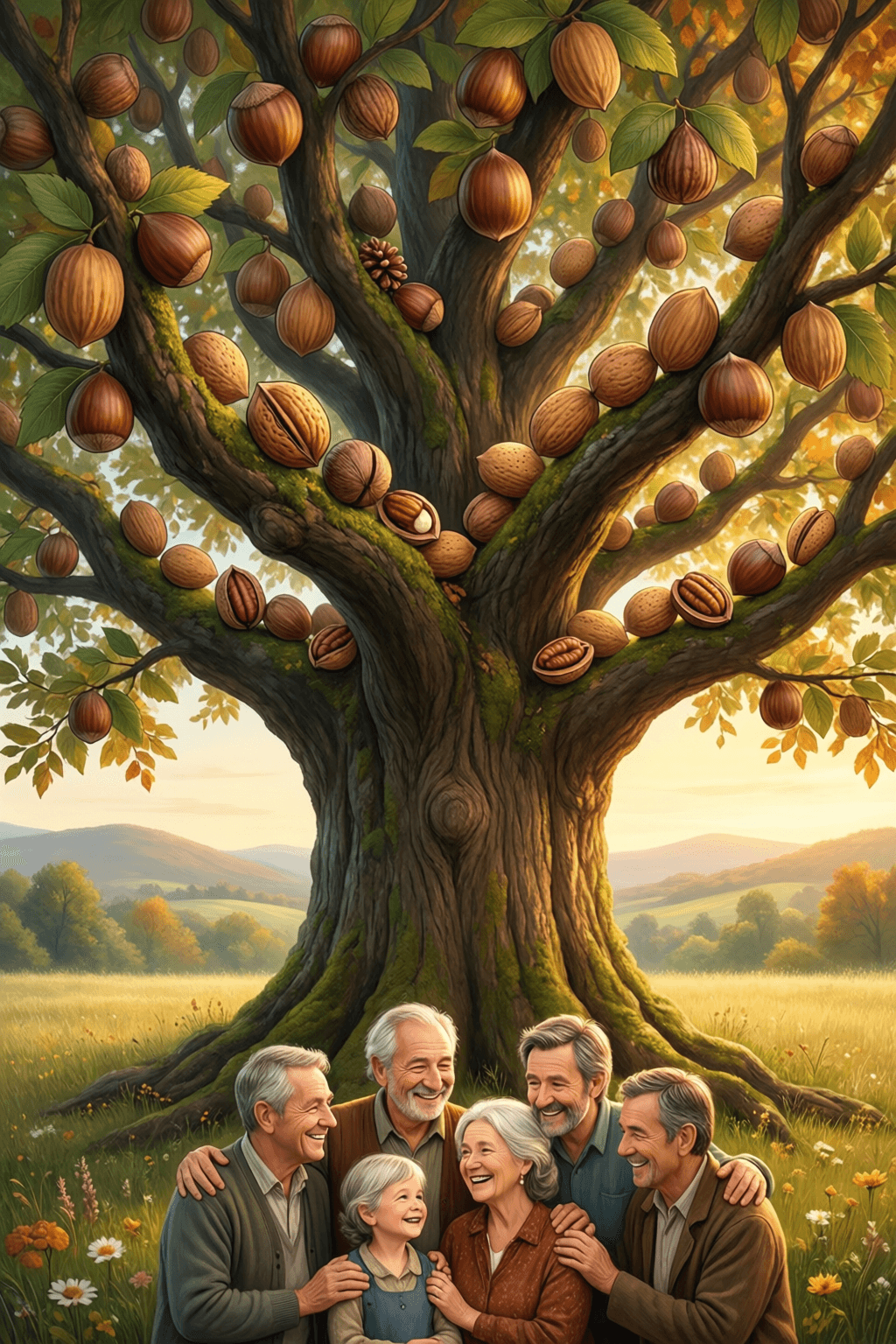
Some family trees bear an enormous crop of nuts. — Wayne Huizenga
—What lingers after this line?
A Bitter Joke About Inheritance
At first glance, Wayne Huizenga’s line sounds playful, but its humor carries a sharp edge. By comparing certain family trees to those that produce “an enormous crop of nuts,” he turns the traditional symbol of ancestry into a commentary on the stubborn, repeated absurdities that can run through generations. The joke works because it borrows the language of pride and legacy, then flips it into satire. In that reversal, Huizenga hints at a familiar truth: families do not merely pass down names, heirlooms, and stories; they also transmit habits, blind spots, and eccentricities. Thus the quote invites us to laugh, but it also nudges us to recognize that lineage can preserve folly as efficiently as virtue.
The Family Tree as Symbol
Traditionally, the family tree evokes rootedness, continuity, and belonging. Genealogies in texts such as the Hebrew Bible, especially in Genesis, use lineage to establish identity and covenant, while later aristocratic records turned ancestry into proof of status. Against that backdrop, Huizenga’s image becomes more cutting, because it takes a noble metaphor and fills it not with worthy descendants but with “nuts.” As a result, the quote punctures sentimental ideas about bloodlines. It suggests that simply belonging to a family does not guarantee wisdom or character. In fact, the more impressive the tree appears from a distance, the more surprising its “crop” may be when examined up close.
How Eccentricity Repeats Itself
From there, the saying opens onto a broader observation about repetition within families. Behavioral patterns often echo across generations, whether through imitation, shared environment, or unspoken family scripts. Modern family systems theory, associated with Murray Bowen in the 20th century, argues that emotional habits can be transmitted across generations with remarkable consistency. Consequently, Huizenga’s punch line feels less like random mockery and more like compressed social insight. Anyone who has heard the same temper, prejudice, or dramatic flair emerge in different relatives recognizes the point immediately. The “crop” is enormous precisely because families can multiply quirks faster than they correct them.
Humor as Social Criticism
What makes the quote memorable, however, is its comedic restraint. Rather than delivering a moral lecture about dysfunction, Huizenga relies on a dry agricultural metaphor. This technique resembles the concise wit found in figures like Oscar Wilde, whose epigrams often exposed social vanity by sounding effortless. The humor softens the blow even as it sharpens the observation. Because of that balance, the line becomes useful in everyday conversation: it lets people acknowledge family chaos without descending into bitterness. In other words, laughter becomes a way to tell the truth safely. The joke may be cruel in outline, yet in practice it often serves as a form of recognition and release.
Beyond Mockery to Self-Reflection
Still, the quote is most valuable when turned inward rather than outward. It is easy to identify the “nuts” in one’s extended family; it is harder to admit that every branch may include our own contradictions. Here the saying shifts from insult to mirror, asking whether we are merely observers of inherited foolishness or participants in it. That self-reflective turn gives the humor its lasting power. Much like Leo Tolstoy’s opening in Anna Karenina (1878) that every unhappy family is unhappy in its own way, Huizenga condenses a vast truth into a compact line: family life mixes affection, absurdity, and repetition. By laughing at the family tree, we may begin to prune what should not keep growing.
One-minute reflection
Why might this line matter today, not tomorrow?
Related Quotes
6 selectedI'm so glad this family is on my side. They'd make terrifying enemies. — Unknown (skipping as requested, replacing with: "Some family trees bear an enormous crop of nuts." — Wayne Huizenga)
Wayne Huizenga
Wayne Huizenga’s quip works because it turns the familiar image of a family tree into a sly comic verdict on relatives. By saying some trees produce “an enormous crop of nuts,” he replaces solemn ancestry with affectiona...
Read full interpretation →People say nothing is impossible, but I do nothing every day. — A.A. Milne
A. A. Milne
At first glance, A.A. Milne’s line turns a familiar motivational slogan inside out.
Read full interpretation →Families are like fudge – mostly sweet with a few nuts. — Rick Riordan
Rick Riordan
Rick Riordan’s line turns family life into a piece of fudge: rich, comforting, and familiar, yet never perfectly smooth. The humor works because it is affectionate rather than cruel.
Read full interpretation →It is hard work and great art to make life not so serious. — Bill Watterson
Bill Watterson
Bill Watterson’s remark turns a common assumption upside down: lightness is not the absence of effort but the result of it. To make life ‘not so serious’ requires intention, restraint, and imagination, because the world...
Read full interpretation →The art of living is not about being a finished masterpiece; it is about being a work in progress that still knows how to laugh at its own paint spills. — Anne Lamott
Anne Lamott
At its heart, Anne Lamott’s remark reframes life from a quest for perfection into an ongoing act of creation. Instead of imagining ourselves as polished masterpieces, she invites us to see our days as brushstrokes still...
Read full interpretation →Marriage is a wonderful institution, but who wants to live in an institution? — Groucho Marx
Groucho Marx
At first glance, Groucho Marx’s line works because it pivots on the word “institution.” Marriage is conventionally praised as a stable social institution, yet the same word can evoke prisons, asylums, or places where fre...
Read full interpretation →More From Author
More from Wayne Huizenga →