
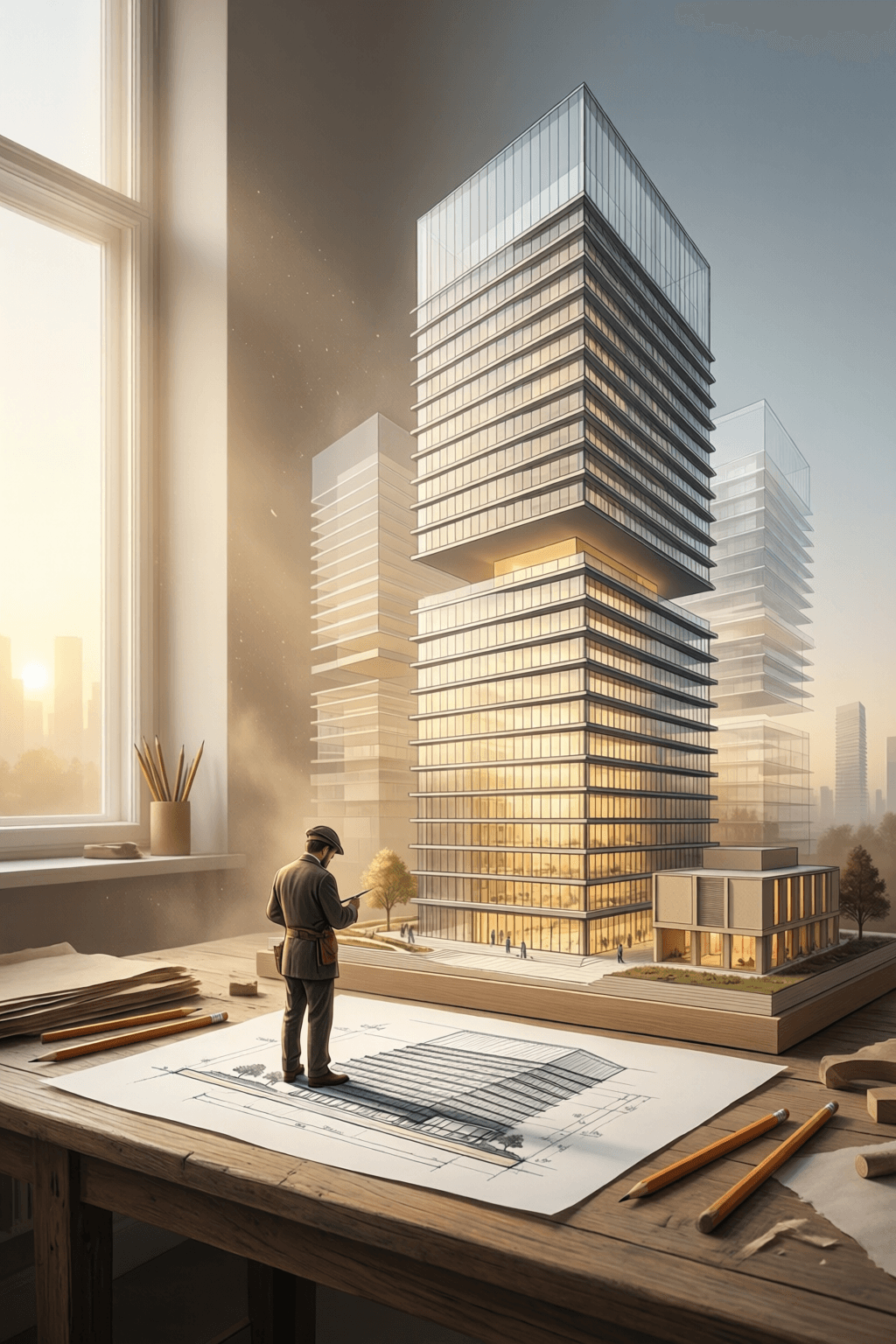
The beauty of architecture is it involves work that stretches over a very long time but often starts in one instant, with just one emotion. — Ma Yansong
—What lingers after this line?
A Sudden Origin
Ma Yansong’s remark begins with a striking contrast: architecture may take years, even decades, to realize, yet its true beginning can occur in a single charged moment. In that instant, a feeling—awe, longing, serenity, or excitement—becomes the seed of a structure that will later require drawings, budgets, labor, and patience. The quote therefore shifts attention away from architecture as mere construction and toward architecture as an emotional act of inception. From this starting point, the architect appears not simply as a technician but as someone who captures a fleeting inner response before it fades. Much like a composer hearing the first phrase of a symphony, the designer senses a form before it fully exists. That emotional spark gives coherence to the long process that follows.
Emotion Before Blueprint
Building on that idea, Ma suggests that feeling is not separate from design logic but often precedes it. Before plans are finalized, there may be a mood the architect wants people to experience: the calm of filtered light, the thrill of height, or the intimacy of enclosure. In this sense, emotion is not an afterthought added to a functional shell; it is the original impulse that shapes the shell itself. This view echoes Juhani Pallasmaa’s The Eyes of the Skin (1996), which argues that architecture is deeply tied to human sensation and memory rather than visual form alone. Consequently, a building’s success cannot be measured only by efficiency or spectacle. It must also preserve the feeling that first called it into being.
Time as a Creative Material
Yet the quote does not romanticize inspiration at the expense of endurance. Instead, it highlights the unusual nature of architecture: unlike a sketch or poem, a building unfolds through prolonged negotiation with materials, engineering, weather, politics, and cost. The original emotion may arrive instantly, but it must survive an extended journey through countless revisions. That is part of architecture’s beauty—its ability to carry a fragile beginning across time. Seen this way, time becomes a material almost as important as concrete or steel. Antoni Gaudí’s Sagrada Família, begun in 1882 and still under construction for much of its history, illustrates this beautifully: a visionary idea had to persist through generations. The emotional origin remains, even as the hands completing it change.
From Private Feeling to Shared Experience
As the process continues, the architect’s solitary emotion gradually becomes public space. What starts as one person’s intuition must eventually be translated into walls, thresholds, curves, and light that others can inhabit. In other words, architecture transforms private feeling into a collective experience. A single emotional instant expands until strangers can walk through it. This transformation helps explain why memorable buildings often feel meaningful even when visitors know nothing about their technical history. Louis Kahn’s Salk Institute (1965), for example, communicates stillness and contemplation through its open courtyard and framing of the horizon. The architect’s inner vision becomes something physically shareable, allowing emotion to be encountered rather than merely described.
Patience Gives Form to Vision
For that reason, Ma’s statement also honors discipline. Inspiration may be immediate, but architecture demands sustained commitment to protect the first idea from dilution. The long timeline of a project tests whether the originating emotion was deep enough to guide decisions repeatedly. Every modification asks the same question: does this still serve the feeling that began it? Thus, the quote offers a quiet lesson about creation itself. What matters is not only having a powerful initial emotion, but also remaining faithful to it through slow, practical work. Architecture becomes beautiful precisely because it joins urgency and patience—the speed of feeling with the endurance of craft.
A Philosophy of Hope and Memory
Finally, Ma Yansong’s words imply that buildings are containers of both hope and memory. They begin in an emotional flash oriented toward the future, yet they often outlast the moment, the project team, and even the era that produced them. This gives architecture a special human resonance: it converts a brief, invisible feeling into something durable enough to accompany generations. In that sense, the quote is about more than design. It speaks to the desire to make emotions lasting, to give form to what would otherwise vanish. Architecture, then, is beautiful not simply because it stands for a long time, but because it proves that one instant of feeling can become a world people live inside.
One-minute reflection
Why might this line matter today, not tomorrow?
Related Quotes
6 selectedMe thinks that the minute my legs begin to move my thoughts begin to flow. — Henry David Thoreau
Henry David Thoreau
At first glance, Thoreau’s remark seems simple: as soon as his body starts moving, his mind comes alive. Yet the line captures a deeper truth about the intimate bond between physical motion and mental clarity.
Read full interpretation →If you have knowledge, let others light their candles in it. — Margaret Fuller
Margaret Fuller
Margaret Fuller’s line presents knowledge not as private property but as a flame meant to be shared. By imagining wisdom as a source from which others may light their candles, she transforms learning into an act of gener...
Read full interpretation →When a work lifts your spirits and inspires bold and noble thoughts in you, do not look for any other standard to judge by: the work is good, the product of a master craftsman. — Jean de la Bruyere
Jean de La Bruyère
La Bruyère proposes a strikingly direct test for artistic greatness: if a work raises your spirit and stirs noble thoughts, it has already proved its worth. Rather than beginning with technical rules or elite opinion, he...
Read full interpretation →The great composer does not set to work because he is inspired, but becomes inspired because he is working. — Ernest Newman
Ernest Newman
At first glance, Ernest Newman overturns a familiar romantic belief: that artists wait passively for inspiration to arrive like a lightning strike. Instead, he argues that the great composer begins with labor, routine, a...
Read full interpretation →The most important thing is to try and inspire people so that they can be great at whatever they want to do. — Kobe Bryant
Kobe Bryant
Kobe Bryant’s words shift the focus of success from the individual to the collective. Rather than centering on his own achievements, he emphasizes the responsibility to spark something in others.
Read full interpretation →Your life is your message to the world. Make sure it’s inspiring. — Lorrin L. Lee
Lorrin L. Lee
This quote emphasizes the importance of living a life that leaves a positive and lasting impact. It suggests that each person's actions and choices are a message that they send out to the world.
Read full interpretation →More From Author
More from Ma Yansong →