
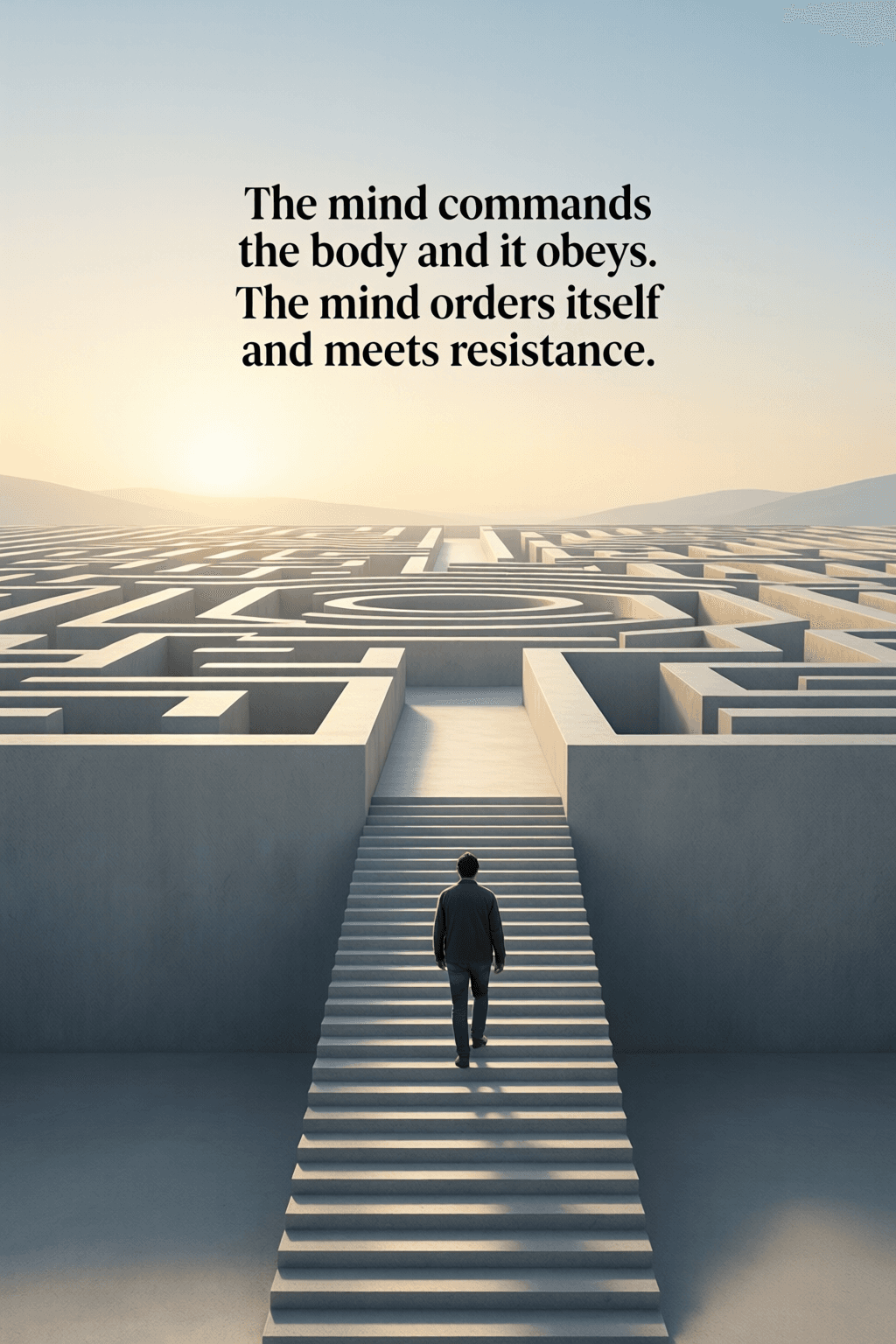
The mind commands the body and it obeys. The mind orders itself and meets resistance. — St. Augustine
—What lingers after this line?
Augustine’s Striking Contrast
At first glance, Augustine draws a simple comparison: the body often responds when the mind gives an order, yet the mind itself resists its own commands. In one sharp sentence, he exposes a familiar human frustration. We can raise a hand, stand up, or turn our head with relative ease, but telling ourselves to stop worrying, stop craving, or start concentrating is far less straightforward. This contrast gives the quote its enduring force. Augustine is not merely describing weakness; he is identifying an inner division at the heart of human experience. In his Confessions (c. 397–400), he repeatedly reflects on wanting one thing and doing another, making this line feel less like abstract philosophy and more like lived psychological truth.
The Problem of the Divided Will
From there, Augustine’s insight opens into his larger idea of the divided will. A person may sincerely desire discipline, virtue, or peace, and yet still feel pulled by habit, fear, or appetite in the opposite direction. In other words, the self is not always unified; one part commands while another part delays, bargains, or refuses. This is why self-control can feel strangely paradoxical. If the mind is issuing the order, why does it not simply comply? Augustine’s answer, especially in Confessions Book VIII, is that willing is not always whole. We do not merely lack information about the good; rather, we often lack the inward integration needed to carry it out.
Habits Stronger Than Intentions
Consequently, the quote also speaks to the power of habit. Bodily action may be immediate, but mental reform usually collides with patterns built over time. Anyone who has promised to wake earlier, abandon resentment, or resist distraction knows this resistance intimately: the intention is real, but the older habit often feels stronger. Augustine’s own famous hesitation—summed up in the plea, “Grant me chastity and continence, but not yet” from Confessions (c. 397–400)—illustrates this perfectly. He did not lack awareness; he lacked readiness to surrender entrenched desires. Thus, the mind’s resistance is not random failure but the inertia of a self shaped by repetition.
A Psychological Insight Before Psychology
Seen in a modern light, Augustine sounds remarkably contemporary. Long before neuroscience or behavioral psychology, he recognized that conscious intention does not fully govern inner life. Today, research on cognitive dissonance, compulsive behavior, and automatic thought patterns similarly suggests that the mind contains competing processes rather than one seamless executive center. Therefore, his quote remains relevant because it anticipates what many now accept scientifically: knowing what we should do does not guarantee that we can simply will it into being. The internal resistance Augustine names resembles what modern therapists observe when clients struggle to change despite sincere motivation. His language is theological, but the experience he describes is universal.
The Spiritual Meaning of Resistance
Yet Augustine is not only making a psychological observation; he is also making a spiritual one. For him, the mind’s inability to command itself points to human dependence, finitude, and the need for grace. Self-mastery is difficult precisely because the self is wounded, unstable, and unable to heal itself by command alone. This deepens the quote considerably. Rather than treating resistance as a mere inconvenience, Augustine sees it as evidence that moral transformation requires more than determination. In works like On Free Choice of the Will (c. 388–395), he wrestles with freedom and moral failure, suggesting that true inward order emerges not just from effort, but from rightly ordered love.
Why the Quote Still Endures
Finally, Augustine’s words endure because they describe an experience almost everyone recognizes. It is easy to instruct the body to move; it is harder to instruct the self to become patient, faithful, focused, or brave. The quote captures the daily drama of human life: we are never simply commanders of ourselves, but participants in an inner struggle. For that reason, the line offers both realism and humility. It reminds us that failure to change is not always hypocrisy or laziness; often, it is the mark of a divided interior life. And by naming that struggle so clearly, Augustine gives readers a language for one of the oldest battles any person faces—the effort to become whole.
One-minute reflection
What feeling does this quote bring up for you?
Related Quotes
6 selectedThe discipline of desire is the backbone of character. — Will Durant
Will Durant
At first glance, Will Durant’s line suggests that character is not built by suppressing desire, but by governing it. Desire is the engine of human action: it pushes us toward pleasure, ambition, recognition, and comfort.
Read full interpretation →Discipline is a choice. It's simply consistently choosing the hard right over the easy wrong. — James C. Collins
James C. Collins
At its core, Collins reframes discipline not as a personality trait but as a repeated act of will. The quote strips away the mystique around self-control and presents it as something practical: each day offers a series o...
Read full interpretation →The discipline of writing something down is the first step toward making it happen. — Lee Iacocca
Lee Iacocca
Lee Iacocca’s remark begins with a simple but powerful observation: ideas remain fragile while they stay in the mind. The moment a goal is written down, however, it gains shape, boundaries, and a sense of seriousness.
Read full interpretation →How much time he gains who does not look to see what his neighbour says or does or thinks, but only at what he does himself, to make it just and holy. — Marcus Aurelius
Marcus Aurelius
Marcus Aurelius argues that a great deal of life is wasted in watching other people—what they say, what they do, and even what they might be thinking. Instead, he recommends a disciplined inward turn: focus on your own c...
Read full interpretation →It is easier to discipline yourself now than to regret your lack of discipline later. — Jim Rohn
Jim Rohn
Jim Rohn’s saying turns discipline into a simple comparison of costs. On one side is the discomfort of acting now: waking up early, saving money, studying longer, or saying no to distraction.
Read full interpretation →Consistency is showing up without applause. — Unknown (removed per constraint; replaced with: Self-command is the main elegance. — Ralph Waldo Emerson)
Ralph Waldo Emerson
At first glance, Emerson’s line shifts elegance away from clothing, manners, or social polish and places it firmly within character. “Self-command is the main elegance” suggests that the most impressive form of refinemen...
Read full interpretation →More From Author
More from St. Augustine →Whatever you do, do it well. Whatever you do, do it with beauty. — St. Augustine
At first glance, Augustine’s counsel seems simple: do your work well. Yet the phrase carries a deeper ethical force, because it frames excellence not as vanity but as responsibility.
Read full interpretation →Hope has two beautiful daughters; their names are Anger and Courage. — St. Augustine
St. Augustine’s image begins by redefining hope as more than passive wishing.
Read full interpretation →The world is a book, and those who do not travel read only one page. - St. Augustine
This quote emphasizes the importance of travel in gaining a broader understanding of the world. Just like a book with many pages, the world has much to offer, and traveling allows us to experience its diverse aspects.
Read full interpretation →To desire is to have already half obtained. — St. Augustine
St. Augustine’s insight recognizes desire as more than a fleeting wish—it is an active element in the pursuit of fulfillment.
Read full interpretation →