
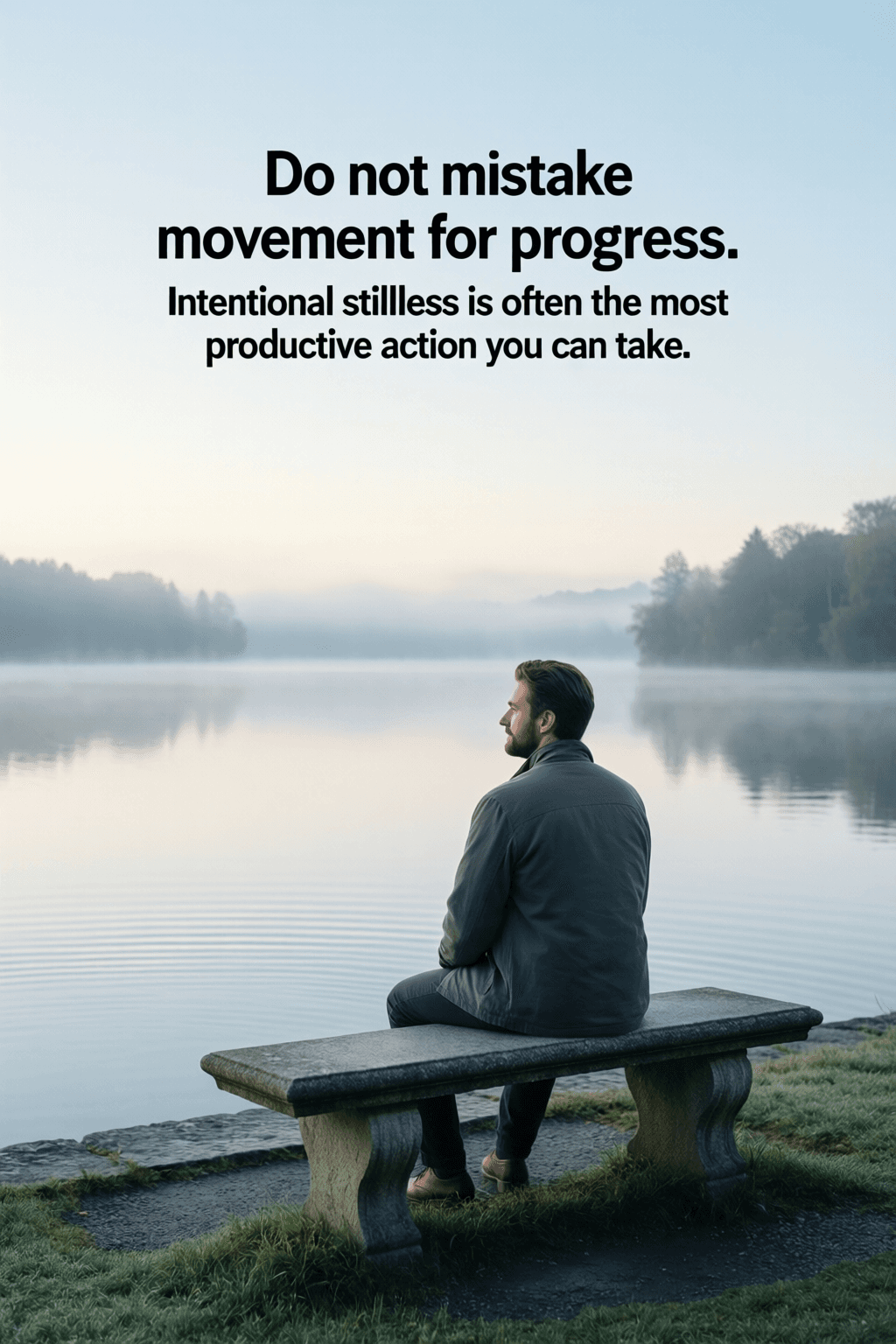
Do not mistake movement for progress. Intentional stillness is often the most productive action you can take. — Ogaryan
—What lingers after this line?
The Difference Between Activity and Advancement
At first glance, Ogaryan’s quote challenges a deeply ingrained modern habit: equating constant motion with meaningful achievement. We often celebrate packed schedules, rapid replies, and visible busyness, yet none of these guarantees that we are moving in the right direction. In this sense, the line draws a sharp distinction between activity, which is easy to display, and progress, which is measured by purpose and outcome. Seen this way, stillness is not laziness but discernment. By pausing, a person can ask whether current efforts actually serve a larger goal. As Seneca’s Letters to Lucilius (c. AD 65) repeatedly suggest, urgency without direction can waste a life just as thoroughly as idleness.
Stillness as a Deliberate Choice
From there, the quote becomes less a warning and more a strategy. “Intentional stillness” implies a pause that is chosen, not imposed—a moment of restraint used to gather clarity before acting. Rather than reacting impulsively, one steps back to observe, assess, and decide. That small interruption can prevent larger mistakes born from haste. This idea appears in many traditions. Sun Tzu’s The Art of War (c. 5th century BC) emphasizes timing, positioning, and the wisdom of not engaging prematurely. In that light, stillness becomes productive precisely because it preserves energy for actions that matter.
The Hidden Work of Reflection
Moreover, the quote recognizes that some of the most important work happens invisibly. Reflection rarely looks impressive from the outside, yet it is often where priorities are refined, emotions are regulated, and better plans are formed. A leader who postpones a rash decision for one night may accomplish more than one who acts immediately simply to appear decisive. History offers many such examples. Abraham Lincoln was known for drafting what scholars call “hot letters” during the Civil War and then setting them aside instead of sending them in anger. That pause—stillness in action—helped turn emotional reaction into wiser leadership.
Resisting the Culture of Constant Motion
At the same time, Ogaryan’s words push back against a culture that rewards visibility over substance. In many workplaces and social settings, being seen doing something can matter more than whether that thing is useful. Endless meetings, constant updates, and frantic multitasking create the impression of momentum while quietly draining attention. Therefore, intentional stillness can also be an act of resistance. It refuses the false logic that speed is always superior to thought. As Cal Newport argues in Deep Work (2016), concentrated, undistracted effort often produces more value than fragmented busyness, reinforcing the quote’s central insight.
Patience, Timing, and Long-Term Results
As the idea unfolds, it becomes clear that stillness is closely tied to patience. Not every problem improves through immediate intervention; some require observation, incubation, or simply time. Farmers do not dig up seeds daily to prove they are growing, and similarly, human projects often need intervals of waiting before the next effective step becomes visible. This principle echoes Ecclesiastes 3, with its famous reminder that there is ‘a time for every purpose under heaven.’ Progress, then, is not merely a matter of force but of rhythm. Knowing when not to move can be as important as knowing when to act.
A More Mature Understanding of Productivity
Ultimately, the quote invites a more mature definition of productivity—one based on alignment rather than mere exertion. Productive action is not whatever fills time; it is whatever moves a person meaningfully toward truth, health, or accomplishment. Sometimes that means advancing boldly, but at other moments it means stopping long enough to recover perspective. Thus, intentional stillness becomes a form of disciplined wisdom. It reminds us that progress is not always loud or visible; sometimes it begins in silence, in restraint, and in the courage to do nothing until the right thing can be done well.
Recommended Reading
As an Amazon Associate, we earn from qualifying purchases.
One-minute reflection
Why might this line matter today, not tomorrow?
Related Quotes
3 selectedIn the midst of movement and chaos, keep stillness inside of you. — Deepak Chopra
Deepak Chopra
This quote by Deepak Chopra emphasizes the importance of maintaining a sense of inner calm and tranquility, even when the external world is chaotic and turbulent.
Read full interpretation →Do not mistake movement for progress; the most significant changes happen in the slow, intentional work of a single day. — James Clear
James Clear
At first glance, James Clear’s quote draws a sharp distinction between activity and advancement. It is possible to be constantly busy—answering emails, attending meetings, rearranging plans—while never truly moving close...
Read full interpretation →Stillness isn't the absence of movement, but the presence of awareness. — Naomi Shihab Nye
Naomi Shihab Nye
At first glance, stillness seems to imply silence, immobility, or retreat from the world. Naomi Shihab Nye overturns that assumption by suggesting that true stillness is not about stopping movement but about deepening at...
Read full interpretation →More From Author
More from Ogaryan →