
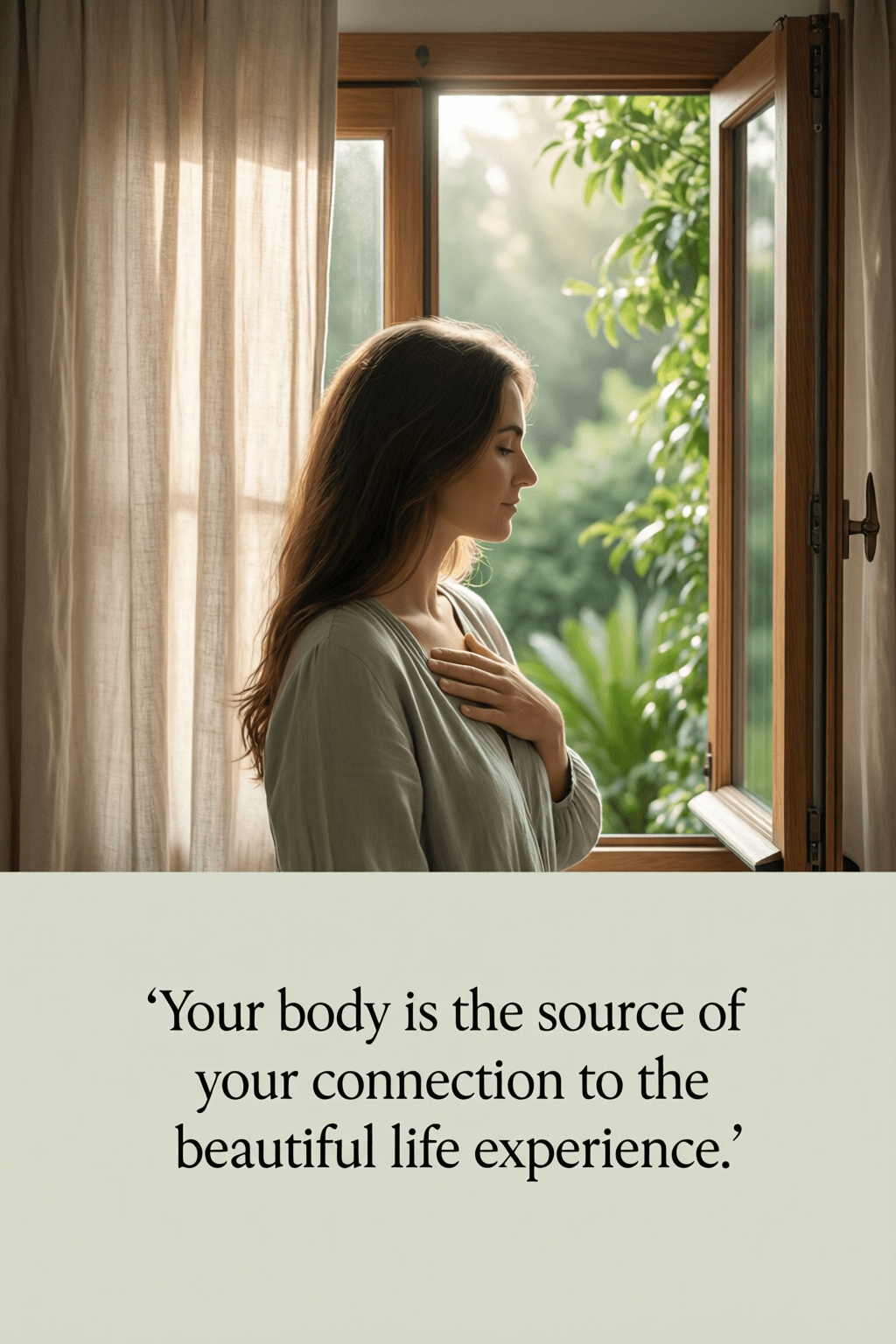
Your body is the source of your connection to the beautiful life experience. — Jane Goodall
—What lingers after this line?
The Body as a Living Bridge
Jane Goodall’s statement begins with a simple but profound reminder: our experience of life is never abstract. We meet the world through breathing, seeing, touching, moving, and feeling, so the body becomes the bridge between the self and everything beautiful around it. In that sense, beauty is not only something we admire from a distance; it is something we physically encounter through our senses. From this starting point, Goodall shifts attention away from purely intellectual living. Thought matters, of course, yet thought alone cannot replace the warmth of sunlight, the rhythm of walking, or the calm that comes from a deep breath. Her words suggest that a beautiful life is not merely imagined—it is embodied.
Sensation Gives Meaning to Experience
Building on that idea, the body is what transforms ordinary moments into meaningful ones. A meal is more than nutrition because of taste; music is more than sound because of the shiver it can send through the skin; affection becomes real through touch. Without the body’s participation, even joy would remain incomplete, lacking the sensory depth that makes it memorable. This insight appears across philosophy and literature. Maurice Merleau-Ponty’s Phenomenology of Perception (1945) argues that perception is the foundation of human experience, not a secondary feature of it. In a similar way, Goodall’s quote implies that the beauty of life does not arrive after bodily experience—it arrives through it.
Respecting the Body as a Form of Wisdom
Once the body is understood as the source of connection, caring for it becomes more than a health habit; it becomes a philosophical act. Rest, nourishment, movement, and recovery are not selfish distractions from living well but essential conditions for it. In other words, neglecting the body can dull our access to the very richness we seek. This is why many contemplative traditions treat physical awareness as wisdom. Buddhist mindfulness practices, for example, often begin with attention to breathing and posture, grounding the mind in the body before reaching for higher insight. Goodall’s observation harmonizes with that tradition by suggesting that honoring the body is one of the clearest ways to honor life itself.
Nature Deepens Bodily Awareness
Given Goodall’s lifelong work with animals and ecosystems, her words also carry a specifically natural meaning. The body is how we feel our kinship with the living world: bare feet on grass, cold air in the lungs, birdsong entering the ear, fatigue after climbing a trail. These are not decorative details; they are the means by which nature becomes intimate rather than distant. Here her perspective recalls Henry David Thoreau’s Walden (1854), where attention to weather, labor, hunger, and seasonal change creates a fuller sense of existence. Similarly, Goodall implies that the beautiful life is not found only in ideas about nature, but in bodily participation within it.
Embodiment Restores Gratitude
As the quote unfolds in practice, it also invites gratitude. When people pause to notice heartbeat, breath, balance, and sensation, life often appears less mechanical and more miraculous. Even simple abilities—stretching in the morning, tasting fresh fruit, feeling rain—can become sources of wonder once the body is recognized as the vessel of experience. This gratitude is especially powerful because the body is both ordinary and extraordinary. We often overlook it until pain or illness interrupts daily life, yet that very fragility can sharpen appreciation. Goodall’s line therefore does more than praise the body; it encourages a gentler, more reverent way of inhabiting it.
A More Beautiful Life Through Presence
Ultimately, Goodall’s message leads to a broader truth: the quality of life depends partly on how fully we inhabit our physical existence. To be present in the body is to be present in the world, and that presence makes beauty more available. Rather than chasing fulfillment as something distant, we begin by attending to the life already arriving through sensation, movement, and awareness. Therefore, the quote offers both comfort and instruction. It tells us that the path to a beautiful life may be closer than we think—within breath, posture, touch, and perception. By returning to the body, we do not withdraw from life; we enter it more completely.
One-minute reflection
What's one small action this suggests?
Related Quotes
6 selectedIf you don't throw yourself into something, you'll never know what you could have had. — Jane Goodall
Jane Goodall
Jane Goodall’s remark begins with a simple but demanding truth: possibilities often remain invisible unless we commit ourselves fully. Half-measures can protect us from disappointment, yet they also shield us from discov...
Read full interpretation →Act in a way that would make you proud. — Jane Goodall
Jane Goodall
This quote encourages individuals to maintain integrity in their actions. Acting in a way that one can be proud of suggests aligning behavior with personal values and ethics.
Read full interpretation →Discovering the difference you can make is the point of living your life. — Jane Goodall
Jane Goodall
This quote highlights the importance of finding purpose in life. Making a difference in the world brings fulfillment and gives meaning to one’s existence.
Read full interpretation →You cannot get through a single day without having an impact on the world around you. — Jane Goodall
Jane Goodall
This quote highlights the idea that every action we take, no matter how small, has a ripple effect on our surroundings and the people we interact with.
Read full interpretation →You may be the star in your own show, but don't forget to let others shine too. — Jane Goodall
Jane Goodall
This quote highlights the importance of recognizing and celebrating the talents, efforts, and achievements of others, even as we focus on our own personal journeys.
Read full interpretation →In every moment, we are creating ourselves. — Jane Goodall
Jane Goodall
This quote emphasizes that personal growth is a continuous process. Every experience, decision, and action shapes who we are becoming.
Read full interpretation →More From Author
More from Jane Goodall →If you don't throw yourself into something, you'll never know what you could have had. — Jane Goodall
Jane Goodall’s remark begins with a simple but demanding truth: possibilities often remain invisible unless we commit ourselves fully. Half-measures can protect us from disappointment, yet they also shield us from discov...
Read full interpretation →Act in a way that would make you proud. — Jane Goodall
This quote encourages individuals to maintain integrity in their actions. Acting in a way that one can be proud of suggests aligning behavior with personal values and ethics.
Read full interpretation →Discovering the difference you can make is the point of living your life. — Jane Goodall
This quote highlights the importance of finding purpose in life. Making a difference in the world brings fulfillment and gives meaning to one’s existence.
Read full interpretation →You cannot get through a single day without having an impact on the world around you. — Jane Goodall
This quote highlights the idea that every action we take, no matter how small, has a ripple effect on our surroundings and the people we interact with.
Read full interpretation →