
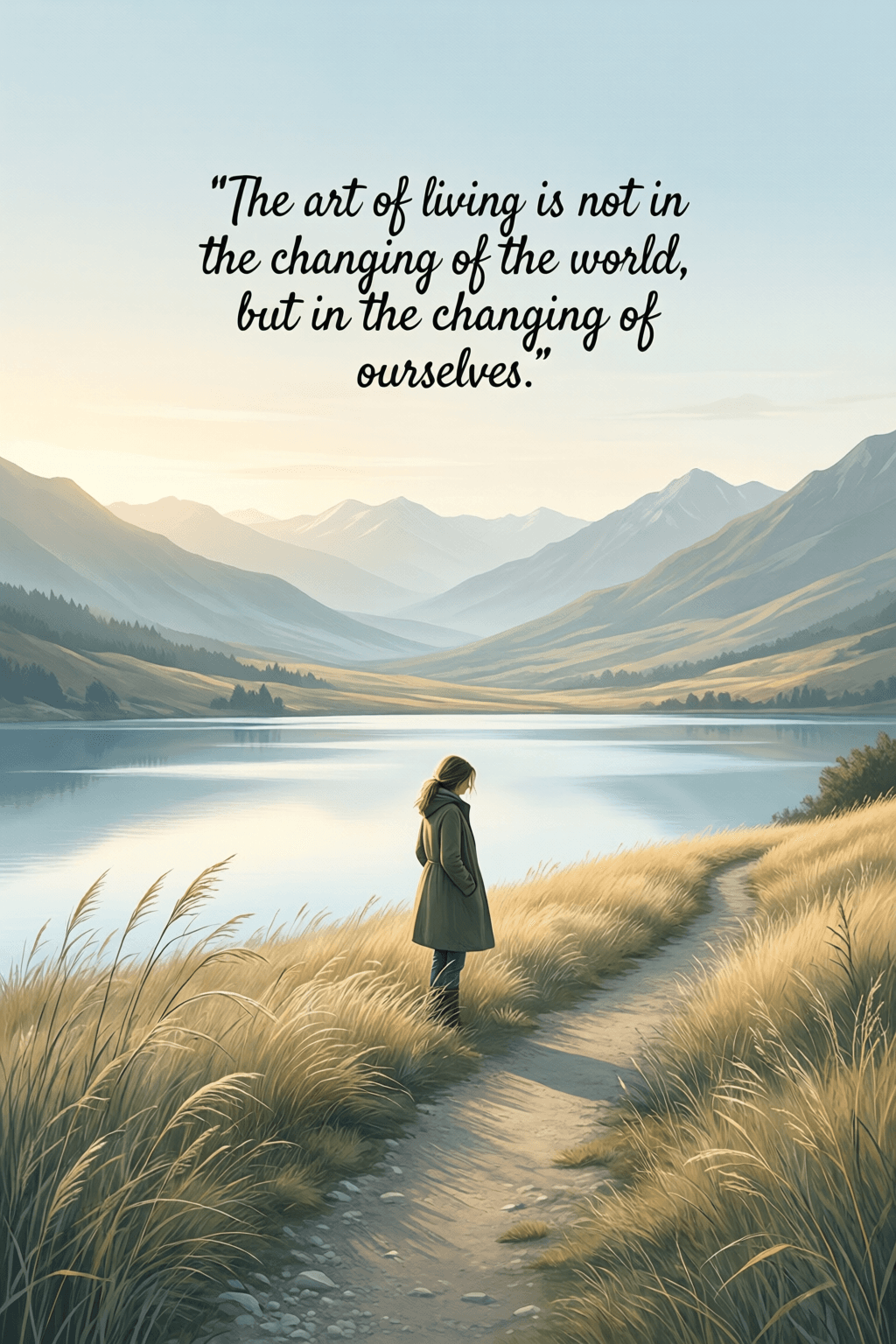
The art of living is not in the changing of the world, but in the changing of ourselves. — Junichiro Tanizaki
—What lingers after this line?
The Core of Tanizaki’s Insight
At its heart, Junichiro Tanizaki’s statement shifts attention from external conquest to inner refinement. Rather than imagining a fulfilling life as the result of controlling circumstances, he suggests that the true art of living lies in adjusting our perceptions, habits, and character. In this sense, the world may remain difficult, unpredictable, or imperfect, yet our relationship to it can be transformed. This idea feels especially powerful because it resists the modern temptation to blame happiness on conditions outside ourselves. By turning inward first, Tanizaki presents self-change not as resignation, but as a deeper form of mastery. What changes is not merely mood, but the very lens through which experience is understood.
An Eastern Aesthetic of Adaptation
Seen in the context of Japanese thought, Tanizaki’s words also evoke an aesthetic and philosophical appreciation of subtle adjustment rather than domination. His own essay In Praise of Shadows (1933) celebrates beauty found not in forcing brightness onto everything, but in learning to see value in dimness, texture, and restraint. That sensibility mirrors the quote’s deeper message: wisdom often means harmonizing with reality rather than remaking it by force. From there, the saying becomes more than personal advice; it becomes a cultural attitude toward existence. Instead of demanding that life conform to our desires, we cultivate the sensitivity to live well within its limits. In that way, adaptation becomes an art form in itself.
A Stoic Parallel in World Philosophy
This inward emphasis finds a strong parallel in Stoic philosophy. Epictetus’s Enchiridion (c. 125 AD) famously distinguishes between what is in our control and what is not, urging people to direct energy toward their own judgments and actions. Like Tanizaki, the Stoics do not deny that the world matters; rather, they argue that peace begins when we stop tying our well-being to external outcomes. Consequently, Tanizaki’s quote can be read as part of a larger human tradition that values self-mastery over circumstance. Whether in ancient Rome or modern Japan, the recurring lesson is that a life of dignity arises less from rearranging the world than from disciplining the self that encounters it.
The Difference Between Surrender and Growth
At first glance, changing ourselves instead of the world might sound passive, even defeatist. Yet the quote becomes richer when we see that self-transformation is not surrender but deliberate growth. A person who learns patience in conflict, humility in success, or resilience in loss has not given up; they have developed capacities that no external upheaval can easily destroy. For example, Viktor Frankl’s Man’s Search for Meaning (1946) recounts how, even in concentration camps, individuals retained the freedom to shape their inner response to suffering. That extreme case clarifies Tanizaki’s point: while circumstances can constrain action, they do not wholly determine the soul. Inner change can therefore be an act of profound strength.
How the Quote Applies to Everyday Life
In ordinary life, this wisdom often appears in small, practical moments. When a workplace feels frustrating, we may not be able to redesign the institution overnight, but we can alter how we communicate, what expectations we carry, and how we manage our reactions. Likewise, in family tensions, genuine progress often begins not with winning arguments, but with listening better, speaking more carefully, or relinquishing pride. Thus, Tanizaki’s insight becomes immediately usable. The art of living is practiced not in grand declarations, but in repeated acts of self-revision. Over time, these modest internal shifts can even influence the outer world indirectly, because changed people often create changed relationships and communities.
A Humane Vision of Lasting Change
Finally, the quote offers a humane corrective to the fantasy that fulfillment lies somewhere outside us, waiting to be engineered. It reminds us that no amount of external rearrangement can substitute for maturity, self-knowledge, and emotional depth. If we remain unchanged, even improved circumstances may leave us restless; if we evolve inwardly, however, the same world can begin to feel newly livable. In the end, Tanizaki does not reject social action so much as he grounds it in personal transformation. The most enduring changes often begin in temperament, awareness, and discipline. By learning to change ourselves, we discover not only how to endure the world, but how to inhabit it more beautifully.
One-minute reflection
What does this quote ask you to notice today?
Related Quotes
6 selectedThe simple step of a courageous individual is not to try to change the world but to change oneself. — Søren Kierkegaard
Søren Kierkegaard
Søren Kierkegaard, the Danish philosopher and father of existentialism, emphasizes the power of the individual in his statement. He urges us to look inward, suggesting that true courage lies not in ambitious efforts to r...
Read full interpretation →Stop looking for the lens. Be the prism. — Shaan Puri
Shaan Puri
At first glance, Shaan Puri’s line overturns a common habit: waiting for the right lens through which to view the world. A lens implies borrowed perspective, something external that clarifies reality for us.
Read full interpretation →If you want to change your life, start by changing your mind—it's the only place you actually live. — Byron Katie
Byron Katie
At its core, Byron Katie’s remark reframes personal change as an inner rather than outer project. We often imagine that a new job, city, or relationship will transform our lives; however, she points to the mind as the ac...
Read full interpretation →The only revolution that is possible is the one within. — Jiddu Krishnamurti
Jiddu Krishnamurti
Krishnamurti’s line turns the usual meaning of “revolution” on its head. Instead of crowds, slogans, or new governments, he points to a quieter upheaval: a deep shift in the way a person perceives, thinks, and acts.
Read full interpretation →You must be the catalyst for your own change. — Patricia Hill Collins
Patricia Hill Collins
This quote highlights the importance of taking initiative in one's own life. Rather than waiting for external forces or others to inspire change, individuals must take charge and begin the transformation themselves.
Read full interpretation →Become the person who would attract the results you seek. — Jim Cathcart
Jim Cathcart
Jim Cathcart’s advice encourages us to shift our focus inward, suggesting that lasting results stem from self-improvement rather than external pursuit. In essence, to draw the outcomes we crave—be it career advancement,...
Read full interpretation →More From Author
More from Jun’ichirō Tanizaki →Odor in folklore is more telling than sight in revealing the inner nature of things. — Jun’ichirō Tanizaki
Jun’ichirō Tanizaki’s insight points to a fascinating phenomenon: while vision dominates our modern understanding of reality, odor often lingers as a more profound revelator of truth in folklore. This notion emerges in c...
Read full interpretation →Odor in folklore is more telling than sight in revealing the inner nature of things. — Jun’ichirō Tanizaki
While sight is often celebrated as our dominant sense, Tanizaki’s insight reminds us that smell plays an equally vital and sometimes more profound role in understanding our world. In many cultures, odors carry layers of...
Read full interpretation →