
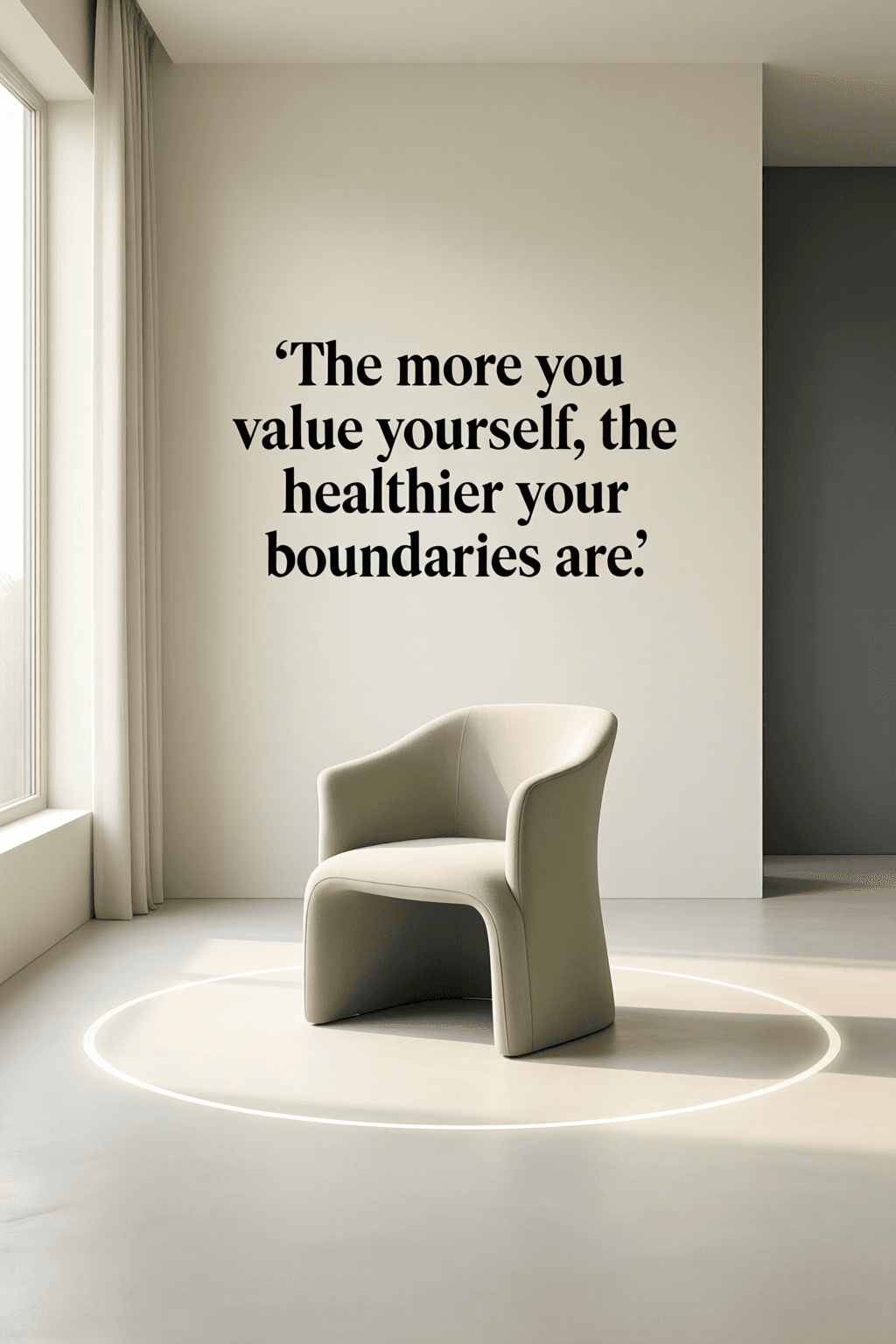
The more you value yourself, the healthier your boundaries are. — Jeanette Coron
—What lingers after this line?
The Core Link Between Worth and Limits
Jeanette Coron’s quote begins with a simple but powerful idea: the way we value ourselves determines what we allow, accept, and refuse. In that sense, boundaries are not merely rules for other people; they are outward expressions of inward self-respect. When a person believes their time, energy, and emotions matter, healthier limits tend to follow naturally. From this perspective, weak boundaries often do not arise from selfishness or confusion alone, but from a shaky sense of worth. Conversely, stronger self-regard makes it easier to say no without guilt and yes without fear. Thus, the quote frames boundaries not as walls of rejection, but as evidence of a person finally recognizing their own value.
Why Low Self-Esteem Invites Overreach
Building on that idea, people who undervalue themselves often tolerate behavior that harms them because they fear conflict, abandonment, or disapproval. They may overextend at work, remain silent in unhealthy relationships, or feel responsible for everyone else’s comfort. In each case, the missing piece is not knowledge of boundaries, but permission to believe they deserve them. Psychological research supports this connection: self-esteem studies, such as Morris Rosenberg’s foundational work in Society and the Adolescent Self-Image (1965), show how self-evaluation shapes social behavior. When inner worth feels unstable, external approval can become too important. As a result, boundaries weaken, and others—knowingly or not—begin to take more than they should.
Boundaries as Daily Acts of Self-Respect
Seen in practice, healthy boundaries are often quiet and ordinary rather than dramatic. They appear when someone declines a last-minute demand, asks for respectful communication, or protects rest without apologizing for it. In this way, valuing yourself becomes visible through repeated choices that honor your needs instead of constantly erasing them. For example, a person who once answered work messages at midnight may begin replying during business hours only. That small shift can signal a larger internal change: ‘My well-being matters too.’ Therefore, boundaries are less about controlling others than about clarifying what kind of treatment aligns with one’s dignity and what does not.
The Difference Between Boundaries and Defensiveness
At the same time, Coron’s quote does not suggest that all distance is healthy. There is an important distinction between boundaries rooted in self-worth and barriers built from fear. The first creates clarity, mutual respect, and emotional safety; the second can create avoidance, rigidity, and isolation. This distinction appears in many therapeutic conversations today, especially in work influenced by Brené Brown’s Daring Greatly (2012), which links vulnerability with self-worth and courage. Healthy boundaries do not shut people out indiscriminately; instead, they let connection happen under respectful conditions. Accordingly, valuing yourself well means neither surrendering yourself nor hiding yourself, but learning the measured space between those extremes.
How Strong Boundaries Improve Relationships
Once this balance is understood, the quote takes on a relational dimension: better boundaries do not weaken love, friendship, or teamwork—they strengthen them. Clear limits reduce resentment because they prevent the silent accumulation of unmet needs. They also make trust more sustainable, since people know where they stand and what is expected. Literature and lived experience alike support this truth. In many family systems studies, including the work of Salvador Minuchin in Family Therapy Techniques (1981), healthier functioning often depends on clear interpersonal boundaries. Thus, self-worth is not only a private feeling; it becomes a public good. When people respect themselves, they are more capable of relating to others honestly rather than through guilt, obligation, or hidden frustration.
Growing Into the Quote’s Wisdom
Ultimately, Coron’s insight is less a judgment than an invitation. If your boundaries are fragile, that may not mean you are weak; it may mean your sense of value has been neglected, challenged, or wounded. The encouraging implication is that as self-worth grows, boundaries can grow with it—steadily, imperfectly, and with practice. This growth often begins with small declarations: ‘I need time,’ ‘That doesn’t work for me,’ or ‘Please speak to me differently.’ Over time, such statements reshape identity itself. In the end, the quote reminds us that healthy boundaries are not borrowed techniques; they are the natural language of a person who has begun to believe they are worth protecting.
One-minute reflection
Where does this idea show up in your life right now?
Related Quotes
6 selectedOur boundaries define our personal space — and we need to be sovereign there in order to be able to step into our full power and potential. — Brené Brown
Brené Brown
Brené Brown’s insight begins with a simple but profound claim: boundaries are not walls meant to isolate us, but lines that clarify where our responsibility begins and ends. To be sovereign in our personal space means to...
Read full interpretation →Setting boundaries is the way we care for ourselves. It is not a way to push others away, but a way to keep ourselves whole. — Melody Beattie
Melody Beattie
At its core, Melody Beattie’s statement reframes boundaries as an act of care rather than rejection. People often fear that saying no, asking for space, or naming limits will appear cold; however, Beattie suggests the op...
Read full interpretation →Stop shrinking yourself to make others comfortable. Your peace is worth more than their approval. — Nedra Glover Tawwab
Nedra Glover Tawwab
Nedra Glover Tawwab’s words begin with a quiet but powerful warning: when we constantly make ourselves smaller to keep others comfortable, we often pay with our confidence, honesty, and emotional well-being. This kind of...
Read full interpretation →Your peace is worth more than their approval. — Karen Salmansohn
Karen Salmansohn
Karen Salmansohn’s quote draws a clear boundary between inner well-being and the exhausting pursuit of validation. At its heart, it reminds us that approval from others can feel rewarding, but it is often unstable, condi...
Read full interpretation →You can't pour from an empty cup. Take care of yourself first. — Arianna Huffington
Arianna Huffington
At its heart, Arianna Huffington’s line turns self-care into an image anyone can understand: a cup cannot nourish others if it has nothing left to give. The metaphor is gentle, but its message is firm.
Read full interpretation →Saying no is an act of integrity. It aligns what you do with what you believe. — Annie Wright
Annie Wright
Annie Wright’s statement reframes the word “no” not as rejection, but as moral clarity. At its core, saying no is a way of protecting the space between one’s values and one’s actions.
Read full interpretation →More From Author
More from Jeanette Coron →You are in control of your life. Set new boundaries by removing all of the toxic people from your inner circle. — Jeanette Coron
Jeanette Coron’s statement begins with a direct reminder: you are not merely reacting to life, but participating in its design. By saying you are in control, the quote shifts attention away from blame and toward agency,...
Read full interpretation →You have to love and respect yourself enough to not let people use and abuse you. Let people clearly know how you won't tolerate being treated. — Jeanette Coron
Jeanette Coron’s quote begins with a simple but demanding principle: self-love is not merely a feeling, but a standard of treatment. To love and respect yourself means recognizing that kindness, dignity, and fairness are...
Read full interpretation →