
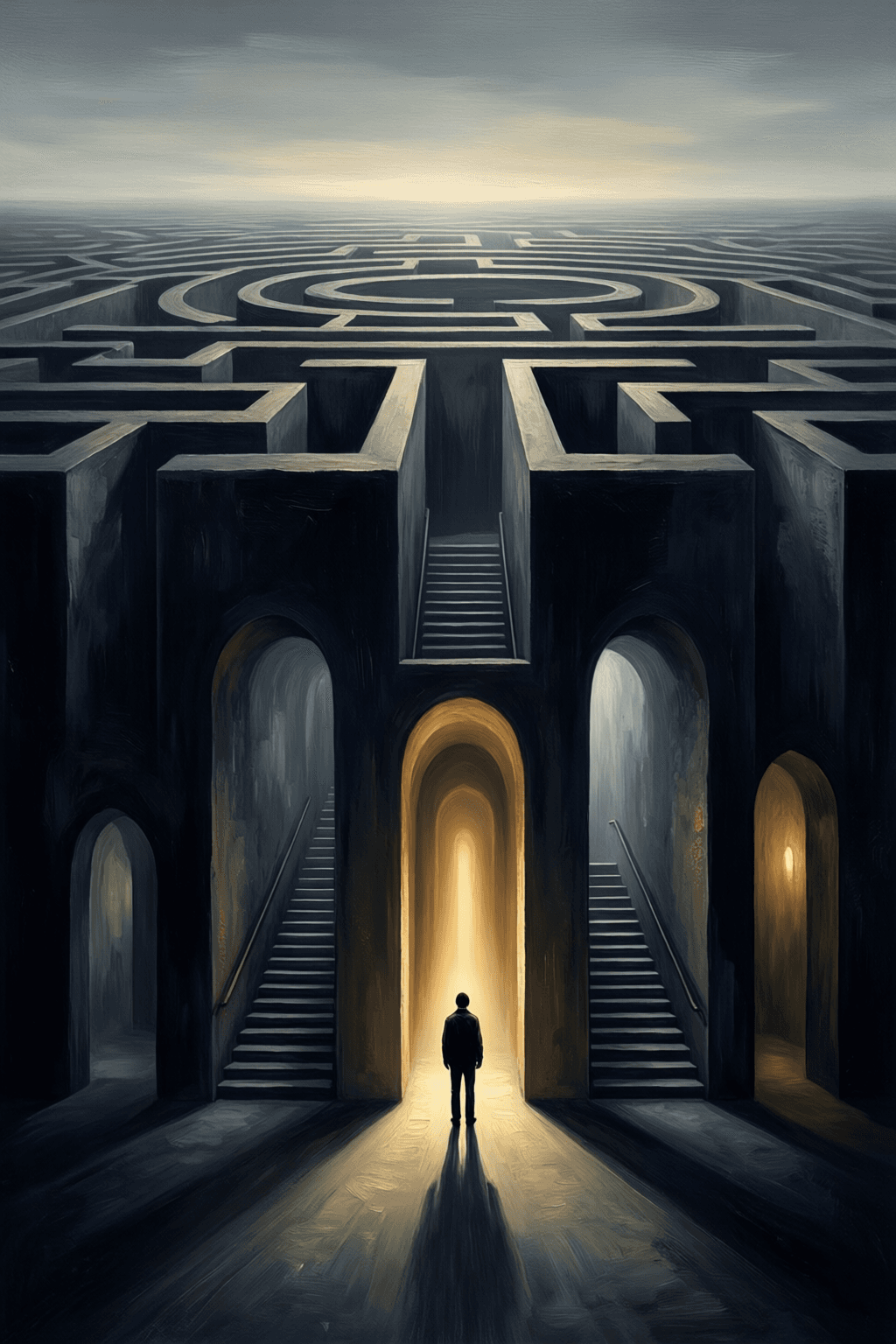
It takes more courage to examine the dark corners of your own soul than it does for a soldier to fight on a battlefield. — W. B. Yeats
—What lingers after this line?
A Different Measure of Courage
Yeats reframes courage by shifting it from the public world of visible action to the private world of self-confrontation. At first glance, the battlefield seems the ultimate test of bravery because it involves physical danger, honor, and sacrifice. Yet his comparison suggests that facing one’s own hidden fears, resentments, and contradictions can be even more demanding, precisely because there is no audience, no ceremony, and no easy script for victory. In this way, the quote challenges heroic tradition without dismissing it. Physical combat requires nerve, but inward honesty requires a rarer endurance: the willingness to see oneself without illusion. What Yeats elevates, therefore, is not spectacle but truthfulness.
The Meaning of the “Dark Corners”
From there, the phrase “dark corners of your own soul” deepens the idea by pointing to the parts of self we prefer to avoid. These corners may contain shame, envy, grief, guilt, prejudice, or unresolved longing—elements that often remain hidden beneath daily competence. By naming them as dark, Yeats implies not evil alone, but obscurity: what is unexamined gains power simply because it stays unseen. This insight echoes older moral and spiritual traditions. For instance, St. Augustine’s Confessions (c. 397–400) turns inward with relentless honesty, exposing desire, vanity, and moral weakness not to indulge them, but to understand them. Likewise, Yeats suggests that true courage begins when denial ends.
Why Inner Conflict Feels So Threatening
Moreover, inner examination can feel more frightening than external struggle because the enemy is not separate from the self. On a battlefield, danger comes from outside, and survival depends on action. In the psyche, however, what must be confronted is intertwined with identity itself. To admit cruelty, cowardice, or self-deception is to risk damaging the story one tells about who one is. Modern psychology helps explain this discomfort. Carl Jung’s writings on the “shadow,” especially in Aion (1951), argue that people often repress traits they cannot accept in themselves, only to project them onto others. Yeats’s claim anticipates this insight: the battle within is uniquely difficult because it requires dismantling comforting illusions before any healing can begin.
Literature’s Long Tradition of Self-Encounter
Consequently, Yeats’s statement belongs to a long literary tradition in which the greatest drama unfolds within. Shakespeare’s Hamlet (c. 1600) is not defeated by lack of intelligence or sensitivity, but by the torment of inward scrutiny; his mind becomes its own battleground. Similarly, Dostoevsky’s Notes from Underground (1864) portrays a narrator so trapped in self-awareness that introspection becomes both revelation and punishment. These works show that inner courage is not serene self-help but a turbulent reckoning. By placing the soul at the center of struggle, they reinforce Yeats’s idea that the deepest acts of bravery often happen silently, in thought, memory, and moral choice rather than in public deeds.
The Ethical Value of Self-Examination
Yet Yeats’s insight is not merely psychological; it is also ethical. A person who has not examined the darker elements within may act with confidence while remaining dangerous, because unacknowledged motives can shape conduct more powerfully than conscious principles. In that sense, introspection becomes a form of responsibility: by knowing one’s impulses, one is better able to restrain harm, cultivate humility, and respond to others with greater fairness. Here the quote aligns with Socratic thought. Plato’s Apology (c. 399 BC) preserves the famous principle that “the unexamined life is not worth living,” and Yeats gives that principle emotional force. Self-knowledge is not a philosophical luxury; it is a courageous discipline with moral consequences.
A Courage Measured by Honesty
Finally, the enduring power of Yeats’s line lies in how it broadens our understanding of heroism. Not all bravery appears in uniforms, crises, or dramatic acts. Sometimes it appears in confession, therapy, repentance, difficult reflection, or the quiet decision to stop lying to oneself. Such acts may look small from the outside, yet they often demand extraordinary strength. By ending where he began—with a comparison to war—Yeats leaves us with a provocative inversion: the fiercest battles may be invisible. His point is not to diminish soldiers, but to remind us that the conquest of self is among the hardest victories a human being can pursue.
Recommended Reading
As an Amazon Associate, we earn from qualifying purchases.
One-minute reflection
What does this quote ask you to notice today?
Related Quotes
6 selectedThe most radical act of courage is to be truly seen, to step out from behind our carefully curated walls and offer our authentic selves to the world. — Glennon Doyle
Glennon Doyle
Glennon Doyle’s quote reframes courage not as conquest or spectacle, but as the quiet, risky decision to be known. At its core, it suggests that the bravest act is not hiding our flaws behind polished identities, but all...
Read full interpretation →Screw your courage to the sticking-place. — William Shakespeare
William Shakespeare
At its core, Shakespeare’s line is a vivid call to steady oneself before decisive action. In Macbeth (c.
Read full interpretation →Do not mistake your digital silence for peace. Real strength is found in the courage to speak the truth to the people who hold your heart. — Anne Lamott
Anne Lamott
At first glance, Anne Lamott’s quote challenges a familiar illusion: silence can resemble peace without actually creating it. Choosing not to speak may keep conflict out of sight, yet beneath that quiet surface, hurt, co...
Read full interpretation →It is necessary to any originality to have the courage to be an amateur. — Wallace Stegner
Wallace Stegner
Wallace Stegner’s remark suggests that originality does not emerge from perfect polish at the beginning, but from a willingness to enter unfamiliar territory without guarantees. To be an amateur, in this sense, is not me...
Read full interpretation →Dreams are made possible if you have courage. — Nnamdi Azikiwe
Nnamdi Azikiwe
At its core, Nnamdi Azikiwe’s statement argues that dreams do not become real through wishing alone; they require the bravery to be pursued. A dream may begin as imagination, yet without courage it remains suspended in t...
Read full interpretation →We don't develop courage by being happy in our relationships every day. We develop it by surviving difficult times and challenging adversity. — Epicurus
Epicurus
At first glance, Epicurus seems to challenge the common belief that healthy relationships are defined by uninterrupted happiness. Instead, he points to a deeper truth: courage is not formed in comfort, but in the moments...
Read full interpretation →More From Author
More from W.B. Yeats →Out of the quarrel with others we make rhetoric; out of the quarrel with ourselves, we make poetry. — W.B. Yeats
At its core, W.B. Yeats draws a sharp line between two kinds of struggle.
Read full interpretation →Tread softly because you tread on my dreams. - W.B. Yeats
This quote suggests that dreams are fragile and should be treated with great care. It underlines the vulnerability of personal aspirations and visions.
Read full interpretation →