
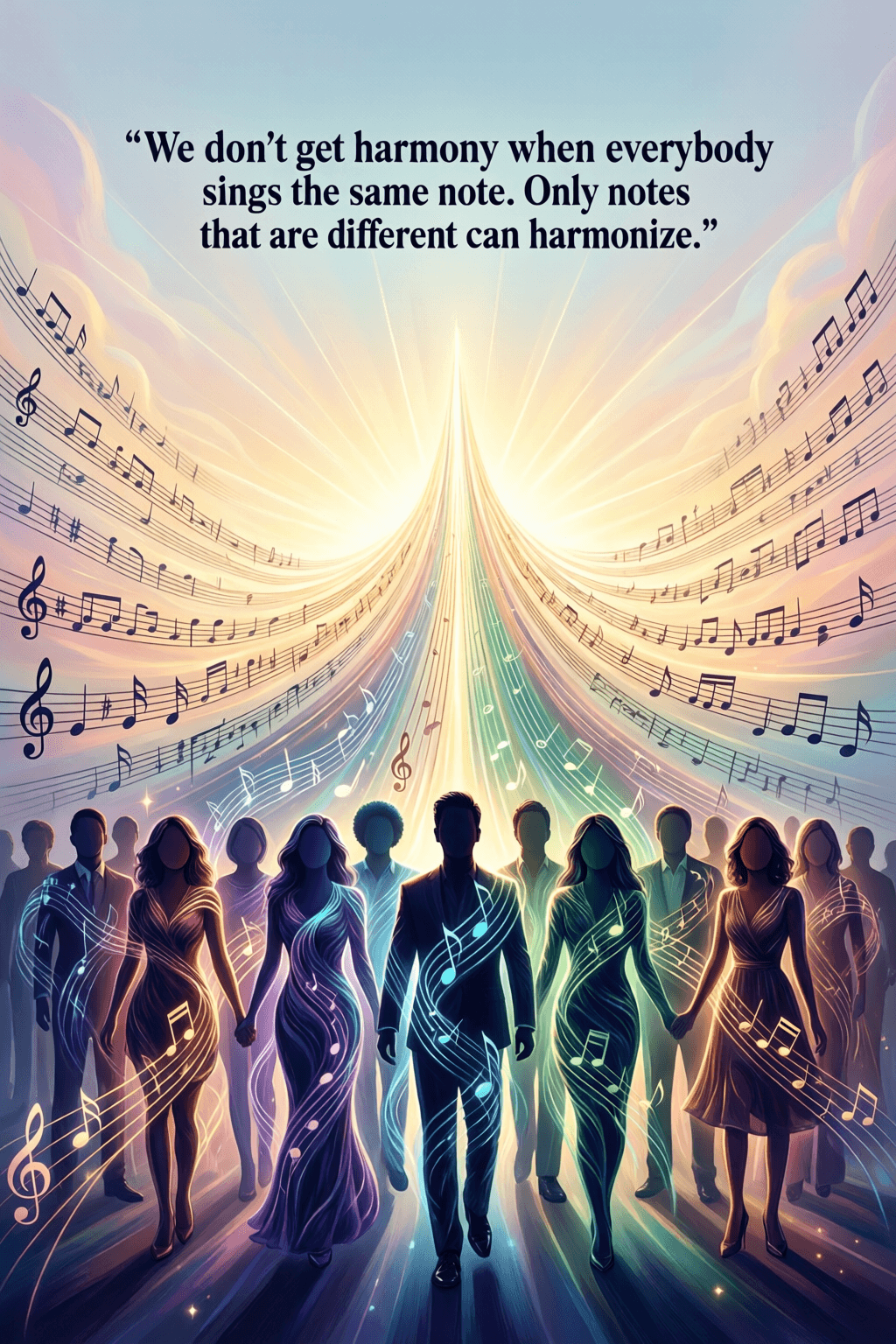
We don't get harmony when everybody sings the same note. Only notes that are different can harmonize. — Steve Goodier
—What lingers after this line?
The Meaning Inside the Musical Image
Steve Goodier’s line turns to music to explain a human truth: sameness may create unity of sound, but it does not create harmony. In musical terms, harmony depends on distinct notes sounding together, each keeping its own identity while contributing to something larger. In the same way, communities, friendships, and families become richer not when every voice is identical, but when differences are arranged with care. From that starting point, the quote gently challenges the common belief that peace requires agreement on everything. Instead, it suggests that real cohesion emerges when contrast is not feared but coordinated. Difference, then, is not the enemy of togetherness; it is often the very condition that makes togetherness meaningful.
Why Sameness Can Limit Human Connection
Seen this way, uniformity can feel orderly, yet it often lacks depth. If everyone thinks alike, responds alike, and values the same things in the same way, a group may avoid friction, but it can also lose creativity, resilience, and surprise. Goodier’s metaphor implies that a single repeated note may be clear, yet it remains flat compared with the emotional richness of a chord. Consequently, human relationships thrive when people bring distinct experiences and perspectives into shared life. A thoughtful friend, a daring colleague, or a patient partner may each contribute something the others lack. Rather than weakening the whole, these differences expand it, much as separate tones combine to produce beauty that no lone sound could achieve.
Difference as the Basis of Cooperation
Once difference is recognized as valuable, cooperation takes on a new meaning. It is no longer about erasing individuality for the sake of agreement, but about learning how unlike parts can work together. This idea appears in Plato’s Republic (c. 375 BC), where a city functions well because different people perform different roles; while Plato emphasizes order more than personal diversity, the broader principle remains that distinction can serve unity. In everyday life, the same pattern appears constantly. A successful team often includes the visionary, the organizer, the critic, and the encourager. Their temperaments may clash at times, yet those very contrasts can produce wiser decisions. Thus harmony is not the absence of tension, but the skilled arrangement of varied strengths toward a common purpose.
The Discipline Required to Harmonize
However, Goodier’s quote does not romanticize difference as if contrast automatically becomes beauty. In music, different notes harmonize only when they are tuned, timed, and related with intention. Likewise, human diversity becomes fruitful only when joined to listening, humility, and restraint. Without those disciplines, difference can harden into noise, rivalry, or mutual dismissal. This is why harmony is more demanding than agreement. Agreement may require little more than compliance, whereas harmony asks each person to keep a distinct voice while remaining attentive to others. The image recalls the social insight behind Martin Luther King Jr.’s vision in Stride Toward Freedom (1958), where peace depends not merely on coexistence, but on constructive, respectful relationship across difference.
A Lesson for Communities and Public Life
From there, the quote expands beyond private relationships into civic life. Healthy societies are not built by forcing every citizen into one cultural or ideological note. Rather, they endure by creating structures in which disagreement can exist without destroying shared belonging. Democratic thought often rests on this premise: competing views, if held within ethical limits, can strengthen the whole by exposing blind spots and preventing arrogance. History repeatedly shows the cost of enforced sameness. Authoritarian systems often demand one voice, one truth, one acceptable identity, and in doing so they silence the very differences that might correct error. Goodier’s observation therefore carries a quiet political wisdom: plurality is not a weakness to be managed away, but a resource from which a more durable common life can be composed.
The Personal Wisdom of Living in Harmony
Finally, the quote invites a personal ethical response. If harmony depends on different notes, then maturity means learning not only to value one’s own voice, but also to welcome voices unlike it. That may involve patience with disagreement, curiosity about unfamiliar backgrounds, and the courage to remain oneself without demanding sameness from others. In that sense, Goodier offers more than a clever metaphor; he offers a practical philosophy of coexistence. The goal is not bland consensus, but a deeper form of unity in which difference becomes complementary. When people learn that lesson, whether in a marriage, a workplace, or a nation, they create something far more moving than repetition: they create harmony.
Recommended Reading
As an Amazon Associate, we earn from qualifying purchases.
One-minute reflection
Why might this line matter today, not tomorrow?
Related Quotes
6 selectedHarmony is found where differences dance together. — Rumi
Rumi
Rumi, the celebrated 13th-century Persian poet and Sufi mystic, often illuminated the paradoxical beauty of life. In this evocative quote, he suggests that true harmony is not derived from sameness but from the interplay...
Read full interpretation →The diversity in the human family should be the cause of love and harmony, as it is in music where many different notes blend together in the making of a perfect chord. — Baha'u'llah
Baha’u’llah
At its heart, Baha'u'llah’s statement transforms diversity from a social challenge into a creative necessity. Just as a chord depends on distinct notes rather than repeated ones, human community becomes richer when diffe...
Read full interpretation →The art of living lies not in eliminating but in harmonizing with our troubles. — L.M. Montgomery
L.M. Montgomery
L.M. Montgomery’s remark shifts the aim of life away from conquest and toward coexistence.
Read full interpretation →I know there is strength in the differences between us. I know there is comfort, where we overlap. — Ani DiFranco
Ani DiFranco
Ani DiFranco’s line holds two ideas in careful balance: difference gives us strength, while similarity gives us comfort. At first glance, these might seem contradictory, yet together they describe how strong relationship...
Read full interpretation →We are all connected in the great Circle of Life. — Mufasa
Mufasa
At its core, Mufasa’s line presents life as an interconnected whole rather than a collection of isolated beings. The image of a circle suggests continuity, reciprocity, and balance: every creature, action, and moment bel...
Read full interpretation →Love is the oil that eases friction, the cement that binds closer together, and the music that brings harmony. — Eva Burrows
Eva Burrows
Eva Burrows frames love through three vivid images—oil, cement, and music—each describing a different way relationships endure. Rather than treating love as a single feeling, she suggests it is an active force that reduc...
Read full interpretation →More From Author
More from Steve Goodier →