
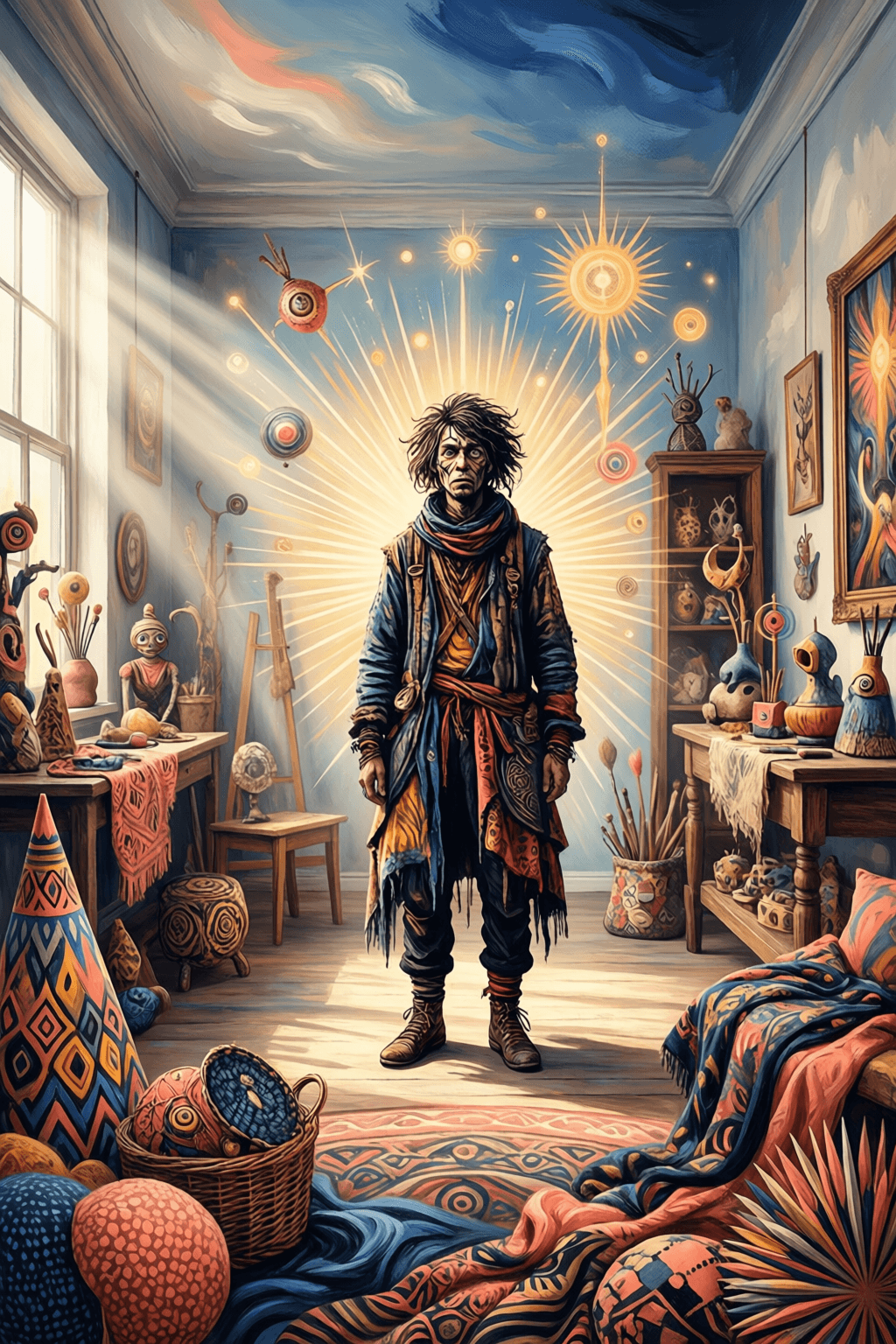
Your weirdness is the source of your character and creative powers. Weird is who we are, the best parts, not perfect, not trying—just yourself. — James Victore
—What lingers after this line?
An Invitation to Self-Acceptance
At its core, James Victore’s quote reframes “weird” from an insult into a declaration of identity. Rather than treating unusual traits as flaws to be corrected, he presents them as the very source of character and creative energy. In this view, the parts of ourselves that do not fit neatly into expectation are often the ones most worth protecting. This idea matters because many people learn early to smooth away their oddities in order to belong. Victore pushes in the opposite direction: stop polishing yourself into sameness. Instead, he suggests that authenticity begins when performance ends and a person allows their natural strangeness to remain visible.
Character Grows from Difference
From that starting point, the quote links individuality directly to character. Character is not built by copying a model of perfection; it emerges from lived quirks, contradictions, and personal history. What makes someone memorable is rarely flawless behavior, but the distinct combination of habits, tastes, and perspectives that could belong to no one else. In this sense, weirdness is not decoration layered on top of identity. Rather, it is structural. Much as Montaigne’s Essays (1580) celebrate the texture of the self in all its inconsistency, Victore implies that our irregular edges give shape to who we are. Without them, personality becomes generic.
Creativity Needs the Unpolished Self
Naturally, the quote then extends beyond identity into art. Creative work depends on deviation: a fresh image, an unexpected connection, a voice that does not sound borrowed. If a person is constantly trying to appear correct, acceptable, or polished, their work may become technically competent yet emotionally empty. History repeatedly supports this insight. Salvador Dalí’s surrealism, David Bowie’s shifting personas, and Björk’s singular musical world each grew from traits others might once have called strange. Their originality came not from hiding eccentricity but from developing it. Victore’s point, therefore, is practical as well as uplifting: the qualities that make you socially awkward in one setting may become artistic power in another.
Against the Trap of Perfection
Just as importantly, Victore contrasts weirdness with perfectionism. “Not perfect, not trying” rejects the exhausting belief that value comes from appearing finished. Perfectionism often narrows expression because it encourages caution, mimicry, and fear of failure. By comparison, weirdness allows experimentation, and experimentation is where discovery happens. This tension appears across creative history. Leonard Cohen reportedly revised obsessively, yet his best songs still carry rough humanity rather than sterile polish. Likewise, the Japanese aesthetic of wabi-sabi values imperfection and impermanence, finding beauty in what is irregular or incomplete. Victore joins that tradition by suggesting that aliveness—not flawlessness—is what gives work its force.
The Courage to Be Unmistakably Yourself
As the quote unfolds, it becomes a quiet argument for courage. To be “just yourself” sounds simple, yet in practice it asks a person to risk misunderstanding. Weirdness is often visible before it is appreciated, which means authenticity can feel socially dangerous long before it feels liberating. Even so, many admired voices gained power by refusing to dilute themselves. Frida Kahlo’s paintings transformed pain, symbolism, and personal style into an unmistakable visual language; her work remains powerful precisely because it is inseparable from her singular self. In that light, Victore’s message is not mere self-esteem rhetoric. It is a challenge to trust that distinctiveness, though vulnerable, is also a source of lasting resonance.
A More Human Standard of Living
Finally, the quote offers a gentler standard for how to live. If the best parts of us are not perfect and not trying to impress, then life becomes less about correction and more about expression. Weirdness here means freedom from constant self-editing—the freedom to think oddly, make boldly, and inhabit one’s own nature without apology. That is why the statement feels both personal and cultural. In a world that rewards conformity, Victore argues that our so-called odd traits are not obstacles to overcome but resources to use. The result is a more human ideal: not the flawless self, but the vivid one.
One-minute reflection
What does this quote ask you to notice today?
Related Quotes
6 selectedIf the family were a fruit, it would be an orange, a circle of sections, held together but separable—each segment distinct. — Letty Cottin Pogrebin
Letty Cottin Pogrebin
At first glance, Letty Cottin Pogrebin’s image feels simple, yet it captures family structure with unusual precision. By comparing a family to an orange, she evokes something whole, rounded, and naturally unified.
Read full interpretation →You're born an original—don't die a copy. — John Mason
John Mason
At its core, John Mason’s line is a sharp reminder that every person begins life with a distinct combination of temperament, talent, and perspective. To be “born an original” suggests that individuality is not something...
Read full interpretation →We are not here to fit into a mold, but to break the ones that keep our most honest work hidden. — Virginia Woolf
Virginia Woolf
At its core, Virginia Woolf’s statement rejects the quiet pressure to adapt ourselves to preexisting expectations. To “fit into a mold” suggests becoming legible, acceptable, and predictable at the cost of what is most i...
Read full interpretation →The individual has always had to struggle to keep from being overwhelmed by the tribe. But no price is too high to pay for the privilege of owning yourself. — Rudyard Kipling
Rudyard Kipling
Kipling’s statement begins with a stark observation: individuality is rarely effortless. From the start, he frames human life as a struggle between the person and the collective, where the ‘tribe’ represents not only com...
Read full interpretation →In a world full of copies, be an original. — Suzy Kassem
Suzy Kassem
At its core, Suzy Kassem’s line urges people to resist the comfort of imitation and instead cultivate a life that reflects their own convictions, talents, and vision. In a culture shaped by trends, algorithms, and social...
Read full interpretation →Don't fit in, don't sit still, don't ever try to be less than what you are. — Angelina Jolie
Angelina Jolie
At its core, Angelina Jolie’s statement rejects the quiet social pressure to become acceptable by becoming smaller. “Don’t fit in” is not a celebration of rebellion for its own sake; rather, it is a defense of individual...
Read full interpretation →More From Author
More from James Victore →