
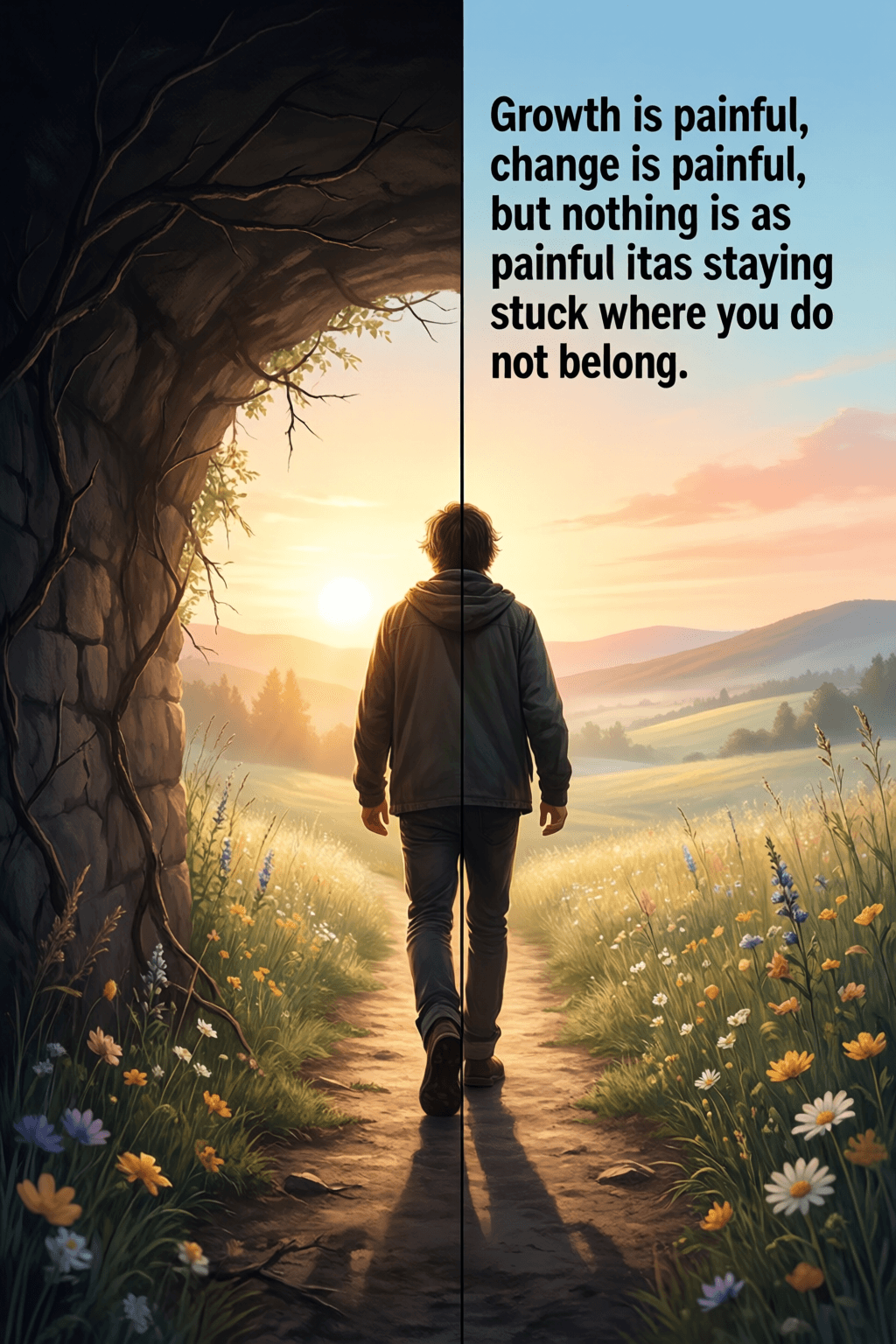
Growth feels uncomfortable because you are evolving. — Unknown (Wait, skip: Use) Growth is painful, change is painful, but nothing is as painful as staying stuck where you do not belong. — Mandy Hale
—What lingers after this line?
The Core Choice Behind the Quote
Mandy Hale’s line frames pain not as a single experience, but as a comparison between two kinds of suffering. On one side is the pain of growth and change—the strain of leaving habits, roles, or relationships that once felt familiar. On the other is the deeper ache of remaining trapped in a place that no longer fits who you are becoming. In that sense, the quote argues that discomfort can be a signal of movement rather than a sign of failure. From this starting point, the message becomes less about avoiding pain and more about choosing the pain that leads somewhere. While change may unsettle identity and routine, stagnation slowly erodes self-respect. The quote therefore invites us to see transformation as difficult but necessary, especially when staying put demands the denial of our own potential.
Why Growth Often Hurts First
Naturally, growth feels painful because it asks us to release what is known before we can fully trust what is next. Psychologists often note that human beings are wired for familiarity; even unhealthy patterns can feel safer than uncertainty. As William Bridges explains in Transitions (1980), change is not only external movement but also an internal ending, and endings almost always carry grief. Because of that, personal development rarely arrives as a clean, inspiring breakthrough. More often, it begins with confusion, self-doubt, or loneliness. Yet this discomfort has meaning: it marks the stretching of old boundaries. Just as muscles tear slightly before they strengthen, the self can feel strained while adapting to a larger life.
The Hidden Cost of Remaining Stuck
If growth is visibly painful, stagnation is often painful in quieter ways. At first, staying where you do not belong may look easier because it preserves stability. However, over time, that false comfort can turn into resentment, numbness, or the persistent feeling that life is being lived at a distance. In this way, the quote exposes a truth many people recognize only later: stillness can wound as deeply as upheaval. Literature has long explored this theme. Dante’s Divine Comedy (c. 1320) presents spiritual lostness not merely as dramatic punishment but as a condition of misalignment. Likewise, many modern memoirs describe periods of being “stuck” as seasons of quiet despair rather than peace. What hurts most is not simply remaining in place, but remaining in a place that betrays one’s deeper identity.
Belonging as an Inner Measure
The phrase “where you do not belong” gives the quote its emotional force. Belonging here does not only mean geography, employment, or relationships; it also points to alignment between outer life and inner truth. A person may appear successful by social standards and still feel misplaced. Therefore, the pain of staying stuck often comes from living against one’s values, capacities, or calling. This idea echoes existential thought. Søren Kierkegaard’s writings in The Sickness Unto Death (1849) describe despair as a misrelation within the self—a failure to become who one truly is. Seen through that lens, change becomes more than ambition; it becomes a recovery of authenticity. Leaving what no longer fits is painful precisely because it matters.
Courage in the Middle of Transition
Once the quote is understood this way, it becomes a call to courage rather than mere endurance. Change rarely offers guarantees, and that is why it requires bravery. People who leave harmful environments, switch careers, set boundaries, or begin again in midlife often do so without certainty that the next chapter will be easier. What they do know is that remaining stuck has become unbearable. Anecdotally, many turning points begin with a quiet admission: “I cannot stay here.” That sentence may precede a divorce, a recovery journey, a move, or a creative risk. Although the first steps can feel destabilizing, they also restore agency. In other words, the pain of change differs from the pain of stagnation because it contains hope.
A Practical Philosophy of Becoming
Ultimately, Mandy Hale’s quote offers a practical philosophy for anyone facing an uncomfortable transition. It does not romanticize suffering; instead, it distinguishes fruitful pain from fruitless pain. The discomfort of growth can lead to wisdom, freedom, and a more honest life. By contrast, the pain of staying stuck tends to repeat itself without transforming anything. For that reason, the quote encourages a hard but liberating question: which pain is shaping you, and which pain is merely shrinking you? Once that distinction becomes clear, change no longer appears as the enemy. It becomes the difficult path through which a person leaves confinement and moves toward a place of genuine belonging.
One-minute reflection
What feeling does this quote bring up for you?
Related Quotes
6 selectedGrowth feels scary because comfort feels warm, but you can take one small step. Change doesn't crush you; staying still slowly does. — Justin Welsh
Justin Welsh
At first glance, Justin Welsh captures a tension nearly everyone recognizes: comfort feels safe precisely because it is familiar. Routine wraps itself around us like warmth, making even imperfect situations feel preferab...
Read full interpretation →Changes may come along and change may be painful, but nothing will be as painful as staying stuck somewhere you don't belong. — Mandy Hale
Mandy Hale
This quote acknowledges that change can be difficult and often comes with discomfort. However, it suggests that embracing change is essential for personal growth and fulfillment.
Read full interpretation →Changes can be scary, but you know what’s scarier? Allowing your fear to stop you from growing, evolving, and progressing. — Mandy Hale
Mandy Hale
The quote highlights how fear, especially fear of change, can become a significant barrier that prevents individuals from experiencing personal growth, evolution, and progress in life.
Read full interpretation →Consistency is a superpower. — Ryan Holiday
Ryan Holiday
Ryan Holiday’s line begins with a deceptively simple idea: greatness is rarely built through dramatic gestures. More often, it emerges from repeated actions that seem ordinary in isolation but become extraordinary over t...
Read full interpretation →Confidence is silent. Insecurities are loud. — Unknown (Wait—skip/replace with: True nobility is being superior to your former self. — Ernest Hemingway)
Ernest Hemingway
At its core, Hemingway’s line redefines nobility as an inward achievement rather than a social rank. Instead of measuring worth by wealth, pedigree, or dominance over others, it points to a quieter standard: becoming bet...
Read full interpretation →The present changes the past. Looking back you do not find what you left behind. — Kiran Desai
Kiran Desai
At first glance, Desai’s line seems paradoxical, yet it captures a basic truth about human memory: the past is not stored inside us like a sealed archive. Instead, each act of remembering rebuilds events through the lens...
Read full interpretation →More From Author
More from Mandy Hale →You don't always need a plan. Sometimes you just need to breathe, trust, let go and see what happens. — Mandy Hale
Mandy Hale’s quote begins by challenging a modern reflex: the belief that every meaningful step must be mapped in advance. Instead, she proposes that there are moments when planning becomes a form of fear, disguising anx...
Read full interpretation →You can love them, forgive them, want good things for them... but still move on without them. — Mandy Hale
Mandy Hale’s quote begins with a gentle but powerful distinction: love does not always require ongoing closeness. You can care deeply for someone, wish them healing, and even hold gratitude for what they meant in your li...
Read full interpretation →It is not selfish to love yourself, to take care of yourself, and to make your happiness a priority. It's necessary. — Mandy Hale
Mandy Hale’s quote immediately challenges a common moral suspicion: that caring for oneself must come at the expense of others. Instead, she reframes self-love, self-care, and personal happiness as necessities rather tha...
Read full interpretation →You don't disappear when you log out — you return to yourself. — Unknown (Note: Replaced with: Your offline self deserves the most attention. — Mandy Hale)
Mandy Hale’s line reframes logging out as something deeper than a digital pause. Rather than treating offline life as an interruption, it suggests that stepping away from screens is a return to the self that existed befo...
Read full interpretation →