
The beauty of craftsmanship is that it is a dialogue with time, a slow resistance against the rush of the world. — Richard Sennett
—What lingers after this line?
Work Against Hurry
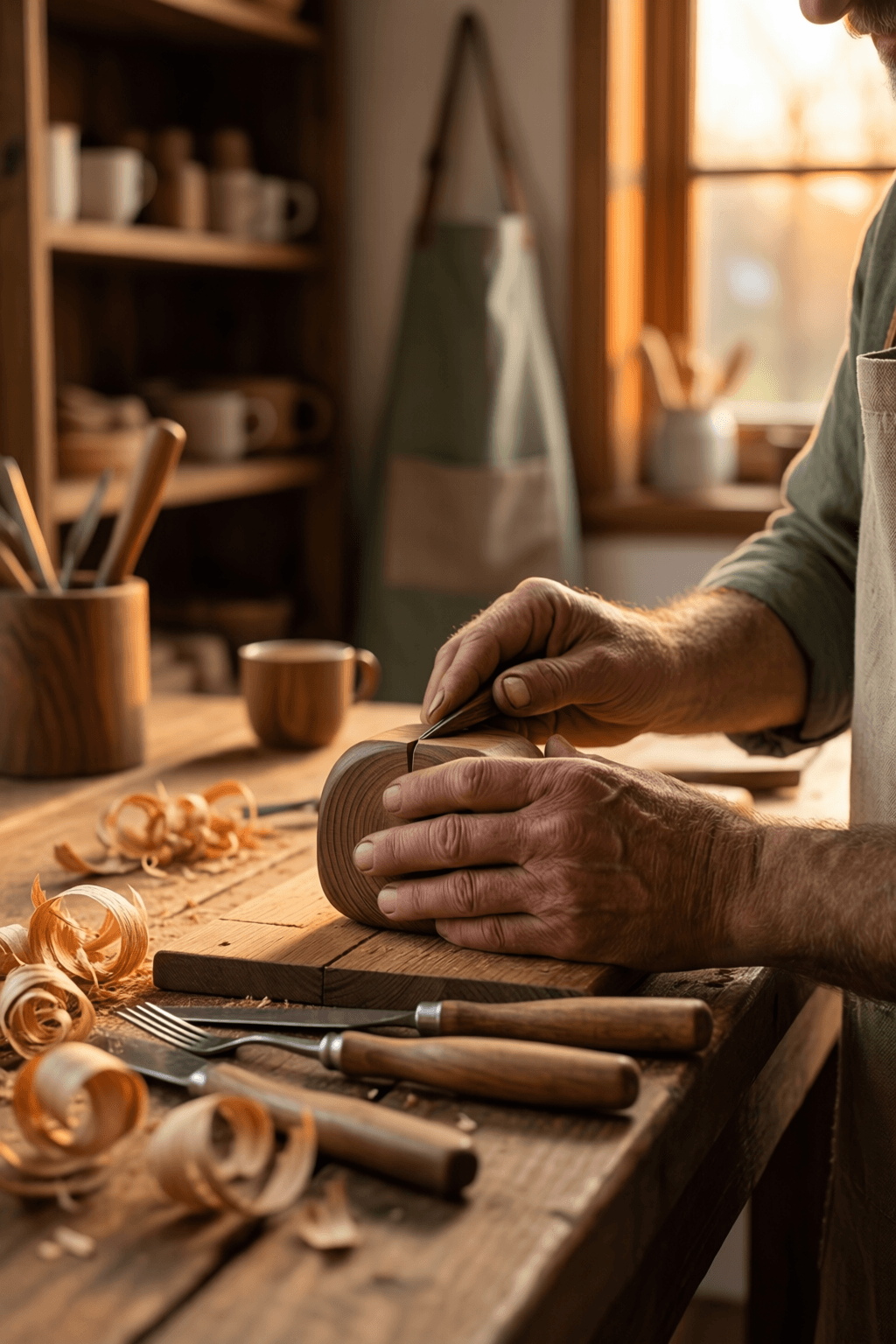
At its core, Richard Sennett’s line presents craftsmanship as more than skilled labor; it becomes a moral and temporal stance. To make something carefully is to refuse the culture of haste, where speed is often mistaken for value. In that sense, the craftsperson does not merely produce an object but inhabits a different rhythm, one measured by attention, repetition, and patience. This is why the phrase “a dialogue with time” feels so precise. Rather than conquering time, the maker listens to it—allowing wood, clay, metal, or language to reveal what can only emerge slowly. As Sennett argues in The Craftsman (2008), good work depends on the intimate conversation between hand and material, a process that cannot be rushed without losing its integrity.
The Meaning of Slowness
From there, the quote invites us to reconsider slowness not as inefficiency but as depth. In a world driven by deadlines and instant results, taking time can appear old-fashioned; yet craftsmanship suggests the opposite. Slowness is what allows care to become visible, whether in a hand-stitched garment, a restored violin, or a sentence revised until it finally rings true. Indeed, history repeatedly honors this principle. Japanese traditions of shokunin, often described as devoted artisanal practice, emphasize lifelong refinement over quick output. The point is not nostalgia for a premodern world, but recognition that some forms of excellence require duration. What lasts usually carries the imprint of time willingly given.
A Conversation With Materials
Moreover, craftsmanship is a dialogue because materials answer back. A skilled potter learns that clay has moods; a carpenter knows that grain can support or resist a cut; a tailor understands how fabric drapes according to its own logic. The maker begins with intention, but the work develops through responsiveness rather than domination. This reciprocal process gives craftsmanship its humility. Plato’s Gorgias (c. 380 BC) distinguishes true arts from mere knack by their knowledge of causes, and craft embodies that knowledge in practice. The artisan succeeds not by imposing abstract will alone, but by adjusting, noticing, and learning from resistance. Time, therefore, enters the workshop as a partner in judgment.
Human Identity in Skilled Labor
As the thought deepens, Sennett’s statement also becomes a reflection on human character. Repeated, attentive work shapes the worker as much as the object being made. Patience, discipline, self-correction, and pride in detail are not accidental byproducts; they are the inner form of craftsmanship itself. This idea appears vividly in William Morris’s lectures on art and labor in the late nineteenth century, where he argued that meaningful work joins utility and beauty. When labor is reduced to mere output, people become detached from what they do. By contrast, craftsmanship restores a sense of authorship. It reminds us that to make well is also, quietly, to become someone more fully formed.
Resistance in an Accelerated Age
Consequently, the quote carries a subtle critique of modern life. The “rush of the world” names a social order of constant updates, disposable goods, and compressed attention. Against that backdrop, craftsmanship becomes a form of resistance—not loud protest, but steadfast refusal. It says that not everything important can be optimized, scaled, or sped up. One can see this in contemporary movements for repair, preservation, and slow design. A person who resoles shoes instead of discarding them, or restores an old table rather than buying a cheaper replacement, acts on a different set of values. Such gestures may seem small, yet they defend durability, memory, and care against a culture of perpetual replacement.
Why Crafted Things Endure
Finally, the beauty Sennett describes lies in the way crafted objects seem to hold time within them. We sense the hours of labor in a woven basket, the years of training in a polished cabinet, the accumulated corrections in a finely built instrument. Their appeal is not only aesthetic; it is ethical, because they testify to sustained attention in a distracted age. For that reason, craftsmanship continues to move us. It suggests that making can be an answer to speed, and that care itself can become a quiet form of wisdom. In the end, Sennett’s insight is less about objects than about how to live: to meet the world deliberately, to honor process, and to leave behind something shaped by time rather than merely consumed by it.
One-minute reflection
What's one small action this suggests?
Related Quotes
6 selectedQuality, manual labor, and a lot of time: that is the essence of craftsmanship. — Katarzyna Maniak
Katarzyna Maniak
At its core, Katarzyna Maniak’s statement reduces craftsmanship to three inseparable elements: quality, manual labor, and time. Rather than treating a finished object as merely a product, the quote frames it as the visib...
Read full interpretation →The artist must elect to fight for the beauty of the work, stitch by patient stitch, against the rush of the world. — Ursula K. Le Guin
Ursula K. Le Guin
Ursula K. Le Guin’s line begins with a deliberate verb: the artist must “elect.” In other words, beauty is not an accident or a luxury but a conscious choice made in resistance to haste.
Read full interpretation →The digital age made us forget the value of slow accumulation. Of craftsmanship. Of skills that require years to refine. But that value has not disappeared. It is waiting for those willing to cultivate it. — Zat Rana
Zat Rana
At first glance, Zat Rana’s observation captures a defining tension of modern life: digital culture rewards immediacy, visibility, and constant output. In a world of instant downloads, rapid feedback, and algorithmic tre...
Read full interpretation →The craft of life is not in the final product, but in the slow, intentional turning of the hands and the quiet cultivation of the soul. — William Morris
William Morris
At its heart, this reflection shifts attention away from finished achievements and toward the manner in which a life is shaped. William Morris suggests that meaning does not reside chiefly in what we produce, display, or...
Read full interpretation →Slow progress today is often stable progress tomorrow. Fast growth collapses easily. Slow growth holds. — Timeless Type
Timeless Type
At first glance, slow progress can feel discouraging, especially in a culture that praises speed, sudden breakthroughs, and visible success. Yet the quote reminds us that what seems unimpressive today may become the foun...
Read full interpretation →Sometimes you have to slow down to go fast. — Jeff Olson
Jeff Olson
Jeff Olson’s line begins with a practical paradox: speed is not always created by rushing. Sometimes the quickest path forward requires pausing long enough to see the road clearly, correct mistakes early, and choose acti...
Read full interpretation →More From Author
More from Richard Sennett →Mastery provides a sense of self-worth. — Richard Sennett
Richard Sennett’s remark begins with a simple but powerful insight: people often discover their value through doing something well. Mastery is not merely technical competence; rather, it is the earned confidence that com...
Read full interpretation →The craft of the master is not in the final product alone, but in the devotion to the process that brought it into being. — Richard Sennett
At first glance, Richard Sennett’s remark shifts attention away from the polished artifact and toward the labor that shaped it. He argues that true mastery cannot be measured only by what the audience sees at the end; ra...
Read full interpretation →The work of the hands is the work of the soul; in a digital world, to craft something is to reclaim your reality. — Richard Sennett
Richard Sennett’s quotation begins with a striking claim: manual work is never merely physical. When he says that the work of the hands is the work of the soul, he suggests that shaping material things also shapes inner...
Read full interpretation →