
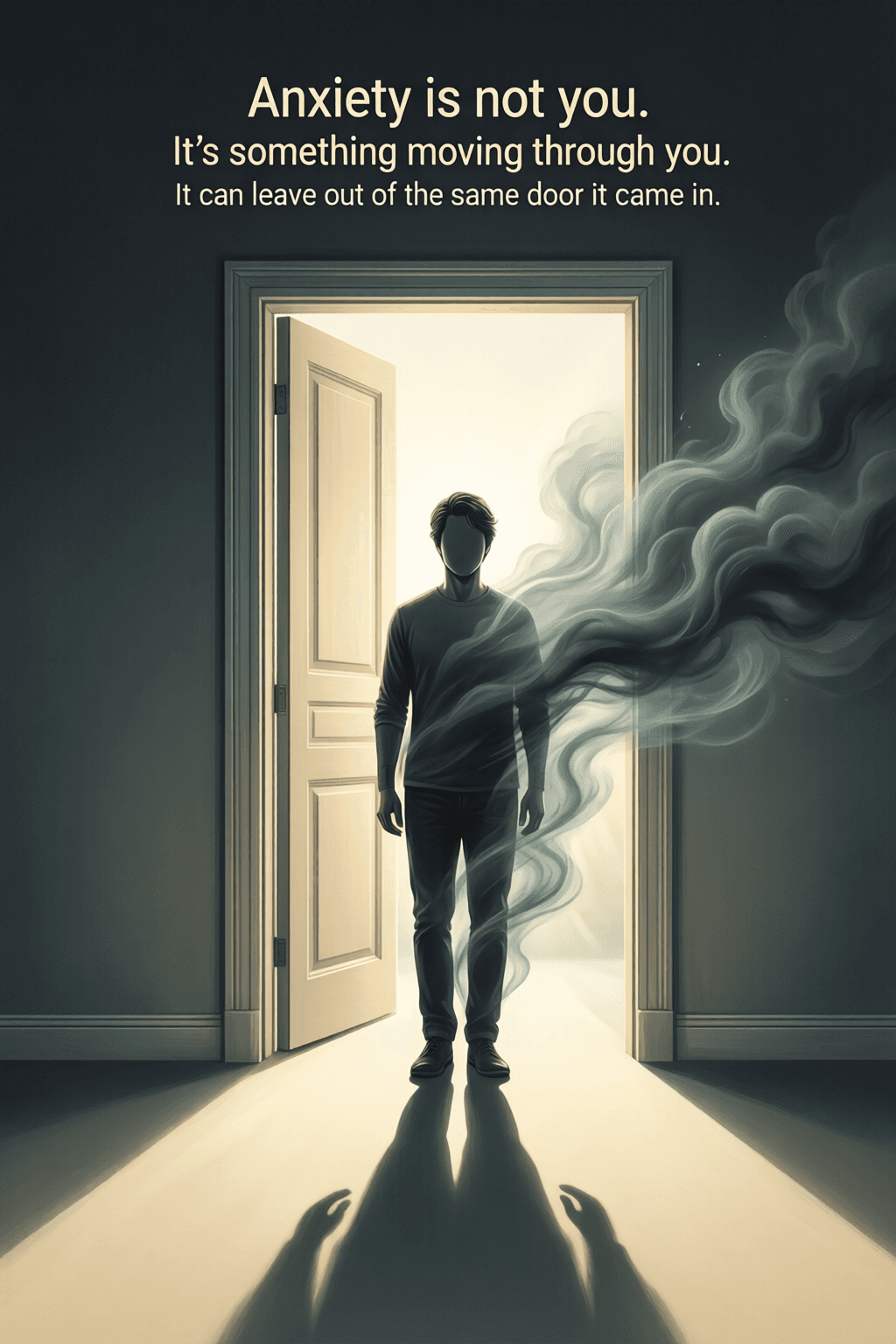
Anxiety is not you. It's something moving through you. It can leave out of the same door it came in. — James Clear
—What lingers after this line?
Separating Identity From Emotion
At its core, James Clear’s line draws a crucial boundary between the self and a temporary emotional state. By saying anxiety is “not you,” he interrupts the common habit of turning a passing feeling into a fixed identity. Instead of saying “I am anxious” as though it were a permanent condition, the quote suggests that anxiety is an experience moving through the mind and body, real but not all-defining. This shift matters because identity shapes hope. Once a person believes anxiety is their essence, change can feel impossible; however, if it is something visiting rather than ruling, then relief becomes imaginable. In that sense, the quote offers not denial, but distance—a gentler way to see distress without surrendering the whole self to it.
The Image of Motion
Just as importantly, the phrase “moving through you” gives anxiety a sense of motion rather than permanence. Emotions often feel immovable in the moment, yet psychology consistently treats them as dynamic states influenced by thoughts, physiology, and environment. Lisa Feldman Barrett’s work in How Emotions Are Made (2017), for example, emphasizes that emotional experiences are constructed and shifting rather than static objects lodged forever inside us. Because of that, Clear’s metaphor carries practical comfort. A storm is easier to endure when one remembers it is traveling. Anxiety may surge, linger, and return, but the image of movement reminds us that inner life is active and changing. What feels stuck may, in fact, already be in motion.
Why the Door Metaphor Matters
From there, the quote’s final image—a door through which anxiety can leave—quietly restores agency. It does not promise that one can command anxiety to disappear instantly; rather, it suggests that what entered can also exit. That simple symmetry resists the panic that often accompanies panic itself, the fear that “this will never end.” Moreover, the metaphor is compassionate because it avoids shame. If anxiety came in, it was not necessarily invited; likewise, letting it pass out may require patience rather than force. Many therapeutic approaches echo this principle. Acceptance and Commitment Therapy, developed by Steven C. Hayes, encourages people to make room for difficult internal experiences instead of waging a futile war against them, often reducing their grip in the process.
A More Gentle Way to Respond
Consequently, the quote points toward a softer response to distress. When people treat anxiety as an invader fused with their identity, they often escalate it through resistance: they fear the feeling, judge themselves for having it, and then fear that judgment too. By contrast, seeing anxiety as something passing through encourages observation over panic—“This is here right now” instead of “This is what I am.” That distinction appears in mindfulness traditions as well. Jon Kabat-Zinn’s writings on mindfulness describe thoughts and emotions as events in awareness, not the totality of the person experiencing them. In everyday life, this may look like pausing to notice a racing heart, naming the feeling, and breathing through it rather than building a second layer of alarm around the first.
Hope Without False Promises
At the same time, Clear’s statement is hopeful without becoming simplistic. It does not say anxiety is trivial, imaginary, or easy to dismiss. For many people, anxiety disorders are serious and may require therapy, medication, or long-term support. Yet even in those harder cases, the quote preserves an essential truth: suffering can be intense without being identical to the self. That is why the line feels reassuring rather than naive. It leaves room for pain while rejecting permanence as destiny. Someone may need help opening that metaphorical door, but the existence of the door still matters. It suggests that healing is not a betrayal of who you are, because anxiety was never the deepest definition of you to begin with.
The Quiet Power of Reframing
Ultimately, the quote works because it transforms a frightening experience into a manageable narrative. Reframing does not erase bodily symptoms, but it changes the relationship a person has with them. Viktor Frankl’s Man’s Search for Meaning (1946) famously argues that a change in attitude can alter how suffering is borne; similarly, Clear offers a compact mental frame that turns anxiety from an identity into a visitor. In the end, that reframing can be profoundly stabilizing. A visitor may be disruptive, unwelcome, and exhausting, but a visitor is not the house itself. By remembering that distinction, people can meet anxiety with more patience, more perspective, and perhaps most importantly, more faith that it will not stay forever.
Recommended Reading
As an Amazon Associate, we earn from qualifying purchases.
One-minute reflection
What's one small action this suggests?
Related Quotes
6 selectedDon't believe every worried thought you have. Worried thoughts are notoriously inaccurate. — Renee Jain
Renee Jain
At its core, Renee Jain’s quote confronts a habit many people barely notice: treating every anxious thought as if it were reliable evidence. Worry often arrives with urgency, and because it feels protective, it can masqu...
Read full interpretation →Your anxiety is not a failure; it is a signal. Stop trying to silence it and start listening to what it is trying to teach you about your boundaries. — Bessel van der Kolk
Bessel van der Kolk
At first glance, anxiety often feels like evidence that something is wrong within us. Yet Bessel van der Kolk reverses that assumption, suggesting that anxiety is not simply a defect to erase but a message to interpret.
Read full interpretation →Anxiety is a storm, but you are the sky. You cannot control the weather of your thoughts, but you can learn to expand your awareness until the clouds no longer define your horizon. — Jon Kabat-Zinn
Zinn
At its heart, Jon Kabat-Zinn’s statement separates temporary mental events from the deeper field of awareness that holds them. Anxiety appears as a storm—loud, shifting, and sometimes frightening—while the self is compar...
Read full interpretation →I have a new philosophy. I'm only going to dread one day at a time. — Charles M. Schulz
Charles M. Schulz
At first glance, Charles M. Schulz’s line sounds like a joke, and that is precisely its power.
Read full interpretation →Anxiety is the precursor to creativity, and every great creation is born from anxiety. — T.S. Eliot
T. S. Eliot
At its core, Eliot’s statement frames anxiety not as a purely destructive force but as the restless tension that often precedes invention. Anxiety unsettles the mind, making ordinary answers feel insufficient; in that di...
Read full interpretation →The dawn of a new era never feels comfortable at first; curiosity and anxiety are simply proof that history is moving. — Doran Gao
Doran Gao
At its core, Doran Gao’s line reframes unease as evidence rather than failure. A new era does not arrive with perfect clarity or emotional calm; instead, it unsettles routines, expectations, and inherited certainties.
Read full interpretation →More From Author
More from James Clear →Consistency is the quiet, daily hum of progress that eventually drowns out the noise of doubt and external expectations. — James Clear
At first glance, James Clear’s quote shifts attention away from dramatic breakthroughs and toward something far less glamorous: repetition. By calling consistency a “quiet, daily hum,” he suggests that meaningful progres...
Read full interpretation →To do anything to a high standard, you must be prepared to be bored for long periods of time. — James Clear
James Clear’s observation cuts against the modern preference for constant stimulation. At first glance, high achievement looks exciting from the outside, yet the path toward it is usually repetitive, slow, and uneventful...
Read full interpretation →The secret to mastery is not intensity, but the grace to show up when you do not feel like it. — James Clear
At first glance, James Clear’s line overturns a common myth: that greatness comes from bursts of passion or extreme effort. Instead, he places mastery in the quieter realm of consistency, especially on the days when enth...
Read full interpretation →If you want to know what you have accomplished, look at your habits. If you want to know where you are going, look at your habits. — James Clear
James Clear’s quote turns attention away from vague intentions and toward repeated behavior. In that sense, habits act like living evidence: they show what a person has actually built, not merely what they once hoped to...
Read full interpretation →