
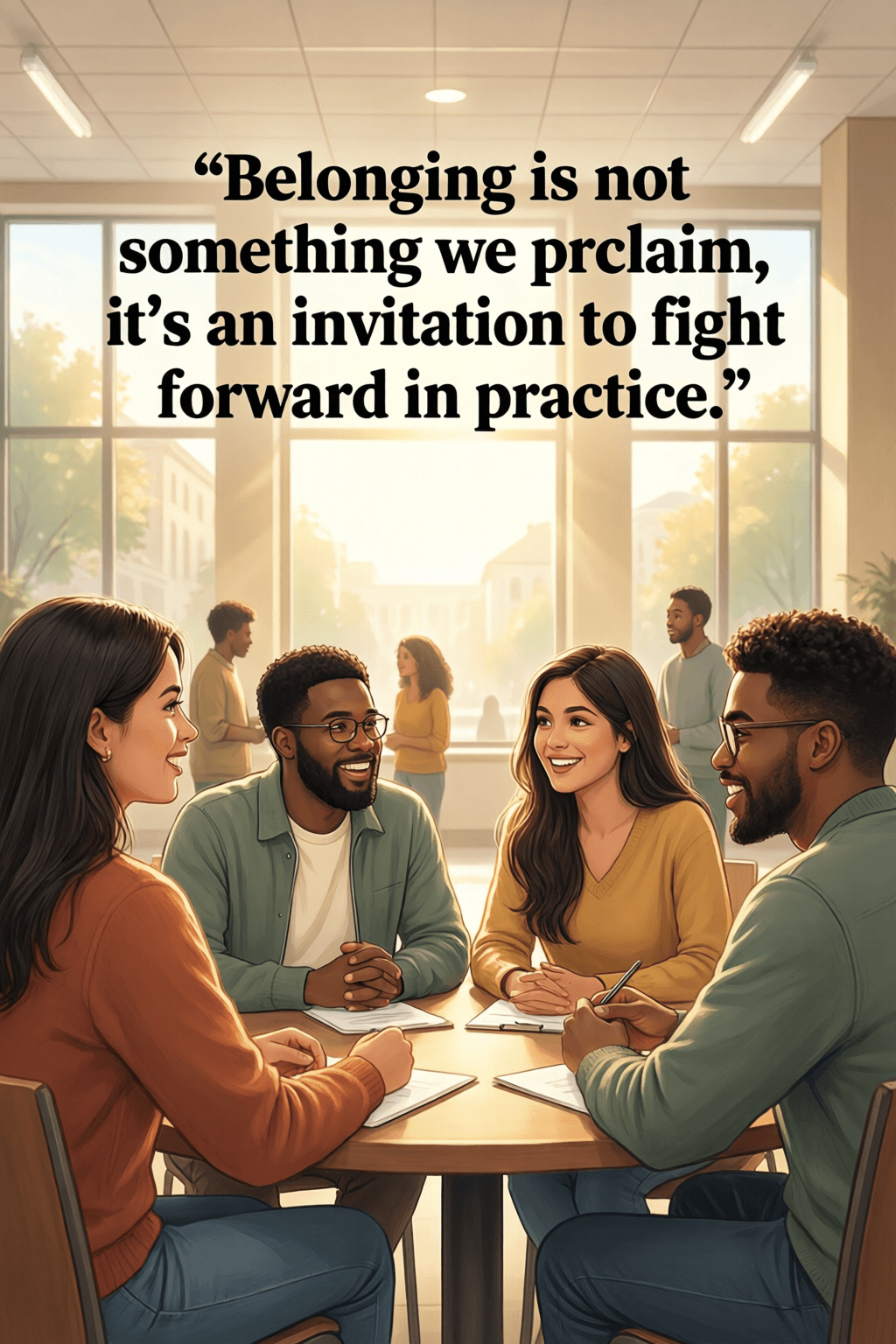
Belonging is not something we proclaim, it's an invitation to fight forward in practice. It lives where people are seen, valued, and able to shape the structures that impact our daily lives. — john a. powell
—What lingers after this line?
Beyond a Mere Declaration
At its core, john a. powell’s statement rejects the idea that belonging can be achieved through slogans alone. To proclaim inclusion is easy; to build conditions where people genuinely feel connected is much harder. In this sense, belonging is not a label bestowed from above but an ongoing social practice that must be enacted repeatedly in everyday life. This distinction matters because institutions often celebrate diversity symbolically while leaving exclusionary habits untouched. By framing belonging as an invitation to “fight forward,” powell emphasizes movement, effort, and shared responsibility. The phrase suggests that belonging emerges not from passive agreement but from collective work aimed at transforming relationships and systems alike.
The Importance of Being Seen
From there, the quote turns to recognition: belonging lives where people are truly seen. To be seen is more than to be noticed; it means one’s history, identity, and experience are acknowledged without being reduced to stereotype. As philosopher Axel Honneth argued in The Struggle for Recognition (1995), human flourishing depends deeply on receiving forms of social recognition that affirm dignity. Consequently, environments that ignore or flatten difference often fail to create belonging, even when they appear formally inclusive. A student whose name is never pronounced correctly, or an employee whose concerns are routinely dismissed, may be present yet never fully received. Seen in this light, belonging begins with attention, but it cannot end there.
Why Valuing People Changes Communities
Naturally, being seen must lead to being valued. Recognition without respect can become a hollow performance, a way of identifying people without honoring their worth. powell’s wording points to a deeper ethic: belonging requires that individuals feel their presence matters and that their contributions are not merely tolerated but welcomed. This has practical implications for communities, schools, and workplaces. For example, research on psychological safety, popularized by Amy Edmondson in The Fearless Organization (2018), shows that people contribute more openly when they believe they will not be humiliated or ignored. In other words, value is not an abstract sentiment; it becomes visible in who gets heard, who gets support, and whose well-being is treated as essential to the whole.
Power Over Everyday Structures
Yet powell moves even further, insisting that belonging is inseparable from the ability to shape the structures affecting daily life. This is a crucial shift because many settings offer interpersonal warmth while withholding meaningful power. Someone may feel welcomed into a room and still have no say in the rules governing housing, education, healthcare, or work. Here the quote aligns with democratic traditions that tie dignity to participation. Carole Pateman’s Participation and Democratic Theory (1970), for instance, argues that meaningful involvement in decision-making develops both agency and citizenship. Accordingly, belonging is not complete when people are merely included within existing systems; it deepens when they can help redesign those systems. Without that power, inclusion risks becoming a managed form of dependency.
Fighting Forward Together
Because of this, the phrase “fight forward” carries unusual moral force. It does not romanticize conflict for its own sake; rather, it recognizes that expanding belonging often requires struggle against inherited barriers. Progress is rarely smooth, especially when institutions have been built around exclusion, hierarchy, or indifference. Still, the direction matters as much as the struggle. To fight forward is to resist cynicism and to keep building toward a wider circle of care. The U.S. civil rights movement offers a clear illustration: the Student Nonviolent Coordinating Committee and other organizers did not simply ask to be acknowledged; they demanded changes to laws, public life, and representation. Their example shows that belonging grows when people contest unjust arrangements and imagine more generous ones.
Belonging as a Shared Civic Practice
Ultimately, powell presents belonging as something relational, structural, and unfinished. It is relational because people must be seen and valued; structural because institutions must be open to shared shaping; and unfinished because each generation must renew the work. This makes belonging less like a status one possesses and more like a civic practice one sustains. In the end, the quote offers both a challenge and a hope. It challenges communities to move beyond performative inclusion, yet it also offers hope that belonging can be built through deliberate action. When people are recognized, respected, and given real influence over the systems that govern their lives, belonging ceases to be a promise and becomes a lived reality.
Recommended Reading
As an Amazon Associate, we earn from qualifying purchases.
One-minute reflection
What does this quote ask you to notice today?
Related Quotes
6 selectedBelonging is not something we join—it's something we bring to life by how we live. — Parker J. Palmer
Parker J. Palmer
At first glance, Parker J. Palmer’s line shifts belonging away from membership and toward practice.
Read full interpretation →One of the most important things about being a human being is feeling like you belong. — Dr. Bruce Perry
Dr. Bruce Perry
Dr. Bruce Perry’s statement begins with a simple but profound truth: human beings do not thrive in isolation.
Read full interpretation →To know that you can navigate the wilderness on your own—to know that you can stay true to your beliefs, trust yourself, and survive it—that is true belonging. — Brené Brown
Brené Brown
At first glance, Brené Brown redefines belonging in a striking way: it is not the comfort of being accepted by a group, but the deeper confidence of remaining fully yourself wherever you are. In this view, true belonging...
Read full interpretation →Fitting in is one of the greatest barriers to belonging. Belonging doesn't require us to change who we are; it requires us to be who we are. — Brené Brown
Brené Brown
At the heart of Brené Brown’s statement is a crucial distinction: fitting in is about adaptation, while belonging is about acceptance. When people try to fit in, they often study the room, edit themselves, and perform wh...
Read full interpretation →A sense of belonging is the best medicine for the human heart; it is the feeling that we are part of something larger than ourselves. — Maya Angelou
Maya Angelou
Maya Angelou’s insight begins with a simple but profound truth: emotional healing rarely happens in isolation. By calling belonging “the best medicine,” she suggests that the heart is restored not only through comfort, b...
Read full interpretation →Belonging is not a service to be outsourced to an app; it is made by people, in rooms, on purpose. — Samuel J. Abrams
Samuel J. Abrams
Samuel J. Abrams’s line pushes back against a modern fantasy: that loneliness can be solved as conveniently as food delivery or ride-hailing.
Read full interpretation →More From Author
More from john a. powell →