
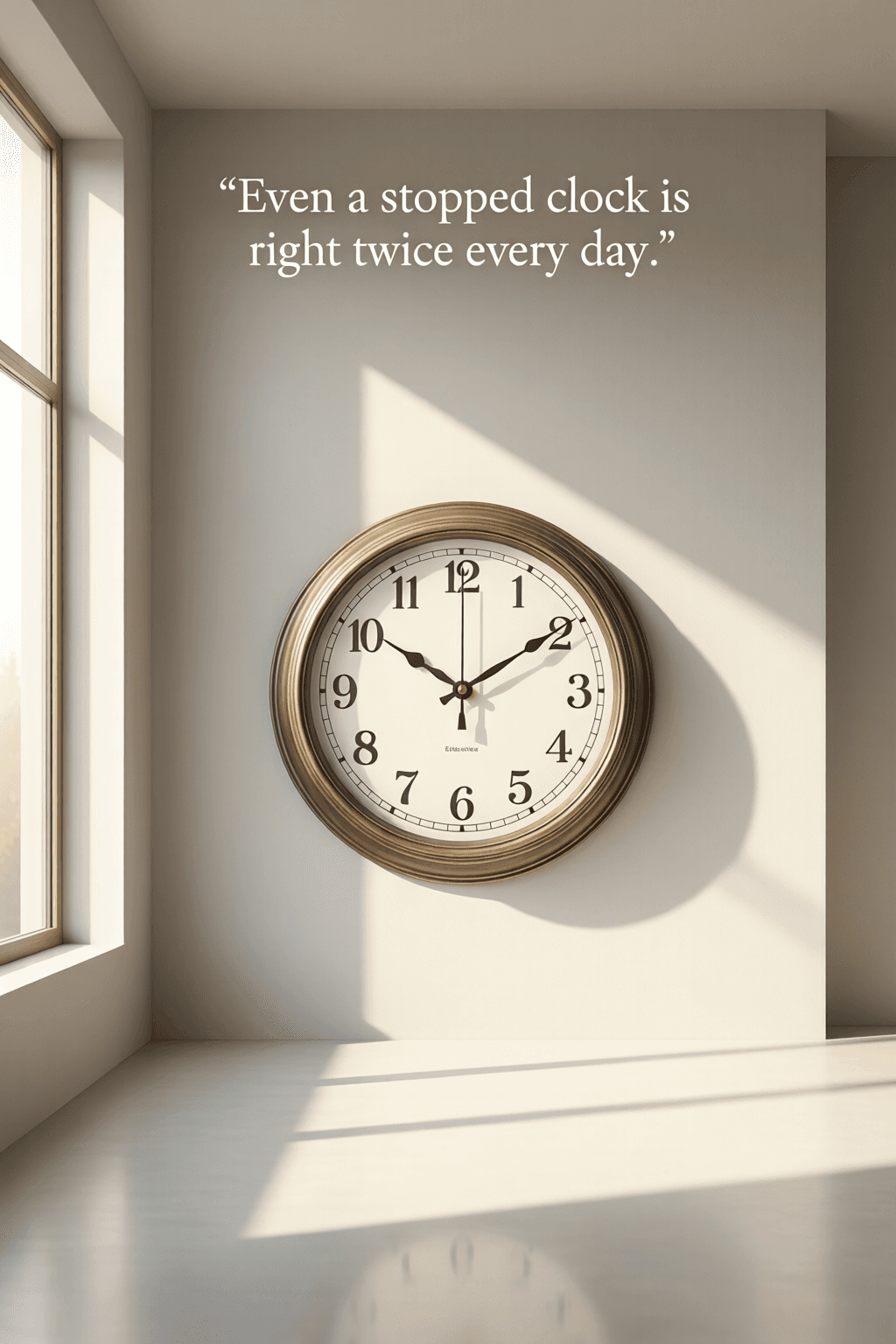
Even a stopped clock is right twice every day. After some years, it can boast of a long series of successes. — Marie von Ebner-Eschenbach
—What lingers after this line?
The Wit Behind the Image
Marie von Ebner-Eschenbach turns a simple household object into a sharp meditation on judgment. A stopped clock, though useless in practice, still aligns with the correct time twice a day; therefore, it can appear successful if one counts only those moments. From the start, her remark exposes how easily people confuse occasional correctness with genuine reliability. This is precisely what gives the quote its enduring force. Rather than mocking error alone, it warns against selective memory—the habit of celebrating hits while ignoring the long stretches of failure between them.
Chance Mistaken for Competence
From that image, the deeper lesson emerges: being right sometimes does not necessarily prove skill. In everyday life, a reckless investor, an impulsive commentator, or an uninformed guesser may occasionally make a correct prediction. Yet, as Nassim Nicholas Taleb argues in Fooled by Randomness (2001), people often mistake lucky outcomes for expertise. Consequently, Ebner-Eschenbach’s clock becomes a metaphor for accidental truth. It reminds us that accuracy without consistency is not wisdom, and isolated successes can hide a fundamentally broken method.
How Reputation Gets Built
Once luck is mistaken for talent, reputation can grow on surprisingly thin evidence. Over time, a person who is intermittently right may collect anecdotes of success, retelling them until they sound like proof of mastery. In this way, the ‘long series of successes’ in the quote is not wholly false; rather, it is misleading because it omits the full record. This pattern appears throughout history. Herodotus’s Histories (5th century BC) and later political memoirs alike show how leaders often survive by shaping narratives of victory, allowing memory to polish chance into authority.
The Psychology of Selective Recall
This distortion persists because the human mind is built to notice confirming evidence more readily than disconfirming facts. Psychologists commonly describe this as confirmation bias: once we believe someone is insightful, we remember their correct statements and quietly discard their errors. The stopped clock prospers in precisely this mental environment. Moreover, social settings amplify the problem. A bold claim that turns out right is repeated, while dozens of wrong ones vanish from conversation. As a result, confidence can look indistinguishable from competence unless we deliberately examine the whole pattern.
A Standard for Real Reliability
For that reason, the quote ultimately asks us to value consistency over spectacle. Real judgment is not measured by occasional triumphs but by dependable performance across changing circumstances. Aristotle’s Nicomachean Ethics (4th century BC) similarly links excellence to habit rather than isolated acts, suggesting that true virtue—and by extension true competence—shows itself repeatedly. In the end, Ebner-Eschenbach offers more than a clever aphorism. She teaches a practical discipline: before admiring a record of success, ask whether it reflects understanding or merely the fortunate timing of a stopped clock.
One-minute reflection
What feeling does this quote bring up for you?
Related Quotes
6 selectedThe point is to have a long-term perspective. — Dalai Lama XIV
Dalai Lama XIV
At its core, the Dalai Lama XIV’s remark urges us to lift our eyes from the pressures of the present moment and consider the wider arc of life. A long-term perspective does not deny today’s difficulties; rather, it place...
Read full interpretation →Sometimes all it takes is a tiny shift of perspective to see something familiar in a totally new light. — Dan Brown
Dan Brown
At first glance, Dan Brown’s quote seems simple, yet its force lies in how little it asks of us: not a total reinvention, but a slight adjustment in viewpoint. He suggests that familiarity can dull perception, making peo...
Read full interpretation →Everything is a season, and this is just a chapter, not your whole story. — Glennon Doyle
Glennon Doyle
At its core, Glennon Doyle’s quote reframes hardship and change by comparing life to the natural cycle of seasons. Just as winter does not cancel spring, a painful or uncertain period does not define a person forever.
Read full interpretation →Sometimes you just have to stop, take a deep breath, and put things into perspective. — Katrina Mayer
Katrina Mayer
At its core, Katrina Mayer’s remark highlights the quiet power of interruption. In moments of stress, urgency often convinces us that we must react immediately, yet the simple act of stopping can break that spell.
Read full interpretation →We must look at the lens through which we see the world, as well as the world we see. — Sarah Ban Breathnach
Sarah Ban Breathnach
Sarah Ban Breathnach’s line reminds us that perception is never a simple act of receiving reality; it is also an act of interpretation. We do not merely look outward at events, people, and circumstances—we also look thro...
Read full interpretation →If you want to move forward, you must first give yourself permission to stand still. Perspective is often the result of stopping long enough to actually see. — Alain de Botton
Alain de Botton
At first glance, Alain de Botton’s line seems contradictory: how can standing still help us move forward? Yet that tension is precisely his point.
Read full interpretation →More From Author
More from Eschenbach →