
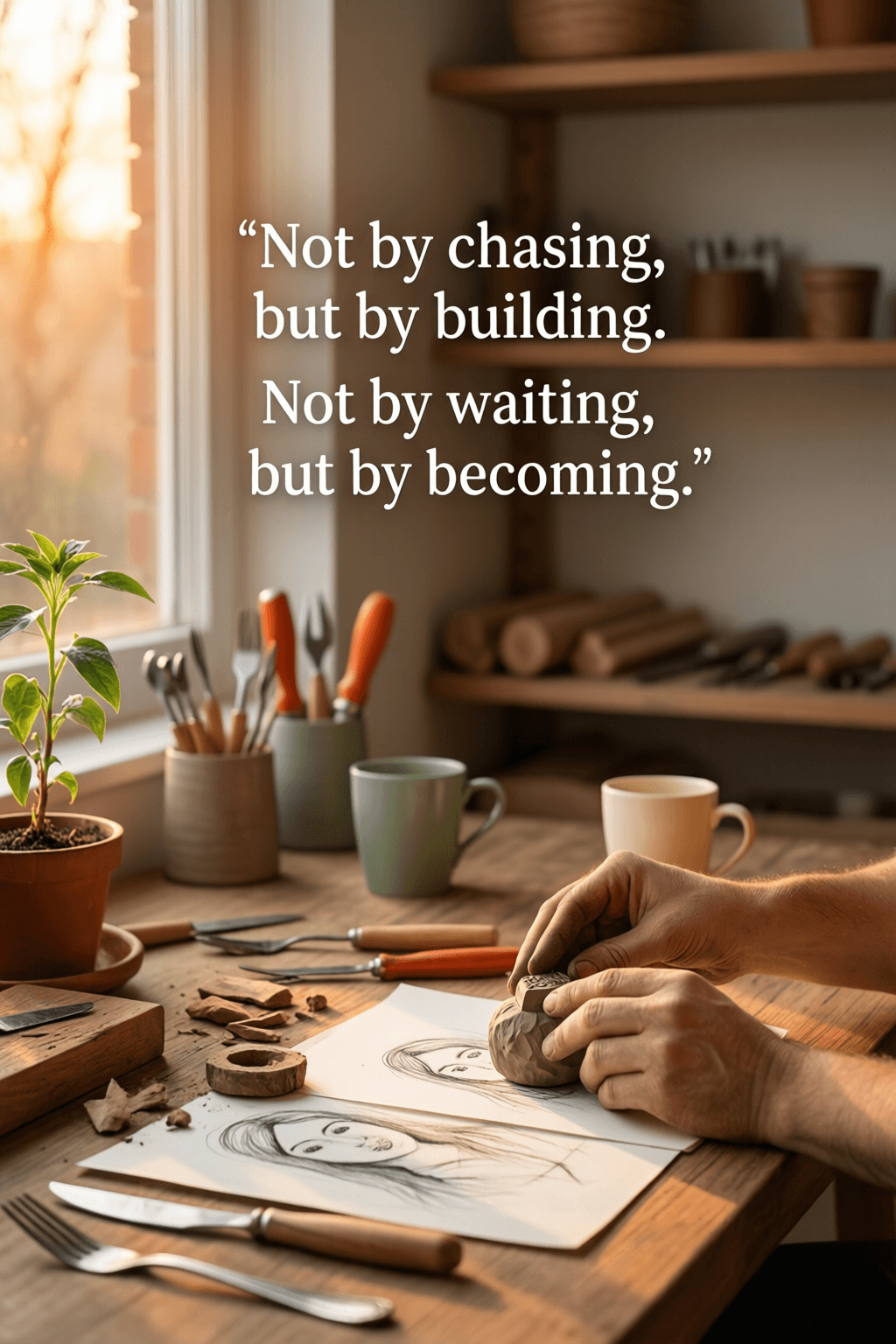
Not by chasing, but by building. Not by waiting, but by becoming. — Zat Rana
—What lingers after this line?
A Shift From Pursuit to Creation
At its core, Zat Rana’s line rejects the anxious energy of chasing outcomes and replaces it with the steadier discipline of construction. The quote implies that meaningful success, love, purpose, or recognition rarely comes from running after external rewards; instead, it emerges from making something valuable within and around oneself. In this way, the statement feels less like a slogan and more like a philosophy of agency. From that starting point, the contrast becomes crucial: chasing is reactive, while building is generative. One depends on what is already out there, just out of reach; the other transforms the present into a foundation for the future. Rana’s phrasing suggests that the most durable achievements are often side effects of patient creation rather than trophies seized through restless pursuit.
Why Chasing Often Leads to Emptiness
Seen more closely, chasing tends to fix attention on scarcity: the promotion not yet won, the audience not yet gained, the relationship not yet secured. Because of that, it can keep a person emotionally dependent on circumstances beyond their control. The ancient Stoic Epictetus, in the Discourses (2nd century AD), repeatedly warned that peace depends on focusing on what can actually be governed—namely one’s judgments and actions. Consequently, Rana’s insight carries a quiet psychological truth. When people chase validation, they often shape themselves around immediate approval rather than enduring substance. Even when they succeed, the satisfaction can be brief, because the habit of chasing simply finds a new object. Building, by contrast, creates inner ballast: skill, character, and work that remain valuable whether applause arrives today or much later.
Building as a Patient Discipline
If chasing is driven by urgency, building is defined by repetition. It involves choosing daily practices that may look small in isolation but accumulate into mastery over time. This logic appears in James Clear’s Atomic Habits (2018), which argues that lasting change comes less from dramatic reinvention than from systems repeated consistently. Rana’s quote compresses that long lesson into a few memorable words. Moreover, building requires tolerance for invisibility. A writer drafts before being read, an entrepreneur designs before being noticed, and a friend earns trust before receiving it. In each case, the important work happens before the visible reward. Thus, the quote honors a hidden phase of life that modern culture often overlooks: the long season when progress is real but not yet publicly recognized.
From Waiting to Becoming
The second half of the quotation deepens the first by moving from action to identity. “Not by waiting, but by becoming” suggests that transformation does not arrive as a passive event; it is something embodied through choices, habits, and perspective. Waiting assumes that life will eventually deliver permission, confidence, or opportunity. Becoming, however, means growing into the kind of person who can meet opportunity when it appears. This idea echoes Aristotle’s Nicomachean Ethics (4th century BC), where character is formed through repeated action: we become just by doing just acts, courageous by doing courageous acts. Rana’s wording brings that classical insight into modern language. Rather than asking when the right moment will come, the quote asks who we are turning into while time passes.
Identity Before Outcome
As the thought unfolds, it becomes clear that becoming is more powerful than waiting because identity shapes results more reliably than hope does. Someone who becomes disciplined, generous, or skillful changes the range of possible futures available to them. In other words, outcomes are not only attained; they are often prepared for internally long before they are visible externally. A simple anecdote illustrates this well: two people want the same job, but one spends months waiting for confidence while the other quietly learns, practices, and improves. When the opportunity finally appears, the second person seems lucky, though the deeper truth is that they became ready. Rana’s quote therefore reframes progress as self-formation, reminding us that the person we are becoming is often the real engine of what we later receive.
A Practical Philosophy for Modern Life
Taken together, the two sentences form a practical ethic for an age obsessed with speed and visibility. Social media encourages chasing attention and waiting for breakthroughs, yet Rana points toward slower and more reliable forces: craft, depth, and inner development. His statement does not deny ambition; rather, it redirects ambition away from frantic pursuit and toward sustained formation. Finally, the quote endures because it offers both comfort and challenge. It comforts by reminding us that we do not need to force every result into existence. At the same time, it challenges us to use the present actively—to build what matters and become who we must be. In that sense, success is no longer something hunted in the distance, but something cultivated from within.
Recommended Reading
As an Amazon Associate, we earn from qualifying purchases.
One-minute reflection
What's one small action this suggests?
Related Quotes
6 selectedAction is the foundational key to all success. — Pablo Picasso
Pablo Picasso
This quote emphasizes that taking action is crucial for achieving success. Without action, plans, dreams, and ideas remain unfulfilled.
Read full interpretation →Success seems to be connected with action. Successful people keep moving. They make mistakes, but they don't quit. — Conrad Hilton
Conrad Hilton
This quote emphasizes that the key to success is continual effort and momentum. Successful people are always on the move, constantly taking actions towards their goals.
Read full interpretation →No matter how full a reservoir of maxims one may possess, if one has not taken advantage of every concrete opportunity to act, one's character may remain entirely unaffected. — William James
William James
At first glance, William James draws a sharp line between knowing and becoming. A person may store up countless moral sayings, noble principles, and wise resolutions, yet these remain largely ornamental if they never pas...
Read full interpretation →A garden is not made by singing 'Oh, how beautiful,' and sitting in the shade. — Rudyard Kipling
Rudyard Kipling
Kipling’s line immediately cuts through passive appreciation. Simply admiring a garden, however sincerely, does nothing to plant seeds, pull weeds, or carry water.
Read full interpretation →You cannot afford to live in potential for the rest of your life; at some point, you have to unleash it. — Eric Thomas
Eric Thomas
Eric Thomas’s quote begins with a stark warning: potential is not a place to live, only a promise of what might be. In other words, talent, intelligence, or ambition mean very little if they remain dormant.
Read full interpretation →The way to do is to be. — B.K.S. Iyengar
B.K.S. Iyengar
At first glance, B.K.S. Iyengar’s line seems to invert common advice.
Read full interpretation →More From Author
More from Zat Rana →