
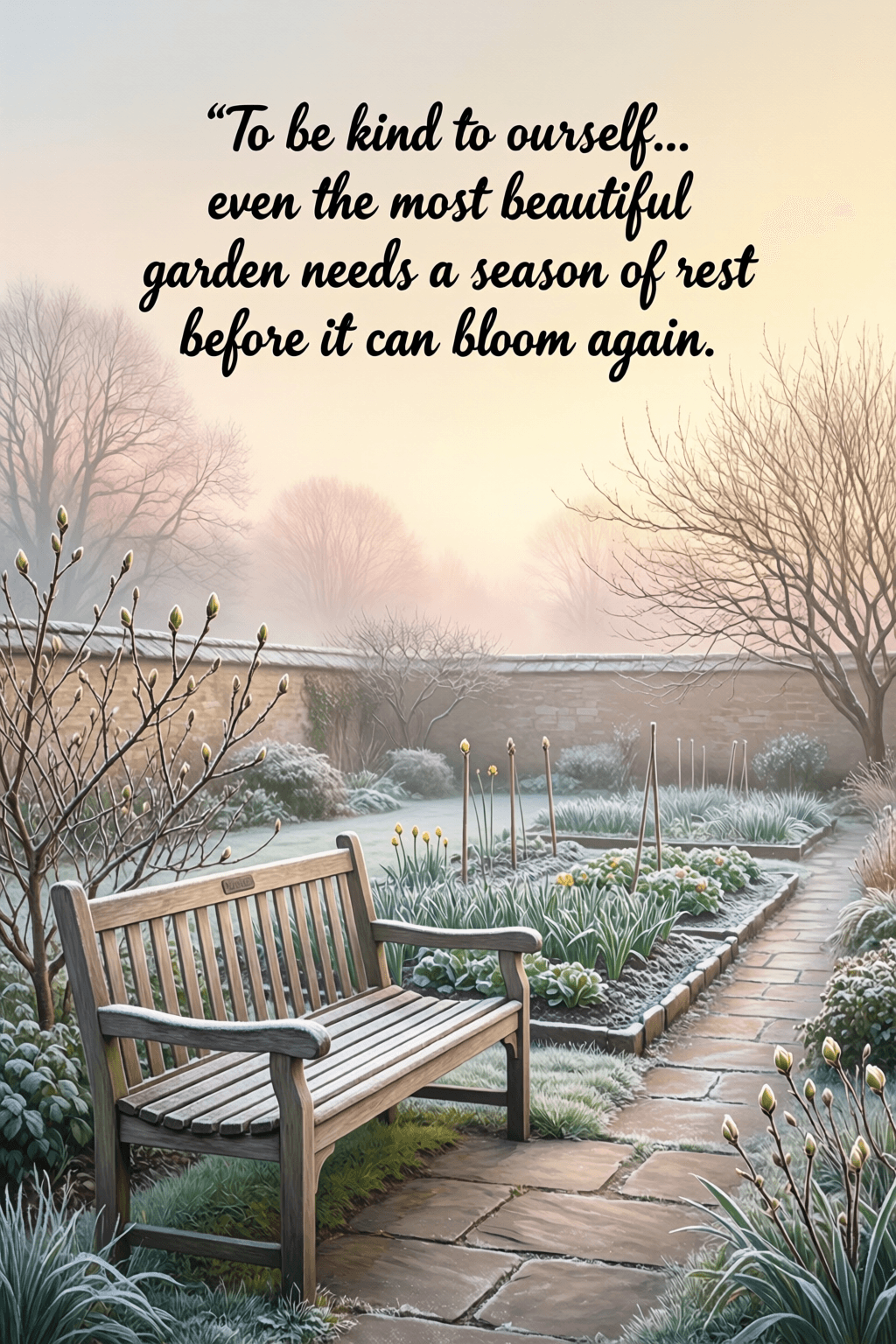
To be kind to oneself is to understand that even the most beautiful garden needs a season of rest before it can bloom again. — Thich Nhat Hanh
—What lingers after this line?
The Garden as Inner Life
At first glance, Thich Nhat Hanh’s image of the garden transforms self-kindness into something organic rather than indulgent. Just as a garden cannot flower endlessly without pause, the human spirit cannot remain productive, cheerful, or resilient without periods of renewal. In this way, the quote gently reframes rest as a natural condition for future growth, not a failure of effort. This metaphor is especially fitting because gardens require invisible work beneath the surface. Roots strengthen in stillness, soil recovers, and dormant life quietly prepares for return. Likewise, our minds and bodies often heal in ways that are not immediately visible, reminding us that worth is not measured only by outward bloom.
Rest as an Act of Compassion
From that foundation, the quote moves into a deeper moral insight: being kind to oneself means offering the same patience we would give to living things we cherish. Few people would scold a winter garden for lacking roses, yet many judge themselves harshly for exhaustion, sadness, or reduced capacity. Thich Nhat Hanh invites a gentler response—one rooted in understanding rather than criticism. This perspective echoes his broader teachings in works like Peace Is Every Step (1991), where mindfulness begins with accepting present reality without violence toward oneself. Consequently, rest becomes more than recovery; it becomes a compassionate acknowledgment that human beings, like nature, move through cycles they cannot entirely command.
Letting Go of Constant Bloom
Moreover, the quote quietly challenges modern ideals of perpetual output. Contemporary culture often praises nonstop achievement, treating pause as weakness or delay. Against this pressure, the garden metaphor offers a corrective: no landscape, however fertile, can sustain endless flowering. Periods of barrenness are not signs of defeat but phases of preparation. This idea has parallels in older wisdom traditions as well. Ecclesiastes 3 in the Hebrew Bible speaks of ‘a time to plant, and a time to pluck up what is planted,’ suggesting that life unfolds in appointed seasons rather than in uninterrupted ascent. Seen this way, self-kindness requires releasing the impossible demand to be in full bloom at all times.
Healing Through Mindful Acceptance
As the metaphor deepens, it also points toward healing. A garden in need of rest is not abandoned; it is being protected so that life may return in healthier form. Similarly, when we allow ourselves sleep, solitude, reflection, or emotional space, we are not withdrawing from life but tending to its conditions. What appears inactive may actually be restorative. Here Thich Nhat Hanh’s Buddhist sensibility becomes especially clear. In The Heart of the Buddha’s Teaching (1998), he emphasizes mindful awareness as a path toward easing suffering. Thus, self-kindness is not merely feeling better in the moment; it is learning to sit with one’s limits without shame, trusting that care itself is transformative.
The Promise of Blooming Again
Finally, the quote carries a quiet promise: rest is not the end of vitality but the prelude to its return. The garden rests precisely because blooming again is possible. This hopeful turn matters, because self-compassion is often misunderstood as resignation. In fact, Thich Nhat Hanh presents it as faith in renewal—an understanding that tenderness toward oneself creates the conditions for future flourishing. That is why the image lingers. It assures us that fallow seasons have meaning, and that pauses in strength, creativity, or joy need not be feared. By accepting our winters with kindness, we make room for spring to arrive in its own time.
Recommended Reading
As an Amazon Associate, we earn from qualifying purchases.
One-minute reflection
What feeling does this quote bring up for you?
Related Quotes
6 selectedRest is not a waste of time; it is the soil from which new life grows. — Thich Nhat Hanh
Thich Nhat Hanh
At first glance, Thich Nhat Hanh’s words challenge a deeply modern assumption that only visible productivity has value. By calling rest “the soil,” he shifts our attention from immediate output to the hidden conditions t...
Read full interpretation →Stopping, calming, and resting are preconditions for healing. — Thich Nhat Hanh
Thich Nhat Hanh
Thich Nhat Hanh’s statement places healing not in constant effort, but in the humble act of pausing. Before repair can happen, he suggests, the body and mind must first stop their habitual momentum.
Read full interpretation →Do not mistake exhaustion for a lack of talent; even the deepest wells need time to refill their waters. — Maya Angelou
Maya Angelou
At its core, Maya Angelou’s line asks us to make a crucial distinction: being drained is not the same as being deficient. People often interpret a season of low output as proof that they have lost their gifts, yet Angelo...
Read full interpretation →It is okay to rest. To recede. — Sanober Khan
Sanober Khan
At its heart, Sanober Khan’s line offers something many people struggle to grant themselves: permission. “It is okay to rest” does not frame rest as a reward for exhaustion or a luxury earned after productivity; instead,...
Read full interpretation →You don't have to earn your right to slow down. — Dr. Thema Bryant
Dr. Thema Bryant
At first glance, Dr. Thema Bryant’s line sounds simple, yet it quietly confronts a powerful modern belief: that rest must be justified by exhaustion, productivity, or achievement.
Read full interpretation →Rest is the sweet sauce of labor. — Plutarch
Plutarch
At first glance, Plutarch’s line turns work and rest into a simple culinary image: labor is the meal, and rest is the sauce that makes it satisfying. The point is not that work alone is noble or that rest alone is pleasu...
Read full interpretation →More From Author
More from Thich Nhat Hanh →To be fully alive is to allow yourself the grace of slowing down. — Thich Nhat Hanh
Thich Nhat Hanh’s words begin with a gentle challenge to modern life: we often mistake speed for vitality, as though being busy proves that we are truly living. Yet his insight reverses that assumption.
Read full interpretation →In the quiet of your own mind, you hold the power to reclaim your attention from the chaos of the world. — Thich Nhat Hanh
Thich Nhat Hanh’s words begin with a gentle but radical claim: the mind contains a quiet space that cannot be fully colonized by the world’s noise. Rather than portraying attention as something stolen forever by distract...
Read full interpretation →To find peace, you must stop trying to solve every problem at once. Sometimes the most productive thing you can do is simply breathe and be present. — Thich Nhat Hanh
At first glance, Thich Nhat Hanh’s insight challenges a habit many people mistake for responsibility: the need to solve every problem immediately. When the mind races from one worry to the next, it often creates more str...
Read full interpretation →Gratitude is not merely an emotion; it is the practice of noticing the quiet light that persists, even when the world feels loud and uncertain. — Thich Nhat Hanh
At first glance, gratitude may seem like a simple emotional response to good fortune. Yet Thich Nhat Hanh reframes it as a discipline of attention, suggesting that thankfulness is less about waiting for ideal circumstanc...
Read full interpretation →