
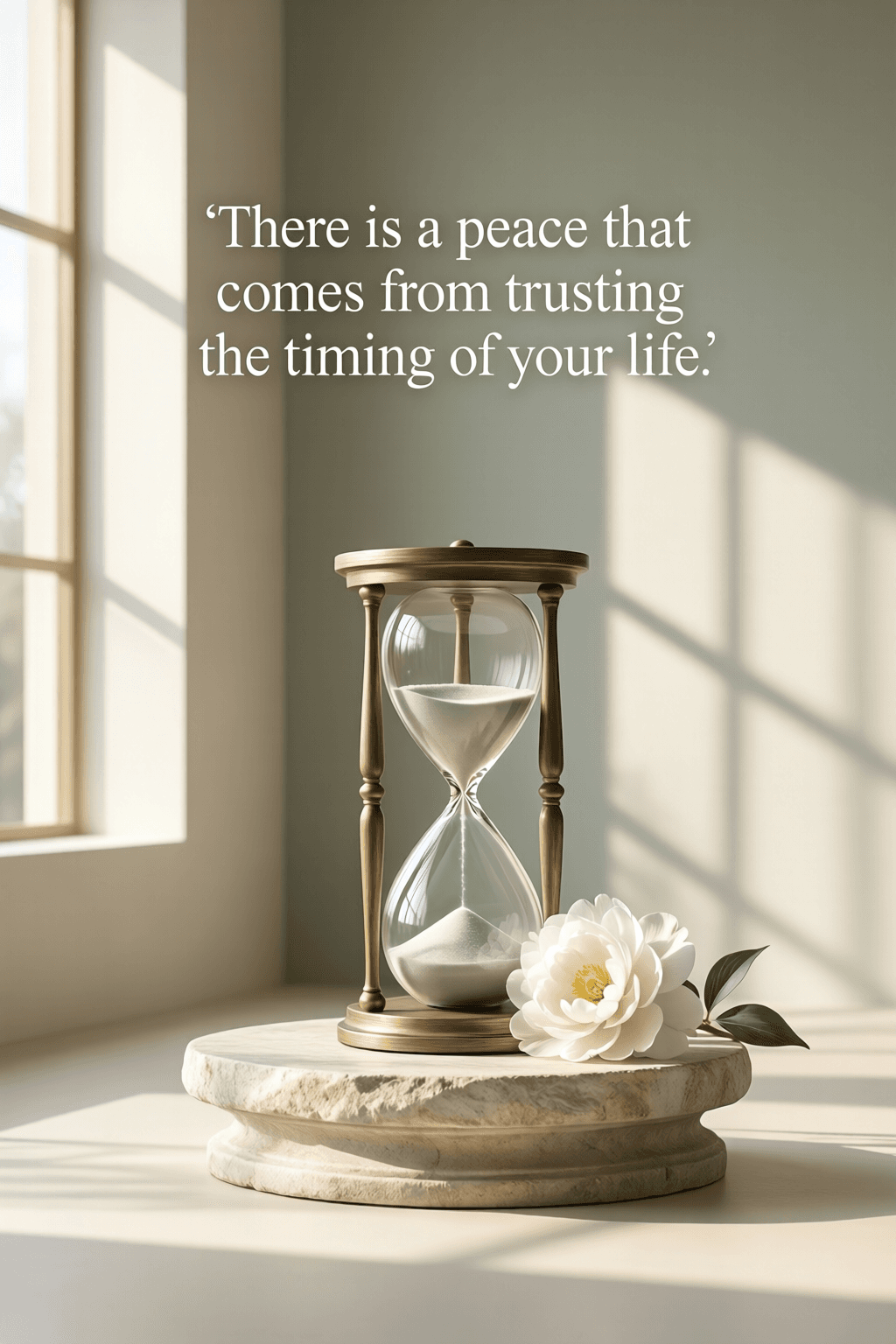
There is a peace that comes from trusting the timing of your life. — Sonia Ricotti
—What lingers after this line?
The Quiet Wisdom of Surrender
At its heart, Sonia Ricotti’s line suggests that peace does not always come from controlling outcomes, but from releasing the demand to force them. Trusting the timing of your life means accepting that not every door opens when you want it to, and that delays are not automatically failures. In this way, peace emerges not from certainty, but from a gentler relationship with uncertainty. This idea shifts the focus from constant striving to patient confidence. Rather than reading every setback as a sign that life is off course, Ricotti invites us to see pauses and detours as part of a larger unfolding. As a result, emotional calm becomes possible even when answers have not yet arrived.
Patience as an Active Strength
From there, the quote deepens into a redefinition of patience. Patience is often mistaken for passivity, yet trusting timing requires real inner discipline: the ability to keep showing up without immediate reward. Much like the farmer in Ecclesiastes 3:1—“To everything there is a season”—one learns that growth cannot be rushed simply because desire is intense. Consequently, this trust becomes a form of strength rather than resignation. It allows a person to work, hope, and prepare while still accepting that some results depend on conditions beyond personal control. In that balance between effort and waiting, a steadier kind of peace begins to take root.
How Delays Can Become Meaningful
Moreover, Ricotti’s thought encourages a different interpretation of delay itself. What first appears to be lost time may later reveal itself as preparation. Many memoirs and biographies carry this pattern: J.K. Rowling has spoken about periods of hardship before Harry Potter’s success, and those years, difficult as they were, shaped both her voice and resilience. Seen this way, timing is not merely about when events happen, but about who we become before they do. A postponed opportunity can refine judgment, deepen empathy, or redirect ambition toward something more fitting. Therefore, peace grows when we stop asking only, “Why not now?” and begin asking, “What might this season be teaching me?”
Freedom from Comparison
Just as importantly, trusting your own timing loosens the grip of comparison. Much anxiety comes from measuring life against other people’s milestones—someone else’s career, marriage, recognition, or apparent certainty. Yet Ricotti’s words remind us that lives do not ripen on identical schedules, and comparing chapters across different stories only breeds restlessness. In contrast, peace arrives when personal worth is no longer tied to being early, fast, or visibly successful. As Alain de Botton notes in The Pleasures and Sorrows of Work (2009), modern life often intensifies status anxiety by making comparison constant. Trusting timing becomes a quiet act of resistance, allowing a person to honor a path that unfolds at its own rightful pace.
A More Compassionate Way to Live
Ultimately, the quote points toward self-compassion. To trust the timing of your life is to stop treating yourself as a project that has fallen behind and to start regarding yourself as a human being in process. This perspective does not deny disappointment; instead, it softens it with the belief that meaning can still emerge from what is unfinished. Finally, that is where the promised peace resides: not in having every plan confirmed, but in meeting life with steadiness, humility, and hope. By accepting that some things bloom later than expected, we make room for a deeper calm—one grounded in trust that our lives may still be unfolding exactly as they need to.
One-minute reflection
What's one small action this suggests?
Related Quotes
6 selectedIf it costs my peace, it's outside my boundary. — Adam J. Jackson
Adam J. Jackson
At its core, Adam J. Jackson’s line reframes boundaries as more than rules we impose on others; they become protections for our inner life.
Read full interpretation →Like water which can clearly mirror the sky and the trees only so long as its surface is undisturbed, the mind can only reflect the true image of the Self when it is tranquil and wholly relaxed. — Indra Devi
Indra Devi
Indra Devi begins with a simple natural image: calm water reflects the sky and trees only when its surface is still. In the same way, she suggests that the mind reveals truth not through strain or agitation, but through...
Read full interpretation →Sometimes, protecting your peace is the better choice. — Marcus Aurelius
Marcus Aurelius
At first glance, the saying frames peace not as passivity but as discipline. To protect one’s peace is to recognize that not every conflict deserves entry into the mind.
Read full interpretation →Never be in a hurry; do everything quietly and in a calm spirit. Do not lose your inner peace for anything whatsoever. — Saint Francis de Sales
Saint Francis de Sales
At first glance, Saint Francis de Sales offers simple advice about slowing down, yet his counsel reaches far beyond time management. In urging us never to be in a hurry, he frames haste as a spiritual danger: it scatters...
Read full interpretation →We are not rest-filled people who occasionally become restless; we are restless people who sometimes find rest. — Henri J. M. Nouwen
Henri J.M. Nouwen
Henri J. M.
Read full interpretation →A rational person can find peace by cultivating indifference to things outside of their control. — Naval Ravikant
Naval Ravikant
At its heart, Naval Ravikant’s statement echoes a classic Stoic principle: inner peace grows when we stop attaching our well-being to events we cannot govern. Rather than encouraging apathy toward life itself, this kind...
Read full interpretation →More From Author
More from Sonia Ricotti →