
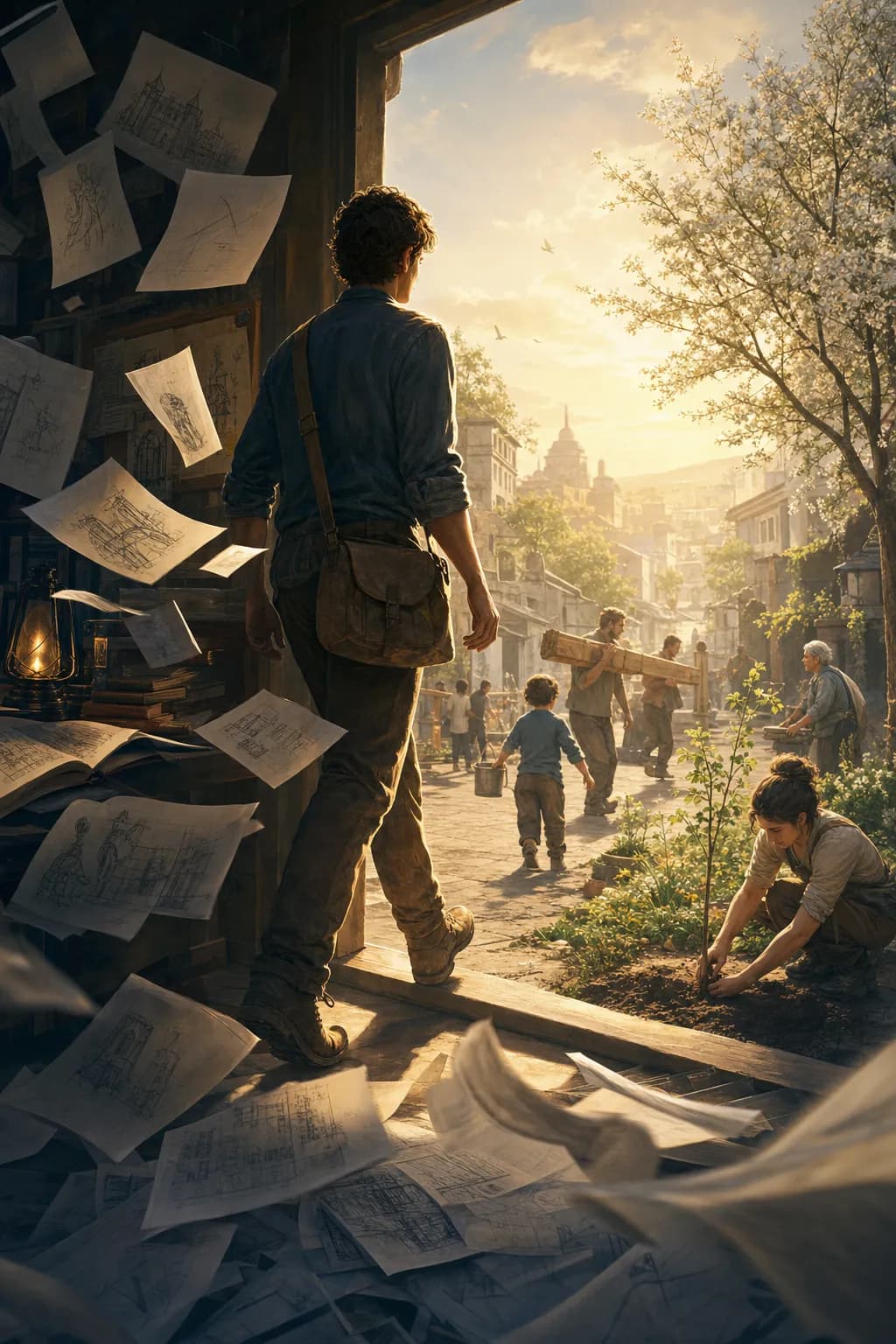
It is by acts and not by ideas that people live. — Anatole France
—What lingers after this line?
The Primacy of Doing
At its core, Anatole France’s remark argues that life is sustained by what people actually do, not merely by what they think or proclaim. Ideas may inspire, guide, or justify, yet they remain inert until translated into conduct. In this sense, he shifts attention from abstract conviction to lived behavior, suggesting that reality is shaped less by belief alone than by repeated action.
Ideas Need Embodiment
From there, the quote invites a crucial distinction: ideas matter, but only when they are embodied. A person may admire justice, generosity, or courage in theory, yet those values become socially meaningful only through decisions and habits. Aristotle’s Nicomachean Ethics (4th century BC) similarly presents virtue as something formed through practice, not possession in the abstract.
Daily Life as the True Measure
Consequently, the saying speaks most clearly in ordinary life, where survival and dignity depend on concrete efforts. Families are supported by work, friendships are maintained by attention, and communities are strengthened by participation rather than sentiment. In that way, France points to a practical truth: people are nourished by bread baked, care given, and promises kept—not by admirable thoughts left unrealized.
A Quiet Critique of Intellectualism
At the same time, the statement can be read as a subtle warning against excessive faith in pure theory. History offers many examples of elegant systems that failed when confronted with human complexity, whereas modest, humane acts often achieved lasting good. Charles Dickens’s Bleak House (1853) repeatedly contrasts lofty talk with tangible kindness, showing how real relief comes through intervention rather than rhetoric.
Action as Moral Evidence
Moreover, actions reveal character with a clarity that ideas alone rarely can. People may profess noble principles, but their conduct under pressure exposes what they truly value. This is why moral traditions so often judge individuals by deeds: in the Christian Epistle of James 2:17, for instance, 'faith by itself, if it does not have works, is dead,' reinforcing the notion that inward belief gains force only through outward expression.
Living Thoughtfully Through Deeds
Finally, Anatole France does not necessarily dismiss ideas; rather, he places them in their proper sequence. Thought begins the process, but action completes it, turning possibility into lived experience. Thus the quote becomes less an attack on thinking than a call to integrity: if ideas are to matter, they must enter the world through deeds that sustain, protect, and transform human life.
One-minute reflection
Why might this line matter today, not tomorrow?
Related Quotes
6 selectedTo accomplish great things, we must not only act, but also dream; not only plan, but also believe. — Anatole France
Anatole France
This quote emphasizes the importance of dreams and vision in achieving greatness. Dreaming allows us to envision possibilities and set ambitious goals.
Read full interpretation →Action is the foundational key to all success. — Pablo Picasso
Pablo Picasso
This quote emphasizes that taking action is crucial for achieving success. Without action, plans, dreams, and ideas remain unfulfilled.
Read full interpretation →Well done is better than well said. — Benjamin Franklin, United States. This quote emphasizes the importance of taking action rather than just talking about ideas, making it a powerful inspiration for a striking visual representation.
Benjamin Franklin, United States. This quote emphasizes the importance of taking action rather than just talking about ideas, making it a powerful inspiration for a striking visual representation.
This quote highlights the idea that actions carry more weight than mere statements. It suggests that what we do is more significant than what we say we will do.
Read full interpretation →The way to do a great deal is to keep on doing a little. The way to do nothing at all is to be continually resolving that you will do everything. — C.H. Spurgeon
C.H. Spurgeon
Spurgeon’s statement begins with a practical paradox: great accomplishments are rarely born from dramatic bursts of effort, but from the steady repetition of small acts. By saying that “a great deal” is done by “doing a...
Read full interpretation →Instead of seeing philosophy as an end to which one aspires, see it as something one applies. Not occasionally, but over the course of a life—making incremental progress along the way. — Ryan Holiday
Ryan Holiday
Ryan Holiday’s point begins by shifting philosophy away from the pedestal. Rather than treating it as a distant intellectual achievement, he frames it as a tool meant to be used in ordinary life.
Read full interpretation →No matter how full a reservoir of maxims one may possess, if one has not taken advantage of every concrete opportunity to act, one's character may remain entirely unaffected. — William James
William James
At first glance, William James draws a sharp line between knowing and becoming. A person may store up countless moral sayings, noble principles, and wise resolutions, yet these remain largely ornamental if they never pas...
Read full interpretation →More From Author
More from Anatole France →To accomplish great things, we must not only act, but also dream; not only plan, but also believe. — Anatole France
This quote emphasizes the importance of dreams and vision in achieving greatness. Dreaming allows us to envision possibilities and set ambitious goals.
Read full interpretation →Until one has loved an animal, a part of one's soul remains unawakened. — Anatole France
This quote highlights the deep emotional and spiritual bond that can be formed between humans and animals, suggesting that such connections can profoundly enrich one's life.
Read full interpretation →I prefer the errors of enthusiasm to the indifference of wisdom. — Anatole France
France extols energetic involvement over detached wisdom, suggesting that active participation in life—though it may lead to mistakes—is preferable to a cold, impartial existence. This philosophy resonates with the spiri...
Read full interpretation →If the path be beautiful, let us not ask where it leads. — Anatole France
Anatole France’s words call us to savor the beauty in our current journey rather than worry about its outcome. In a world preoccupied with goals and destinations, this quote encourages mindfulness and presence.
Read full interpretation →