
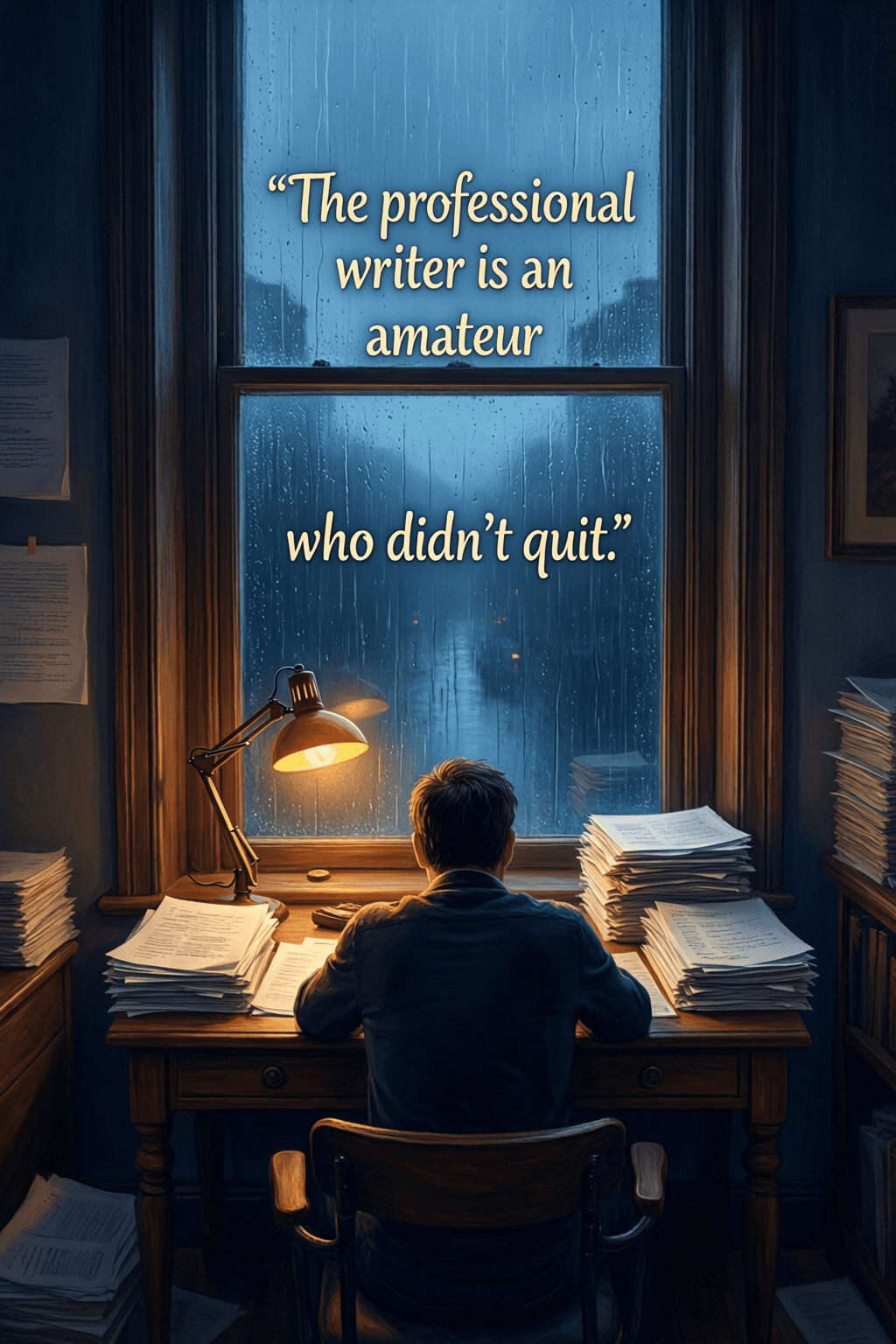
The professional writer is an amateur who didn't quit. — Richard Bach
—What lingers after this line?
The Core Idea of Endurance
Richard Bach’s line reframes professionalism in a strikingly democratic way: the difference between an amateur and a professional may be less about innate genius than about staying power. At its heart, the quote suggests that mastery often belongs to the person who keeps showing up, revising, failing, and trying again long after others have stopped. In that sense, the statement quietly dismantles romantic myths about talent. Rather than presenting the professional writer as a rare, finished creature, Bach presents one as a persistent beginner—someone who remains willing to learn. The amateur does not become professional by ceasing to be imperfect, but by refusing to abandon the work.
Talent Matters Less Than Practice
From this starting point, the quote naturally shifts attention from inspiration to routine. Many aspiring writers imagine that professionals possess a superior spark, yet writers from Anthony Trollope to Stephen King have emphasized regular practice over waiting for ideal conditions. Trollope’s Autobiography (1883) famously describes writing by the clock, turning craft into habit rather than mystery. Consequently, Bach’s remark highlights a truth seen in many fields: repetition builds fluency. What first appears to be natural polish is often the accumulated result of thousands of ordinary sessions. The professional, then, is frequently just the amateur who kept practicing until skill looked effortless.
Failure as Part of the Apprenticeship
Just as importantly, not quitting means enduring rejection without letting it define identity. Literary history is full of such examples: Beatrix Potter faced repeated refusals before The Tale of Peter Rabbit (1902) found publication, and Stephen King famously discarded early drafts and collected rejection slips before succeeding. These stories matter because they expose failure not as an exception, but as a stage of development. Therefore, Bach’s line carries an implicit lesson about emotional resilience. The amateur who continues is not spared disappointment; rather, that person learns to metabolize it. Each failed submission, clumsy paragraph, or abandoned idea becomes less a verdict and more a lesson in craft.
Professionalism as a Mindset
Building on that, the quote also broadens the meaning of the word professional. It does not merely refer to payment or status, but to a disciplined relationship with one’s work. A professional returns to the desk, meets deadlines, revises honestly, and treats improvement as an ongoing responsibility. In this view, professionalism begins internally before it is confirmed externally. This perspective echoes Brenda Ueland’s If You Want to Write (1938), which encourages writers to protect their creative impulse while still doing the labor that expression requires. Thus, Bach’s phrase suggests that the crossing from amateur to professional is gradual: it happens through habits of seriousness, not through a single moment of recognition.
A Wider Lesson Beyond Writing
Finally, although Bach speaks of writers, the insight travels easily beyond literature. Musicians, athletes, researchers, and entrepreneurs often advance in the same unspectacular way—through sustained effort that outlasts discouragement. Angela Duckworth’s Grit (2016) popularized this idea by arguing that perseverance and passion over time often predict achievement more reliably than raw ability alone. Seen this way, the quote becomes both encouragement and challenge. It reassures beginners that excellence is not reserved for the naturally gifted, yet it also insists on stamina as the price of growth. The professional writer, Bach implies, is not someone untouched by amateurism, but someone who stayed with it long enough to transform it into craft.
One-minute reflection
What does this quote ask you to notice today?
Related Quotes
6 selectedConsistency is the jewel worth wearing; it is the anchor worth weighing; it is the thread worth weaving. — Charles Swindoll
Charles Swindoll
At first glance, Charles Swindoll’s line turns consistency into three vivid objects: a jewel, an anchor, and a thread. Each image adds a different dimension to the same virtue.
Read full interpretation →Don't worry about being brilliant; just be consistent. The world is built by people who showed up even when they didn't feel like it. — James Clear
James Clear
At its core, James Clear’s quote pushes back against the modern obsession with exceptional talent. Rather than glorifying brilliance, it elevates consistency—the humble act of returning to the work again and again.
Read full interpretation →The brick walls are there for a reason... to give us a chance to show how badly we want something. — Randy Pausch
Randy Pausch
At first glance, Randy Pausch’s line turns frustration into meaning. Rather than treating barriers as pointless interruptions, he frames them as tests that reveal the seriousness of our intentions.
Read full interpretation →There is no royal road to anything. One thing at a time, all things in succession. That which grows fast, withers as rapidly. That which grows slowly, endures. — J. G. Holland
J. G. Holland
J. G.
Read full interpretation →When you have a difficult task, if you only work a little at a time, every day a little, the work will finish itself. — Isak Dinesen
Isak Dinesen
At its core, Isak Dinesen’s remark transforms a daunting truth into a practical comfort: difficult work becomes less frightening when it is broken into modest, repeatable steps. Rather than demanding heroic bursts of eff...
Read full interpretation →The secret to mastery is not a giant leap, but the quiet, relentless rhythm of showing up when the light is dim. — T.S. Eliot
T. S. Eliot
At first glance, the quote overturns the popular fantasy that mastery arrives through a single breakthrough. Instead, it presents excellence as something quieter: the repeated act of returning to the work, especially whe...
Read full interpretation →More From Author
More from Richard Bach →The bond that links your true family is not one of blood, but of respect and joy in each other's life. — Richard Bach
Richard Bach’s line begins by quietly overturning a default assumption: that family is primarily a biological fact. Instead, he proposes a relational definition—“true family” is recognized not by shared DNA but by the qu...
Read full interpretation →The more I want to get something done, the less I call it work. — Richard Bach
This quote reflects the idea that when you're deeply passionate about a task, it stops feeling like a chore or obligation. The desire to complete it out of personal interest or fulfillment erases the sensation of it bein...
Read full interpretation →Here is the test to find whether your mission on Earth is complete. If you're alive, it isn't. — Richard Bach
The quote implies that as long as one is alive, their purpose or mission is ongoing. Life is seen as a continuous journey with always something more to achieve or experience.
Read full interpretation →You are always free to change your mind and choose a different future, or a different past. — Richard Bach
This quote highlights the human capacity to make choices at any moment. It emphasizes that we are not stuck with our current beliefs, decisions, or future, but are always free to make new choices.
Read full interpretation →