
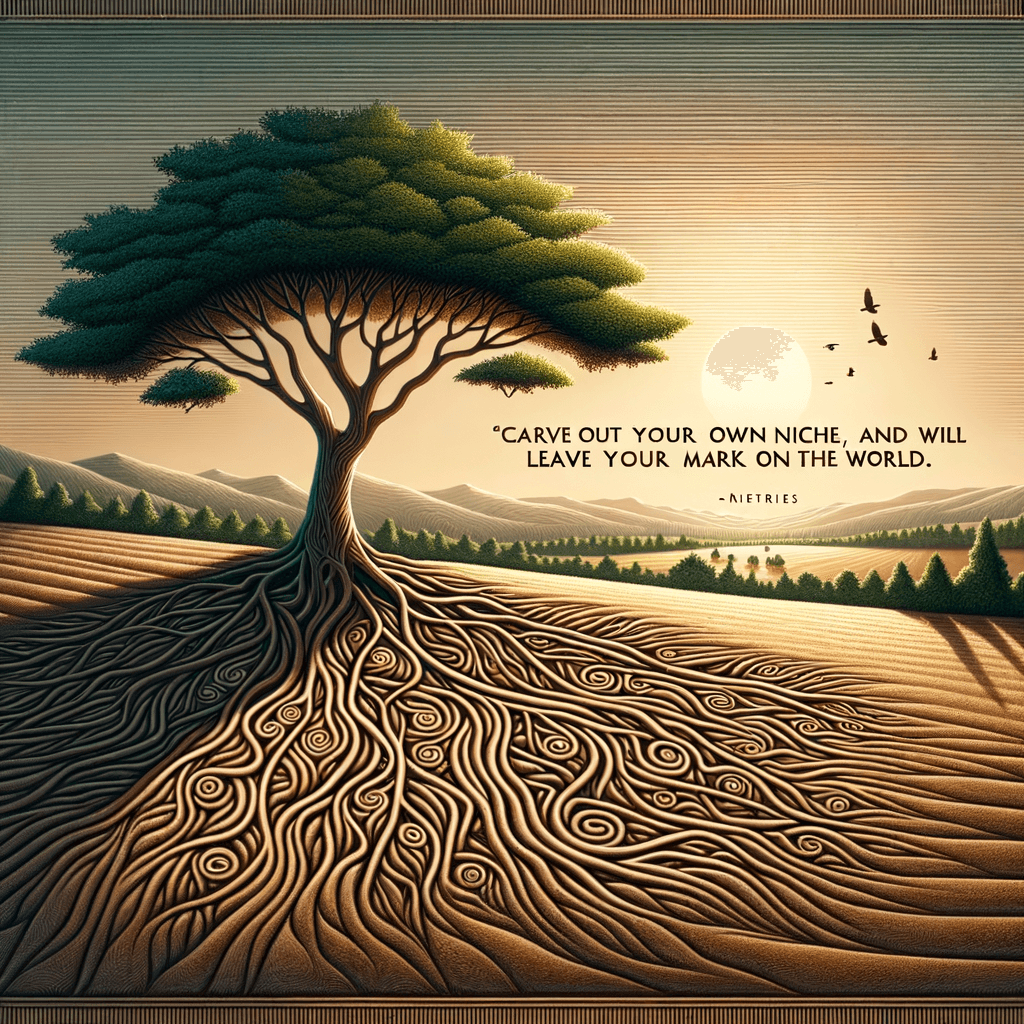
Carve out your own niche, and you will leave your mark on the world. — Nigerian Proverb
—What lingers after this line?
Individuality and Uniqueness
This proverb emphasizes the importance of embracing one's individuality and creating a unique path in life. By doing so, one can make a significant impact on the world.
Innovation and Creativity
It highlights the value of innovation and creativity. Discovering and cultivating a niche allows individuals to offer something new and valuable that stands out.
Personal Fulfillment
Finding and working in one's niche can lead to personal satisfaction and fulfillment. It encourages people to pursue their passions and strengths.
Legacy and Influence
The proverb suggests that those who carve out their own niche leave a lasting legacy. Their unique contributions can influence future generations and inspire others.
Cultural Wisdom
Nigerian proverbs often carry deep wisdom and practical life lessons. This one reflects the cultural value placed on individuality, resourcefulness, and the importance of making one's mark in society.
One-minute reflection
What does this quote ask you to notice today?
Related Quotes
6 selectedBe a voice, not an echo; let your individuality resonate and inspire others to find their own. — Unknown.
Unknown
This quote emphasizes the importance of being true to oneself. It encourages people to express their unique thoughts and feelings rather than merely repeating what others say.
Read full interpretation →Children do not need us to shape them. They need us to respond to who they are. — Naomi Aldort
Naomi Aldort
Naomi Aldort’s statement begins by rejecting a familiar adult impulse: the desire to mold children into predetermined forms. Instead, she proposes a quieter and more demanding task—paying attention to the person already...
Read full interpretation →If the family were a fruit, it would be an orange, a circle of sections, held together but separable—each segment distinct. — Letty Cottin Pogrebin
Letty Cottin Pogrebin
At first glance, Letty Cottin Pogrebin’s image feels simple, yet it captures family structure with unusual precision. By comparing a family to an orange, she evokes something whole, rounded, and naturally unified.
Read full interpretation →You're born an original—don't die a copy. — John Mason
John Mason
At its core, John Mason’s line is a sharp reminder that every person begins life with a distinct combination of temperament, talent, and perspective. To be “born an original” suggests that individuality is not something...
Read full interpretation →The beauty of a life well-lived is measured by the depth of the roots you grow into the lives of those standing right beside you. — Wendell Berry
Wendell Berry
At first glance, Wendell Berry shifts our idea of a successful life away from personal achievement and toward human closeness. The beauty of living well, he suggests, is not counted in status, wealth, or visibility, but...
Read full interpretation →The things that you do for yourself are gone when you are gone, but the things that you do for others remain as your legacy. — Kalu K. Ndukwe Kalu
Kalu K. Ndukwe Kalu
At its heart, Kalu K. Ndukwe Kalu’s quote redirects attention from personal gain to shared impact.
Read full interpretation →More From Author
More from Nigerian Proverb →To reach the stars, you must take the first step on the ground. — Nigerian Proverb
This proverb highlights that every great achievement begins with a small step. No matter how ambitious your goals are, progress is only possible if you start from where you are.
Read full interpretation →Do not give up, the beginning is always the hardest. — Nigerian Proverb
The Nigerian proverb, 'Do not give up, the beginning is always the hardest,' captures a universal truth about starting anew. Whether embarking on a new job, learning a skill, or forming a relationship, initial steps are...
Read full interpretation →Resistance is fertile; endurance is a seed. — Nigerian Proverb
At its core, the Nigerian proverb 'Resistance is fertile; endurance is a seed' uses agricultural metaphors to convey the value of perseverance. 'Fertile' land is rich with possibilities, while a 'seed' embodies future po...
Read full interpretation →The future is no place to place your better days. — Nigerian Proverb
At first glance, the Nigerian proverb, 'The future is no place to place your better days,' offers succinct but profound advice about the dangers of deferring happiness. Rather than treating the future as a magical reposi...
Read full interpretation →