
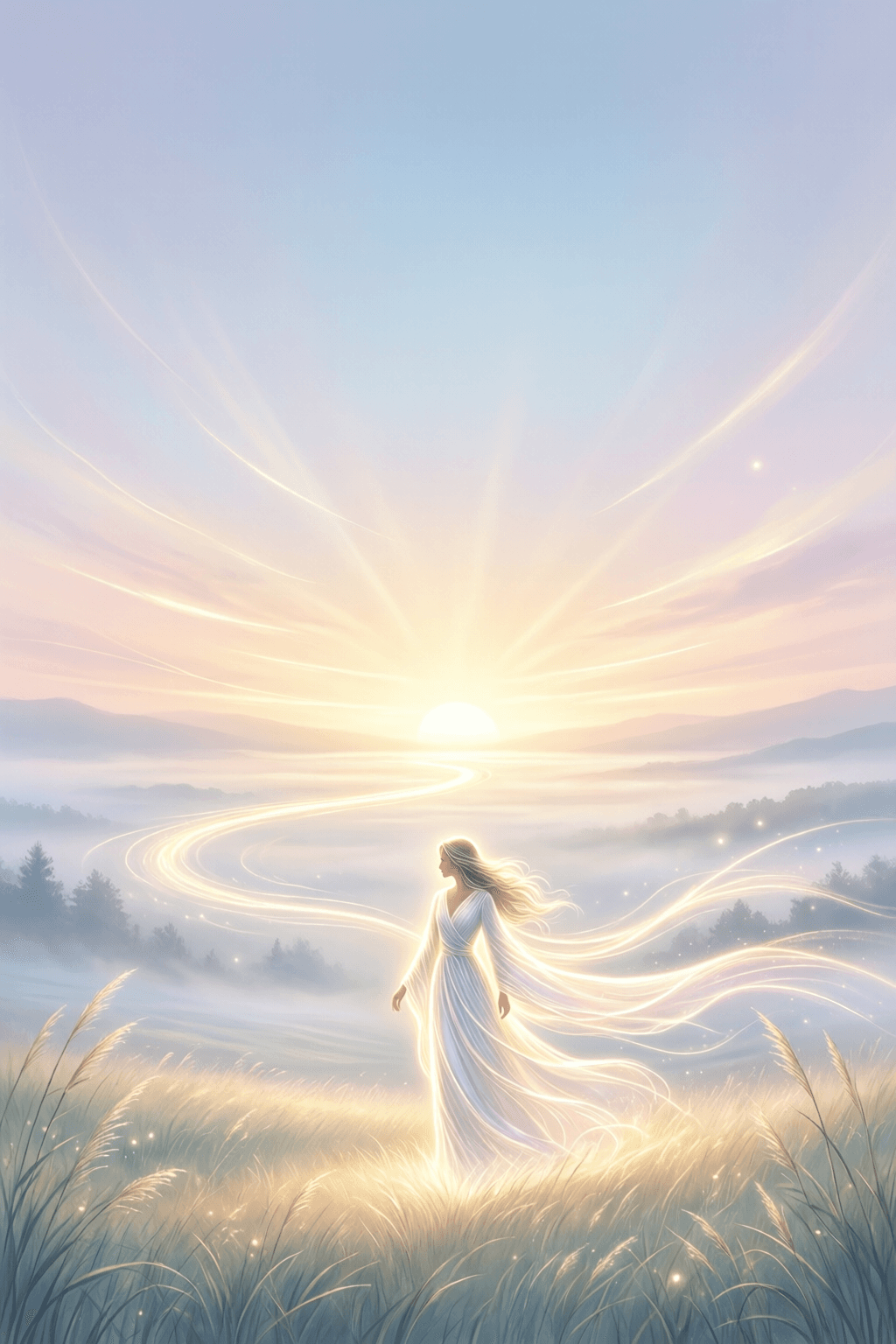
You were born a child of light's wonderful secret—you return to the beauty you have always been. — Aberjhani
—What lingers after this line?
A Sacred Origin
At its heart, Aberjhani’s line begins with a reassuring claim about human identity: we are born not in spiritual emptiness, but as “a child of light’s wonderful secret.” In other words, the self is rooted in something radiant, mysterious, and inherently meaningful. Rather than treating worth as something earned later through success or approval, the quote frames it as an original inheritance. From this starting point, the rest of the statement gains its power. If beauty is native to our being, then life’s task is not to manufacture value from nothing, but to remember what has always been there. The image of light suggests purity, hope, and inner illumination, all of which make the quote feel less like praise and more like revelation.
The Meaning of Return
Just as importantly, Aberjhani does not say we become beautiful for the first time; he says we “return” to the beauty we have always been. This subtle shift changes the message from transformation to restoration. It implies that the damage of life—grief, shame, fear, or alienation—may conceal our essence without ever fully destroying it. Consequently, the quote offers comfort to those who feel lost from themselves. It echoes spiritual traditions in which awakening is a form of remembrance; for instance, Plato’s theory of recollection in dialogues like the *Meno* (c. 380 BC) suggests that truth is recovered rather than newly invented. Here too, beauty is not acquired externally but rediscovered inwardly.
Light as a Spiritual Symbol
Moreover, the symbolism of light carries the quote beyond simple optimism into the realm of the sacred. Across traditions, light often represents divine presence, wisdom, and the soul’s deepest clarity. The Gospel of John 8:12 calls light a guide through darkness, while Sufi poetry by Jalal al-Din Rumi frequently treats illumination as the unveiling of one’s true nature. Seen in that context, Aberjhani’s wording suggests that each person bears a hidden radiance that earthly confusion can dim but not extinguish. Therefore, the “wonderful secret” is not merely that beauty exists, but that it persists. Even in obscurity, the self remains connected to a luminous source.
Healing Through Self-Recognition
From there, the quote naturally speaks to healing. Many people spend years trying to fix themselves, as though brokenness were their most essential truth. Aberjhani offers a gentler alternative: healing may begin when we stop defining ourselves by wounds and start recognizing the beauty that survived them. In this sense, the line resembles insights from Maya Angelou’s autobiographical work *I Know Why the Caged Bird Sings* (1969), where dignity endures despite trauma. The journey back to oneself is not naïve denial of pain; rather, it is the refusal to let pain become the whole story. Thus, return becomes an act of reclamation.
A Message of Hope and Identity
Finally, the quote endures because it joins hope with identity. It does not merely promise that things will get better; it insists that beneath confusion, there is already something whole, beautiful, and enduring. That assurance can be deeply empowering in moments of transition, when people wonder whether they have strayed too far from who they meant to be. As a result, Aberjhani’s words read like both blessing and reminder. They suggest that the path forward may actually be a path inward, back toward an original beauty that has waited patiently beneath every hardship. In that return, the self is not remade so much as recognized.
Recommended Reading
As an Amazon Associate, we earn from qualifying purchases.
One-minute reflection
What feeling does this quote bring up for you?
Related Quotes
6 selectedBelieve you are a light and then be that light. — Unknown
Unknown
This quote emphasizes the importance of having faith in oneself. It suggests that the first step to becoming a positive force in the world is to believe in your own potential to make a difference.
Read full interpretation →Art and love are the same thing: it's the process of seeing yourself in things that are not you. — Chuck Klosterman
Chuck Klosterman
At first glance, Chuck Klosterman’s line collapses two vast experiences into one elegant idea: both art and love involve recognizing ourselves in something outside us. In this sense, a painting, a song, or another person...
Read full interpretation →The entrance door to the sanctuary is inside you. — Stephen Levine
Stephen Levine
Stephen Levine’s line turns the idea of sanctuary inward, suggesting that refuge is not primarily a place we travel to but a condition we awaken within ourselves. At first glance, the image is simple: a door leading to s...
Read full interpretation →Don't wait until you know who you are to get started. — Austin Kleon
Austin Kleon
Austin Kleon’s line challenges a common hesitation: the belief that we must first discover a fixed, authentic self before we can begin meaningful work. Instead, he implies that identity is not a prerequisite for action b...
Read full interpretation →Adversity is like a strong wind. It tears away from us all but the things that cannot be torn, so that we see ourselves as we really are. — Arthur Golden
Arthur Golden
Arthur Golden frames adversity as a strong wind, and the image is precise because wind does not politely inspect us—it strips, shakes, and exposes. In that sense, hardship removes the accessories of identity: status, rou...
Read full interpretation →Your soul isn't gone; it's just waiting for you to slow down and find it again. — Sam Keen
Sam Keen
Sam Keen’s line begins by refusing panic: the soul is not destroyed or stolen, only misplaced in the rush of living. That shift matters because it turns a story of permanent loss into one of possible return.
Read full interpretation →More From Author
More from Aberjhani →