
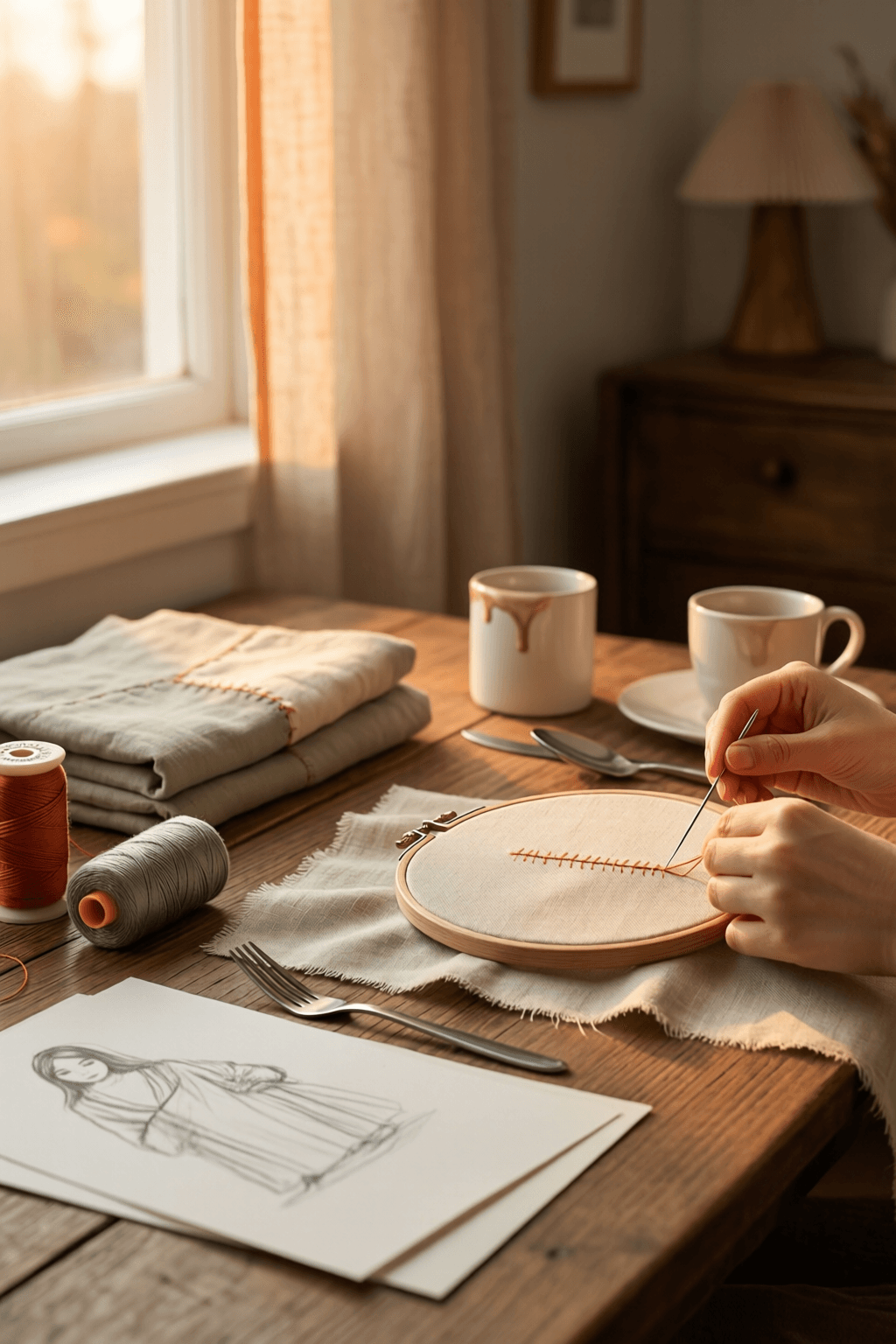
The artist must elect to fight for the beauty of the work, stitch by patient stitch, against the rush of the world. — Ursula K. Le Guin
—What lingers after this line?
Choosing Beauty Against Speed
Ursula K. Le Guin’s line begins with a deliberate verb: the artist must “elect.” In other words, beauty is not an accident or a luxury but a conscious choice made in resistance to haste. By framing art as something defended “against the rush of the world,” she suggests that modern life constantly pressures creators to value quick output over careful making. From the start, then, her image turns artistic labor into a moral stance. The artist is not merely producing an object but protecting a standard of attention. In this view, beauty emerges not from convenience but from the refusal to let urgency dictate form.
The Meaning of Patient Stitching
Le Guin’s phrase “stitch by patient stitch” brings the texture of handcraft into the heart of artistic creation. Rather than imagining genius as sudden inspiration, she emphasizes accumulation: one decision, one revision, one careful joining at a time. This metaphor recalls traditions such as quilting, embroidery, and mending, where beauty is inseparable from patience and precision. As a result, the quote broadens our idea of artistry itself. A novel, painting, song, or ceramic vessel is not simply expressed; it is assembled through repeated acts of care. What looks effortless in the finished work often rests on invisible discipline.
Art as Resistance to Modern Urgency
From there, the quote takes on a wider cultural meaning. The “rush of the world” evokes deadlines, markets, distraction, and the constant demand to be instantly visible. In that climate, slowness can appear inefficient, yet Le Guin reverses the judgment: haste is the threat, while patience is the safeguard of quality. This perspective aligns with broader critiques of industrial and digital speed. For instance, the Arts and Crafts movement associated with William Morris in the late 19th century defended skilled workmanship against mass production. Similarly, Le Guin implies that genuine art preserves human depth precisely by refusing to move at the world’s most frantic pace.
Beauty as Ethical Commitment
Yet Le Guin does not speak of beauty as mere decoration. By saying the artist must “fight for” it, she gives beauty ethical weight. The struggle suggests that beautiful work requires loyalty to truth, integrity, and form even when shortcuts are easier or more profitable. In this light, beauty becomes a discipline of respect—respect for the material, the audience, and the work’s own potential. John Keats’s famous “Beauty is truth, truth beauty” from “Ode on a Grecian Urn” (1819) offers a useful echo, though Le Guin is more practical and less idealized. For her, beauty is not simply contemplated; it is defended through labor.
The Hidden Courage of Craft
Consequently, the quote honors a kind of courage that often goes unnoticed. Artistic struggle is commonly imagined as dramatic rebellion, but Le Guin points instead to endurance: staying with the work, revising what fails, and continuing when recognition is absent. The fight she describes is quiet, repetitive, and inward, yet no less real. This idea fits her broader literary sensibility. In essays such as those collected in The Wave in the Mind (2004), Le Guin repeatedly values craft, responsibility, and attentiveness over spectacle. The artist’s bravery, then, lies not only in originality but in sustained fidelity to what the work asks to become.
Why the Quote Still Resonates
Finally, Le Guin’s words remain powerful because they speak directly to a culture of acceleration. Today creators are often pushed to post constantly, finish quickly, and measure worth through immediacy. Against that pressure, her sentence offers a different ideal: meaningful work takes time, and taking time is not failure but commitment. The quote therefore becomes more than advice for artists alone. It speaks to anyone who wants to make something well—whether a story, a garden, a lesson plan, or a life. In every case, beauty survives when someone is willing to protect it patiently, stitch by patient stitch.
One-minute reflection
What feeling does this quote bring up for you?
Related Quotes
6 selectedThe beauty of craftsmanship is that it is a dialogue with time, a slow resistance against the rush of the world. — Richard Sennett
Richard Sennett
At its core, Richard Sennett’s line presents craftsmanship as more than skilled labor; it becomes a moral and temporal stance. To make something carefully is to refuse the culture of haste, where speed is often mistaken...
Read full interpretation →Patience is not passive waiting. Patience is active acceptance of the process required to attain your goals and dreams. — Ray Davis
Ray Davis
Ray Davis’s words begin by correcting a common misunderstanding: patience is not the same as doing nothing. Passive waiting suggests resignation, as if time alone will deliver success.
Read full interpretation →Slow progress today is often stable progress tomorrow. Fast growth collapses easily. Slow growth holds. — Timeless Type
Timeless Type
At first glance, slow progress can feel discouraging, especially in a culture that praises speed, sudden breakthroughs, and visible success. Yet the quote reminds us that what seems unimpressive today may become the foun...
Read full interpretation →Sometimes you have to slow down to go fast. — Jeff Olson
Jeff Olson
Jeff Olson’s line begins with a practical paradox: speed is not always created by rushing. Sometimes the quickest path forward requires pausing long enough to see the road clearly, correct mistakes early, and choose acti...
Read full interpretation →Everything that is great in life is the product of slow growth; the newer, and greater, and higher, and nobler the work, the slower is its growth. — William George Jordan
William George Jordan
William George Jordan’s reflection begins with a quiet but demanding truth: the most meaningful achievements rarely arrive quickly. He suggests that greatness is not manufactured in sudden bursts but cultivated through t...
Read full interpretation →You cannot force ideas. Successful ideas are the result of slow growth. — Alexander Graham Bell
Alexander Graham Bell
Alexander Graham Bell’s statement begins with a quiet warning against impatience: ideas cannot be commanded into maturity simply because we desire results. Like plants, they require conditions, time, and repeated attenti...
Read full interpretation →More From Author
More from Ursula K. Le Guin →The capacity to change one's mind in the face of new reality is the highest form of intelligence. — Ursula K. Le Guin
At first glance, Ursula K. Le Guin’s statement shifts intelligence away from raw knowledge and toward responsiveness.
Read full interpretation →True craftsmanship is found in the willingness to return to the task, not for perfection, but for the beauty of the work itself. — Ursula K. Le Guin
At its core, Ursula K. Le Guin’s statement shifts attention away from flawless results and toward a deeper kind of dedication.
Read full interpretation →The craft of life is not in the grand design, but in the patient, quiet attention we pay to the daily grain. — Ursula K. Le Guin
At first glance, Le Guin shifts our focus away from sweeping ambitions and toward the texture of everyday living. Her phrase “the daily grain” suggests that life is built not from rare dramatic moments, but from repeated...
Read full interpretation →The act of making is an act of defiance against a culture that demands everything be instant and disposable. — Ursula K. Le Guin
At its core, Ursula K. Le Guin’s statement reframes making—whether writing, building, sewing, painting, or planting—as more than simple production.
Read full interpretation →