
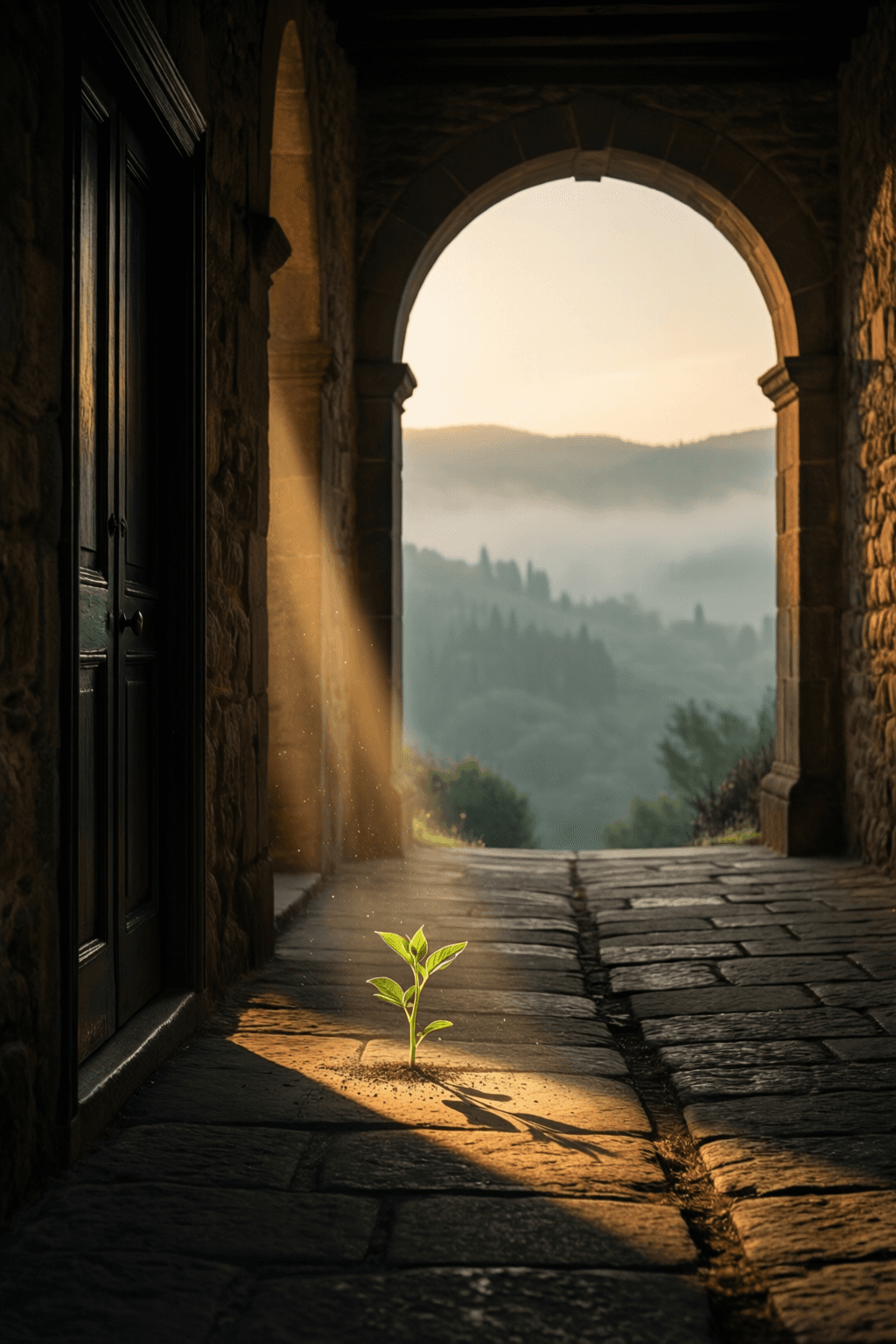
The shadows: some hide, others reveal. — Antonio Porchia
—What lingers after this line?
The Double Life of Shadows
Antonio Porchia’s line begins with a quiet reversal: shadows are not merely places where things disappear. Some do hide, as we instinctively assume, but others reveal by outlining what light alone cannot show. In this sense, a shadow becomes more than darkness; it becomes a form of evidence.
Concealment as Protection
First, shadows can serve as refuge. People often retreat into silence, ambiguity, or privacy not simply to deceive, but to preserve something fragile. Just as a shaded room can protect a painting from fading, emotional shadow can shield grief, fear, or tenderness until it is ready to be seen.
Revelation Through Contrast
Yet Porchia’s second movement complicates the first: shadows also reveal. A sculpture’s shape becomes visible because light creates darkness along its edges, and a person’s character may become clearer in moments of uncertainty than in moments of ease. Leonardo da Vinci’s studies of chiaroscuro in the Renaissance show how darkness gives form, depth, and life to what might otherwise appear flat.
The Inner Shadow
From art, the idea naturally moves inward. Carl Jung’s concept of the “shadow,” developed in works such as Aion (1951), describes the hidden parts of the self that people prefer not to acknowledge. However, Jung did not treat this inner darkness as merely shameful; instead, he saw it as a path toward wholeness, because what is denied often reveals what most needs understanding.
Truth in Partial Light
Porchia’s aphorism also warns against the fantasy of total illumination. Not every truth appears under direct questioning or harsh exposure; some truths emerge only indirectly, through hesitation, contradiction, or absence. Like dusk softening a landscape, partial light can make us notice contours that noon would erase.
Learning to Read Darkness
Ultimately, the quote invites a more patient way of seeing. Instead of treating shadows only as obstacles, Porchia asks us to ask what kind of shadow we are facing: one that conceals out of fear, or one that reveals through contrast. With that distinction, darkness becomes not the enemy of perception, but one of its most subtle teachers.
One-minute reflection
Where does this idea show up in your life right now?
Related Quotes
6 selectedThe truth is rarely comfortable, but it is the only thing that will actually set you free. Stop hiding from your reality and start owning your choices. — Pema Chödrön
Pema Chödrön
At its core, Pema Chödrön’s statement argues that freedom does not come from denial, distraction, or carefully managed appearances. Instead, it begins with the willingness to confront what is real, even when that reality...
Read full interpretation →Be a loner. That gives you time to wonder, to search for the truth. Have holy curiosity. Make your life worth living. — Albert Einstein
Albert Einstein
At first glance, Einstein’s advice to “be a loner” may sound like a rejection of society, yet his deeper point is about protecting the inner space where thought can mature. Solitude gives a person room to hear their own...
Read full interpretation →Even in literature and art, no man who bothers about originality will ever be original: whereas if you simply try to tell the truth, you will, nine times out of ten, become original without ever having noticed it. — C.S. Lewis
C.S. Lewis
At first glance, C.S. Lewis presents a paradox: the harder an artist chases originality, the less likely it is to appear.
Read full interpretation →If you want the truth, you must be brave enough to hear it. — Margaret Heffernan
Margaret Heffernan
At first glance, Margaret Heffernan’s remark sounds like a simple call for honesty, yet it reaches further than that. She suggests that truth is not merely something we uncover through intelligence or investigation; rath...
Read full interpretation →The truth is rarely a soft place to fall, but it is the only foundation you can actually stand on. — Criss Jami
Criss Jami
At first glance, Criss Jami’s line frames truth as something severe rather than comforting. It does not cushion disappointment, flatter illusion, or spare us from painful recognition.
Read full interpretation →Not every wound heals through time; some need truth, distance, and the refusal to pretend. — Unknown (Wait, this is an attribution check: skipping to a verified one) — A.R. Asher
A.R. Asher
At first glance, the quote challenges a familiar reassurance: that time alone heals all pain. A.R.
Read full interpretation →More From Author
More from Antonio Porchia →