
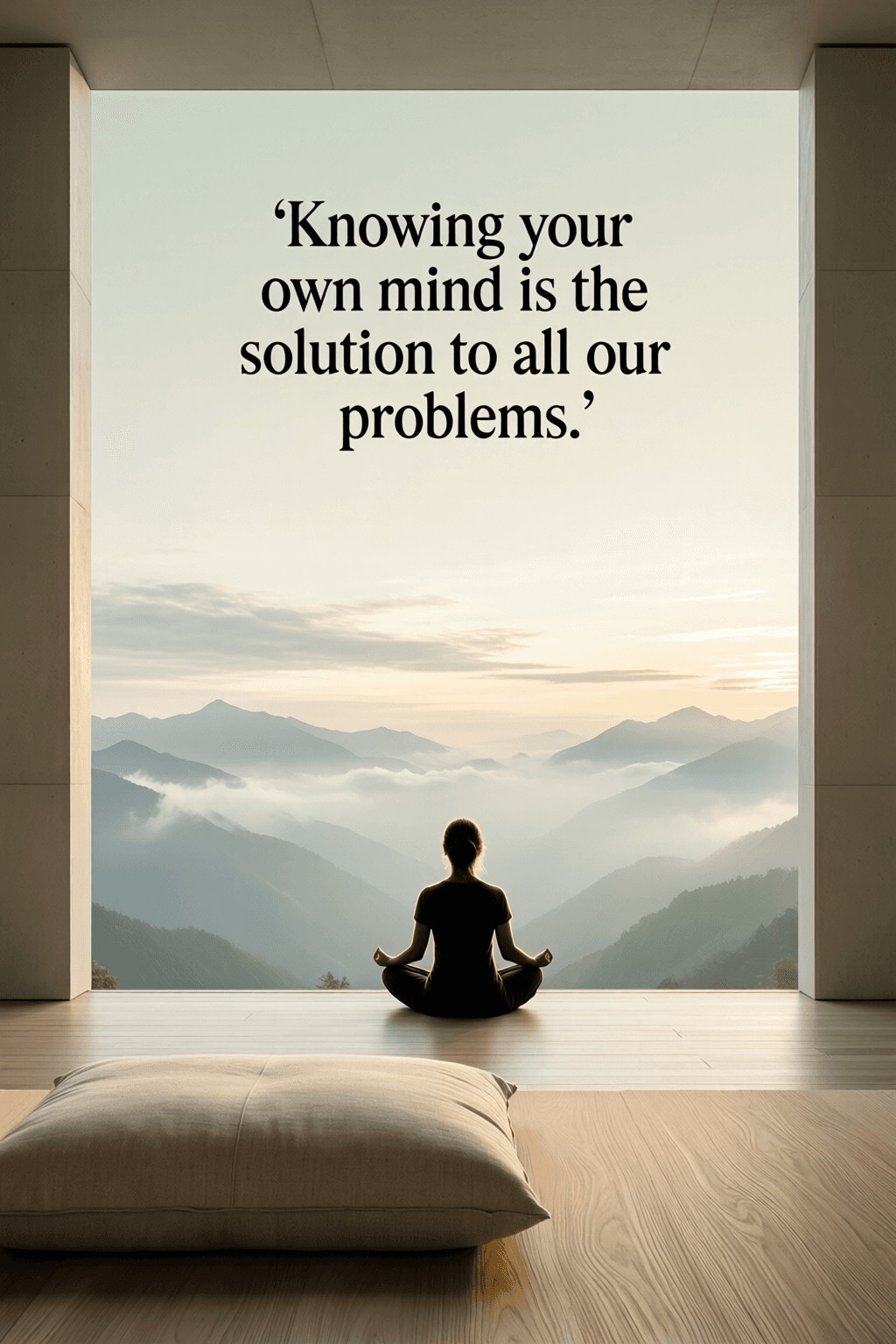
Knowing your own mind is the solution to all our problems. — Lama Yeshe
—What lingers after this line?
The Problem Beneath Problems
Lama Yeshe’s statement begins with a striking shift of attention: the root of our difficulties is not merely in the outside world, but in the mind that interprets it. Circumstances may challenge us, yet confusion, fear, craving, and resentment often turn those challenges into lasting suffering. In this sense, knowing the mind means learning how experience is shaped from within.
A Buddhist View of Inner Clarity
Building on that insight, Buddhist teaching has long treated self-knowledge as a practical form of liberation. The *Dhammapada* (c. 3rd century BC) says, “Mind precedes all mental states,” suggesting that our thoughts and perceptions condition the life we inhabit. Lama Yeshe continues this tradition by presenting awareness not as abstract philosophy, but as a direct remedy for human distress.
From Reaction to Recognition
Once we begin observing the mind, a crucial change becomes possible: we no longer have to obey every impulse. Anger, for example, may still arise, but it can be recognized before it becomes speech or action. In that small pause between feeling and response, self-knowledge becomes practical wisdom, turning automatic reaction into conscious choice.
Psychology Meets Contemplation
This idea also resonates with modern psychology. Cognitive behavioral therapy, developed by figures such as Aaron Beck in the 1960s, emphasizes that distorted thoughts can intensify suffering, while recognizing them can reduce it. In a similar way, Lama Yeshe’s teaching suggests that when we understand the habits of our own mind, many problems lose the hidden force they once had over us.
The Discipline of Looking Within
However, knowing the mind is not a single moment of insight; it is a discipline. Meditation, reflection, honest conversation, and ethical living all help reveal the patterns that usually remain unseen. Gradually, the mind becomes less like a storm that carries us away and more like a landscape we can navigate with patience.
Freedom Through Self-Knowledge
Finally, Lama Yeshe’s claim is radical because it locates freedom close at hand. We may not control every event, person, or loss, but we can come to understand the mental habits that create confusion around them. To know one’s own mind, then, is not to escape life’s problems; it is to meet them with clarity, steadiness, and compassion.
One-minute reflection
Where does this idea show up in your life right now?
Related Quotes
6 selectedWhat you are looking for is what is looking. — Saint Francis of Assisi
Saint Francis of Assisi
At first glance, Saint Francis of Assisi’s saying sounds like a riddle, yet its force lies in the way it reverses the direction of spiritual longing. We often imagine truth, peace, or God as something distant that must b...
Read full interpretation →We cannot be more connected to others than we are to ourselves. — Brené Brown
Brené Brown
Brené Brown’s statement begins with a simple but demanding truth: our relationships with others are limited by the relationship we have with ourselves. If we are estranged from our own feelings, needs, and fears, then ou...
Read full interpretation →When I stopped to pay attention to where my breathing was deep and settled, the truth began to emerge from the mist. — Sanchita Pandey
Sanchita Pandey
At first glance, Sanchita Pandey’s line suggests that truth does not always arrive through argument or analysis; instead, it begins with attention to the body. By noticing where breathing feels deep and settled, the spea...
Read full interpretation →We must look at the lens through which we see the world, as well as the world we see. — Sarah Ban Breathnach
Sarah Ban Breathnach
Sarah Ban Breathnach’s line reminds us that perception is never a simple act of receiving reality; it is also an act of interpretation. We do not merely look outward at events, people, and circumstances—we also look thro...
Read full interpretation →The most important form of incremental change is the decision by the individual to become more conscious in their own life. — Carol J. Adams
Carol J. Adams
Carol J. Adams frames incremental change not as a distant political event, but as a personal awakening.
Read full interpretation →You cannot change what you refuse to confront. Growth begins when you stop hiding from your own truth. — Marc Chernoff
Marc Chernoff
Marc Chernoff’s quote turns growth into an act of courage rather than comfort. At its heart, the message is simple: real change cannot begin while we avoid the facts of our own lives.
Read full interpretation →More From Author
More from Lama Yeshe →