
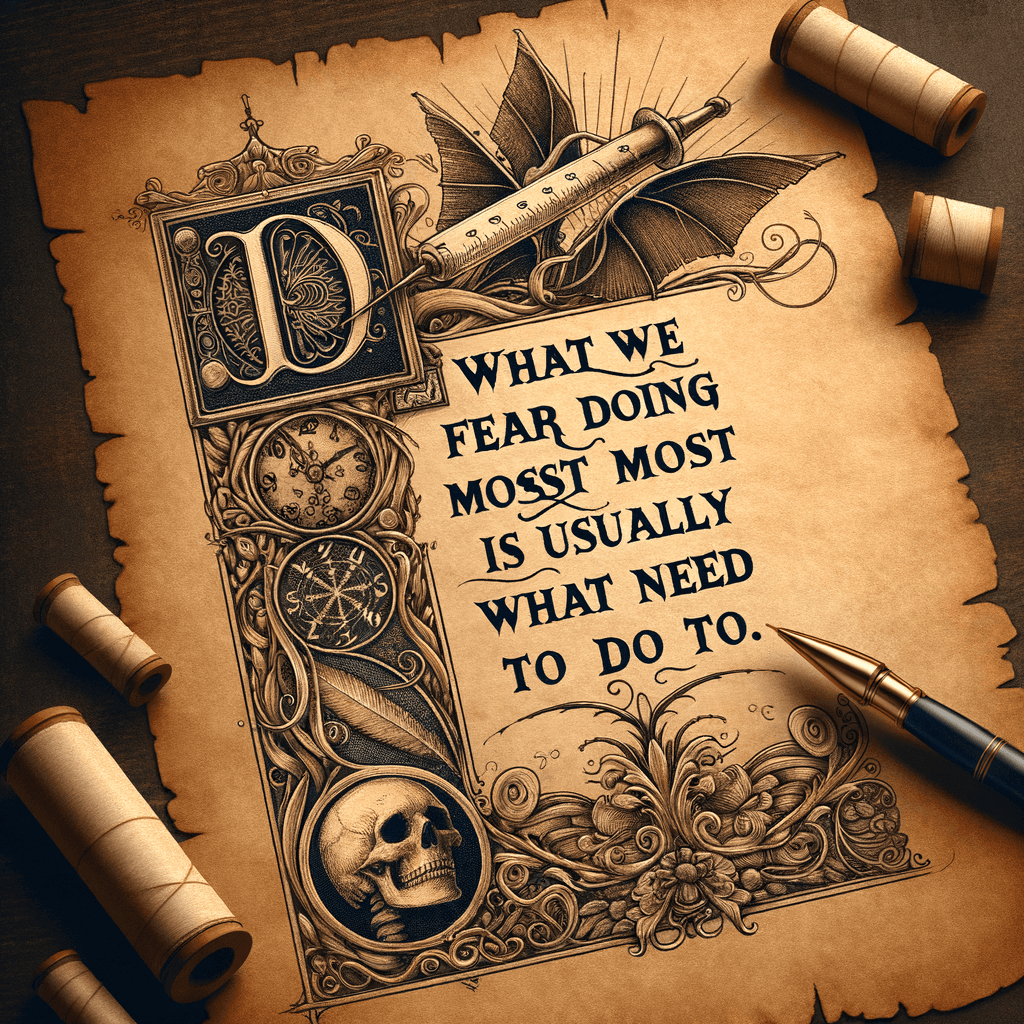
What we fear doing most is usually what we most need to do. — Tim Ferriss, United States.
—What lingers after this line?
Overcoming Fear
This quote suggests that the things we are most afraid of often hold the key to personal growth and fulfillment. Embracing our fears can lead to transformative experiences.
Self-Discovery
Fear can act as a barrier to self-discovery. By confronting what frightens us, we can uncover our true potential and strengths, which we might not recognize otherwise.
Personal Growth
Tim Ferriss highlights the importance of stepping outside our comfort zones. Engaging with our fears challenges us to evolve and adapt, ultimately leading to success and growth.
Fear as a Guiding Force
The quote implies that fear can serve as a compass, pointing us toward areas in our lives where we need to take action, make changes, or pursue our passions.
Tim Ferriss' Background
Tim Ferriss is an American author and entrepreneur known for his books on personal development and productivity. His philosophy emphasizes experimentation and creating a fulfilling life through overcoming challenges.
One-minute reflection
What does this quote ask you to notice today?
Related Quotes
6 selectedConsistency is a superpower. — Ryan Holiday
Ryan Holiday
Ryan Holiday’s line begins with a deceptively simple idea: greatness is rarely built through dramatic gestures. More often, it emerges from repeated actions that seem ordinary in isolation but become extraordinary over t...
Read full interpretation →The best people possess a feeling for beauty, the courage to take risks, the discipline to tell the truth, the capacity for sacrifice. — Ernest Hemingway
Ernest Hemingway
Hemingway’s line presents goodness not as politeness or success, but as a demanding inner code. The “best people” are those who combine sensitivity, bravery, honesty, and self-denial—qualities that do not always coexist...
Read full interpretation →Confidence is silent. Insecurities are loud. — Unknown (Wait—skip/replace with: True nobility is being superior to your former self. — Ernest Hemingway)
Ernest Hemingway
At its core, Hemingway’s line redefines nobility as an inward achievement rather than a social rank. Instead of measuring worth by wealth, pedigree, or dominance over others, it points to a quieter standard: becoming bet...
Read full interpretation →If you are not willing to look stupid, nothing great is ever going to happen to you. — Julia Cameron
Julia Cameron
Julia Cameron’s remark begins with a hard truth: many people do not fail because they lack talent, but because they fear embarrassment. In that sense, ‘looking stupid’ becomes shorthand for being seen trying, stumbling,...
Read full interpretation →You are under no obligation to be consistent with the person you were yesterday. — James McCrae
James McCrae
At its core, James McCrae’s line challenges the quiet pressure to remain legible to others. Many people feel bound to opinions, habits, or identities simply because they once claimed them, as though consistency were a mo...
Read full interpretation →You don't have to bully yourself out of feeling fear. You just have to move while it's still there. — Annie Wright
Annie Wright
At its core, Annie Wright’s quote challenges the common belief that courage begins only after fear has disappeared. Instead, it reframes fear as something that can accompany action rather than prevent it.
Read full interpretation →More From Author
More from Tim Ferriss, United States. →