
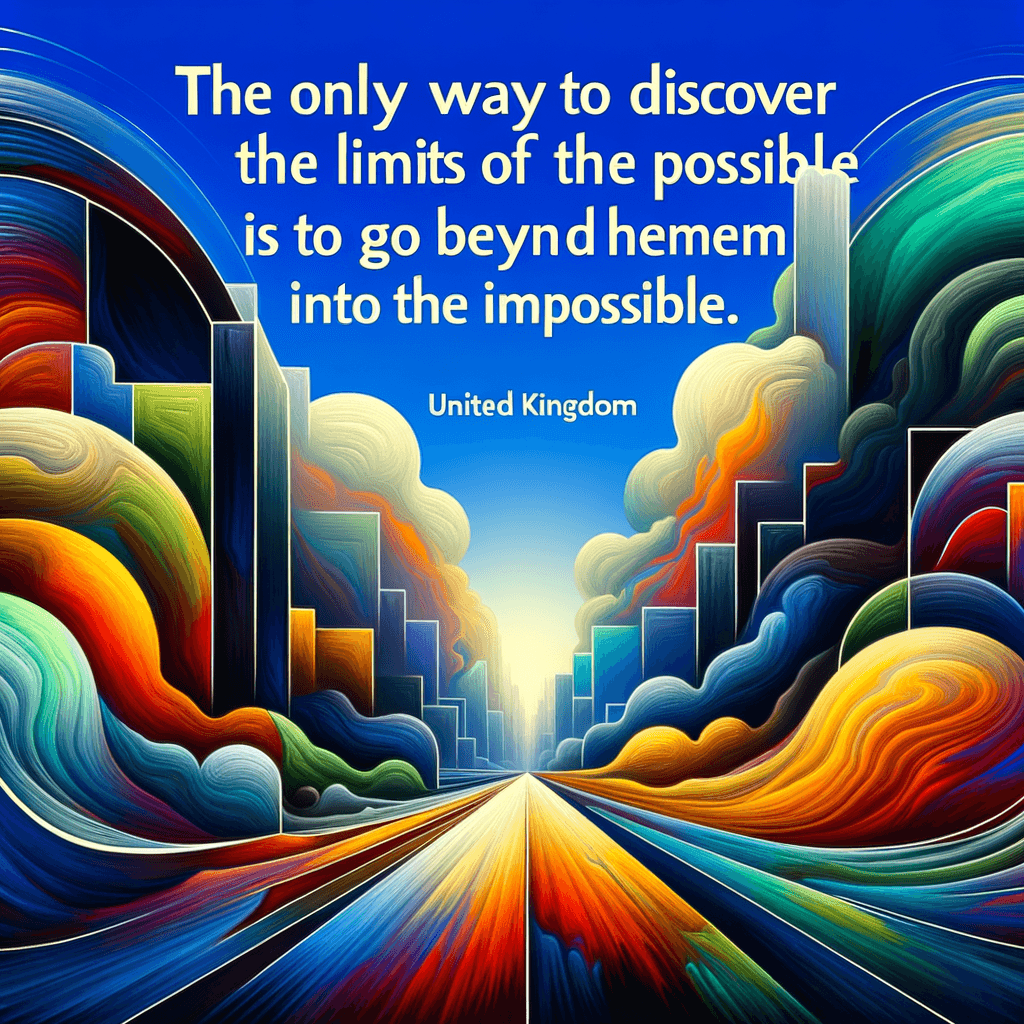
The only way to discover the limits of the possible is to go beyond them into the impossible. — Arthur C. Clarke, United Kingdom.
—What lingers after this line?
Exploration of Possibility
This quote implies that in order to truly understand what can be achieved, one must push past existing boundaries and venture into areas that seem unattainable.
Innovation and Progress
Clarke highlights that great advancements stem from daring to challenge and surpass current limitations, suggesting that innovation often requires taking risks and thinking outside the box.
Resilience and Determination
Going into the 'impossible' requires a strong sense of resilience and determination, indicating that perseverance is key to achieving extraordinary feats.
Philosophical Reflection
This idea touches on a philosophical perspective where understanding is gained through experience. Engaging with the impossible teaches us more about our capabilities and the nature of reality.
Arthur C. Clarke's Legacy
Arthur C. Clarke, known for his significant contributions to science fiction and futurism, often explored themes of technology, exploration, and the potential of humanity, making this quote a reflection of his visionary thinking.
One-minute reflection
Why might this line matter today, not tomorrow?
Related Quotes
6 selectedThe only way of discovering the limits of the possible is to venture a little way past them into the impossible. - Arthur C. Clarke
Arthur C. Clarke
Arthur C. Clarke’s line reads like a dare, but it is really a method: you cannot map the shoreline of what can be done while standing safely inland.
Read full interpretation →Art is the act of navigating without a map. — Seth Godin
Seth Godin
At its core, Seth Godin’s line defines art not as technical polish but as a willingness to move forward without guaranteed direction. To create without a map is to accept uncertainty as part of the process, trusting intu...
Read full interpretation →Map your own territory; the unknown becomes familiar through careful passage. — Jorge Luis Borges
Jorge Luis Borges
Borges’s invitation to “map your own territory” urges each person to become the cartographer of their life. Rather than inheriting second‑hand maps—social expectations, family scripts, or conventional success stories—he...
Read full interpretation →Walk toward the unknown with hands open; discovery favors the willing — Rabindranath Tagore
Rabindranath Tagore
Tagore’s line begins with a deceptively simple image: walking toward the unknown with hands open. This posture suggests not only physical movement but also an inner stance of receptivity.
Read full interpretation →Create a map of wonder, then travel beyond the edges. — Kahlil Gibran
Kahlil Gibran
Gibran’s line entwines two impulses: to name what astonishes us and to step past what names can hold. A map of wonder gathers the contours of what moves us—places, questions, encounters—so that we are oriented rather tha...
Read full interpretation →Start with a clear question, then act to discover the answer; discovery favors motion. — Albert Camus
Albert Camus
We begin where Camus directs: with a question sharp enough to cut through noise. Clear questions narrow the field of view, turning vague curiosity into testable intent.
Read full interpretation →More From Author
More from Arthur C. Clarke, United Kingdom. →