
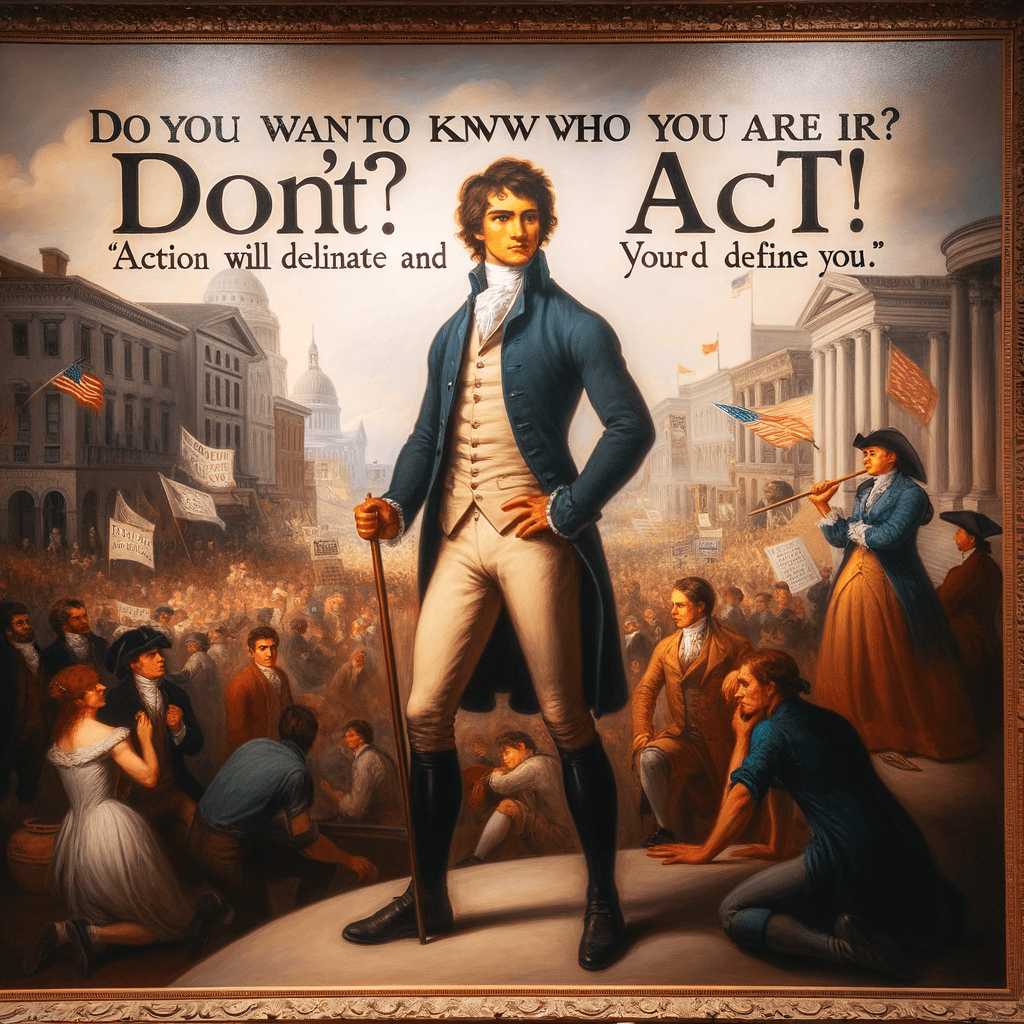
Do you want to know who you are? Don’t ask. Act! Action will delineate and define you. — Thomas Jefferson, United States.
—What lingers after this line?
Definition of Self
This quote suggests that our true identity is revealed through our actions rather than through contemplation or inquiry. It implies that understanding oneself comes from doing rather than merely thinking.
Importance of Action
It emphasizes that actions speak louder than words. Taking action is crucial to shaping one's character and determining who we truly are, rather than relying on self-questions or external validation.
Self-Discovery
Engaging in activities and making choices leads to self-discovery. By acting, individuals can explore their capabilities, passions, and values, contributing to a clearer sense of identity.
Empowerment and Agency
The quote advocates for personal responsibility and empowerment. It suggests that individuals hold the power to define themselves through their decisions and actions, fostering a sense of control over their identity.
Historical Context
Thomas Jefferson, one of the Founding Fathers of the United States, was a proponent of individual liberty and self-governance. His emphasis on action reflects Enlightenment ideals that stress reason, experience, and the importance of civic engagement in defining one’s role in society.
One-minute reflection
What does this quote ask you to notice today?
Related Quotes
6 selectedThe way to do a great deal is to keep on doing a little. The way to do nothing at all is to be continually resolving that you will do everything. — C.H. Spurgeon
C.H. Spurgeon
Spurgeon’s statement begins with a practical paradox: great accomplishments are rarely born from dramatic bursts of effort, but from the steady repetition of small acts. By saying that “a great deal” is done by “doing a...
Read full interpretation →I am a part of all that I have met. — Alfred Lord Tennyson
Alfred Lord Tennyson
Tennyson’s line suggests that identity is not sealed within us from birth; rather, it is gradually formed by every person, place, hardship, and joy we encounter. Each meeting leaves a trace, sometimes obvious and sometim...
Read full interpretation →No matter how full a reservoir of maxims one may possess, if one has not taken advantage of every concrete opportunity to act, one's character may remain entirely unaffected. — William James
William James
At first glance, William James draws a sharp line between knowing and becoming. A person may store up countless moral sayings, noble principles, and wise resolutions, yet these remain largely ornamental if they never pas...
Read full interpretation →A garden is not made by singing 'Oh, how beautiful,' and sitting in the shade. — Rudyard Kipling
Rudyard Kipling
Kipling’s line immediately cuts through passive appreciation. Simply admiring a garden, however sincerely, does nothing to plant seeds, pull weeds, or carry water.
Read full interpretation →I am not a glitch in the system; I am the system evolving. — Octavia Butler
Octavia Butler
At first glance, Octavia Butler’s line transforms a defensive statement into a declaration of power. To say “I am not a glitch in the system” rejects the idea of being an error, an anomaly, or an inconvenience to the est...
Read full interpretation →You cannot afford to live in potential for the rest of your life; at some point, you have to unleash it. — Eric Thomas
Eric Thomas
Eric Thomas’s quote begins with a stark warning: potential is not a place to live, only a promise of what might be. In other words, talent, intelligence, or ambition mean very little if they remain dormant.
Read full interpretation →More From Author
More from Thomas Jefferson, United States. →