
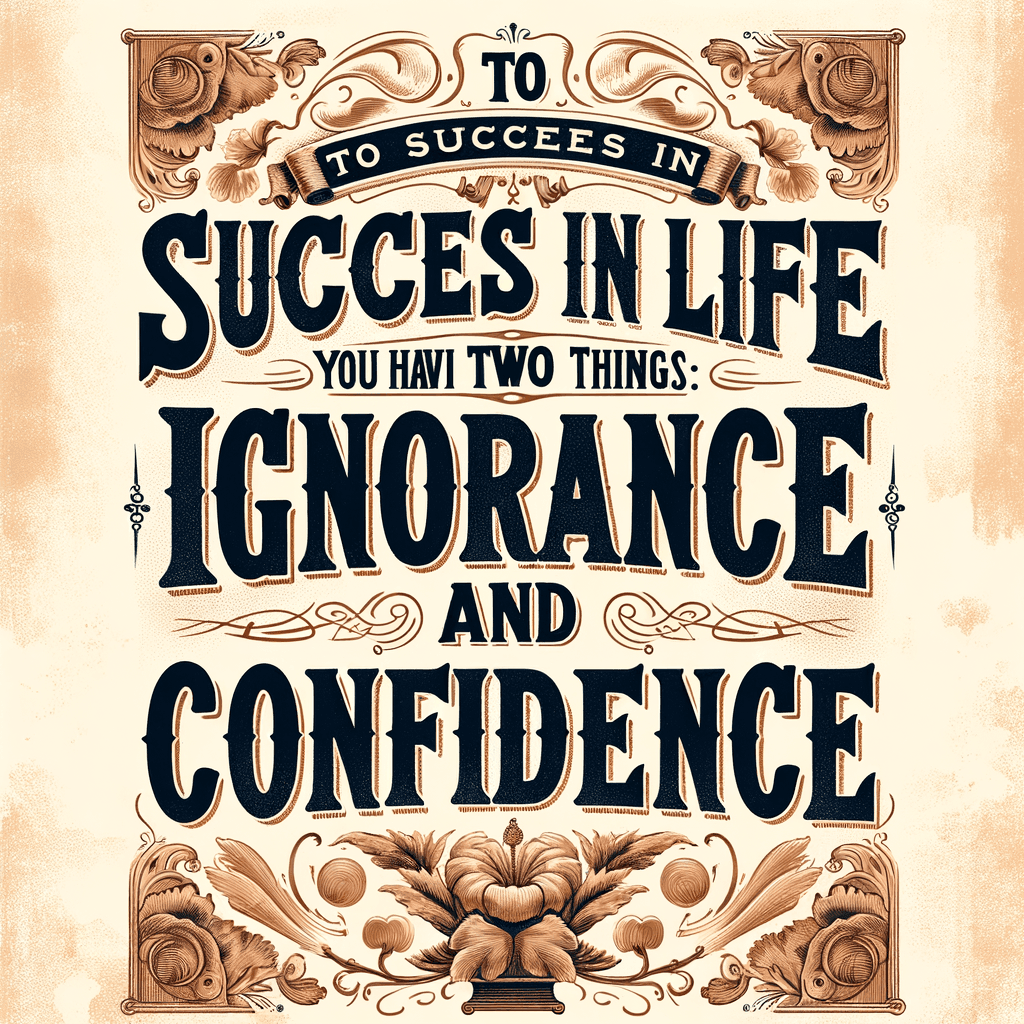
To succeed in life, you need two things: ignorance and confidence. — Mark Twain, United States.
—What lingers after this line?
Ignorance as a Tool
This quote highlights the idea that sometimes lack of knowledge or awareness about certain challenges can be advantageous. Ignorance can lead to a willingness to take risks that a more informed person might avoid.
The Importance of Confidence
Confidence is portrayed as essential for success. Believing in oneself can empower individuals to pursue their goals fearlessly and tackle obstacles that may deter others.
Risk-Taking Behavior
The combination of ignorance and confidence can foster a propensity for taking risks. Individuals who are unaware of potential pitfalls may be more inclined to embark on ambitious ventures.
Contrarian View on Success
Twain's perspective challenges conventional wisdom that suggests knowledge and caution are necessary for success. Instead, he implies that a degree of naivete can sometimes lead to remarkable achievements.
Mark Twain's Background
Mark Twain was an influential American author and humorist known for his keen observations of human nature. His wit often pointed out the absurdities of life and society, as reflected in this quote.
One-minute reflection
Why might this line matter today, not tomorrow?
Related Quotes
6 selectedConfidence is not absence of fear; it is the quiet recognition that you have survived every hard day so far. — Michelle Obama
Michelle Obama
At first glance, confidence is often mistaken for boldness without hesitation, yet Michelle Obama’s words gently overturn that myth. She frames confidence not as the absence of fear, but as a steadier inner knowledge: yo...
Read full interpretation →Confidence doesn't mean being fearless. It means creating, even when your hands shake. — Lisa Golightly
Lisa Golightly
At first glance, Lisa Golightly’s quote overturns a common myth: that confident people move through life without fear. Instead, she presents confidence as action taken in spite of fear, not in the absence of it.
Read full interpretation →Don't be intimidated by what you don't know. That can be your greatest strength. — Sara Blakely
Sara Blakely
At first glance, Sara Blakely’s quote sounds like a simple encouragement, yet it points to a deeper truth: ignorance is not always a weakness. When people are not trapped by assumptions about how things are “supposed” to...
Read full interpretation →Confidence doesn't mean being fearless. Confidence is knowing you are capable of handling the fear. — Amy Poehler
Amy Poehler
At first glance, people often imagine confidence as a polished kind of fearlessness, as though brave individuals simply do not tremble. Amy Poehler’s quote overturns that myth by suggesting that confidence begins not wit...
Read full interpretation →It is not so much our friends' help that helps us, as the confidence of their help. — Epicurus
Epicurus
Epicurus shifts attention away from visible acts of assistance and toward something quieter but often more powerful: the assurance that help exists if needed. In this sense, friendship becomes a source of inner steadines...
Read full interpretation →Real confidence is not needing to prove anything. — Naval Ravikant
Naval Ravikant
At first glance, Naval Ravikant’s remark separates genuine confidence from the urge to advertise it. If someone truly trusts their own worth, they do not need constant applause, argument, or comparison to confirm it.
Read full interpretation →More From Author
More from Mark Twain, United States. →