
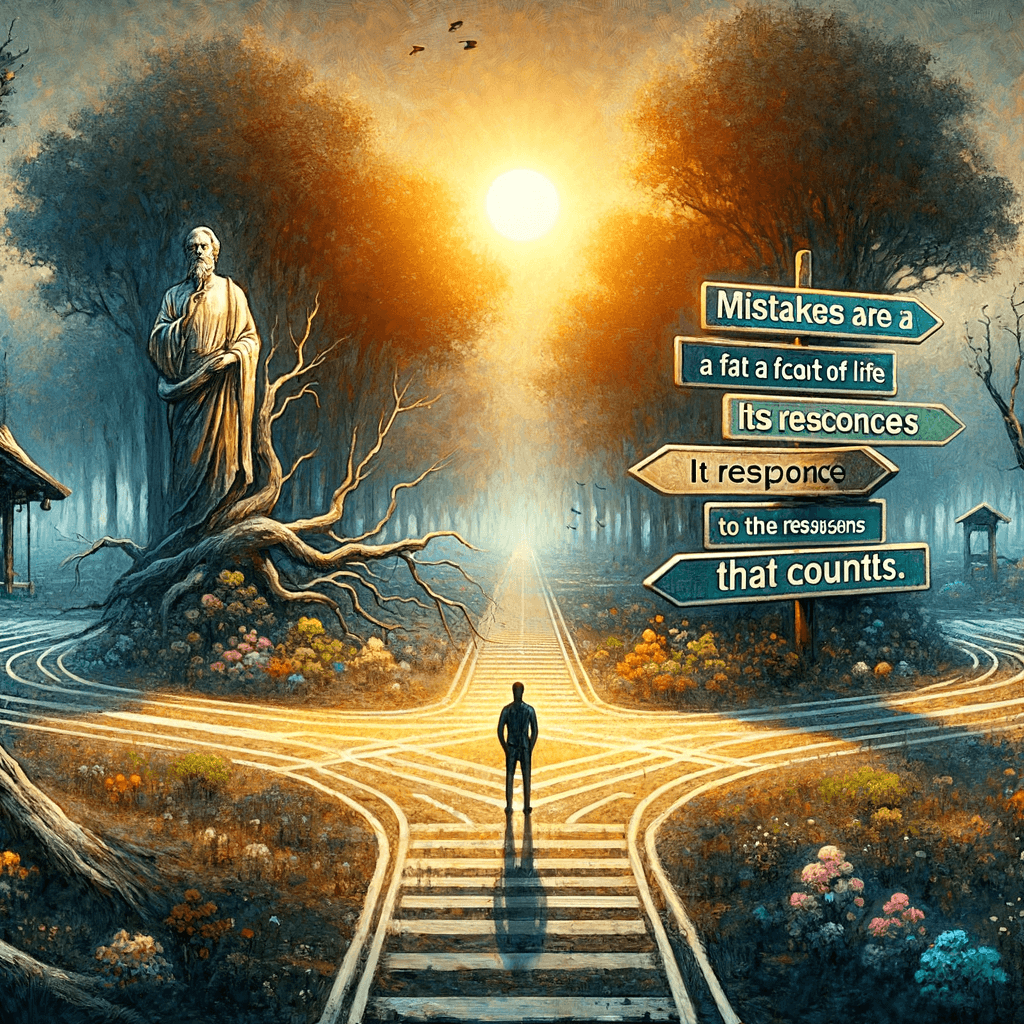
Mistakes are a fact of life. It is the response to the error that counts. — Nikki Giovanni
—What lingers after this line?
Acceptance of Imperfection
This quote highlights the inevitability of making mistakes in life. It emphasizes that errors are a natural part of the human experience, and acknowledging this can lead to personal growth.
Response to Error
Giovanni underscores the importance of how we react to our mistakes. It’s not the mistake itself that defines us, but the actions we take afterward that reflect our character and resilience.
Learning and Growth
Mistakes serve as valuable lessons. The ability to learn from errors and adapt is crucial for personal development and can lead to greater success in future endeavors.
Cultivating a Positive Mindset
The response to mistakes is about mindset. Approaching errors with a positive attitude can facilitate progress and prevent feelings of defeat, fostering a more constructive outlook on challenges.
Empowerment through Accountability
Taking responsibility for one’s mistakes empowers individuals. It encourages honesty and self-reflection, which are essential for growth and improving future decision-making.
One-minute reflection
Why might this line matter today, not tomorrow?
Related Quotes
6 selectedConsistency is a superpower. — Ryan Holiday
Ryan Holiday
Ryan Holiday’s line begins with a deceptively simple idea: greatness is rarely built through dramatic gestures. More often, it emerges from repeated actions that seem ordinary in isolation but become extraordinary over t...
Read full interpretation →Just because your light flickers does not mean it is about to go out. — Yohancé Salimu
Yohancé Salimu
At first glance, Yohancé Salimu’s line separates appearance from reality. A flicker suggests instability, fatigue, or interruption, yet it does not automatically signal extinction.
Read full interpretation →Confidence is silent. Insecurities are loud. — Unknown (Wait—skip/replace with: True nobility is being superior to your former self. — Ernest Hemingway)
Ernest Hemingway
At its core, Hemingway’s line redefines nobility as an inward achievement rather than a social rank. Instead of measuring worth by wealth, pedigree, or dominance over others, it points to a quieter standard: becoming bet...
Read full interpretation →When something in your life dies—whether it be a job, a hobby, or a dream—I encourage you not to focus on what could have been but instead to look for the new life and the new opportunities that result. — Ryan Hall
Ryan Hall
Ryan Hall frames loss as a kind of death, and that metaphor immediately broadens the quote beyond grief in the literal sense. A job can end, a cherished hobby can fade, and a long-held dream can collapse; yet in each cas...
Read full interpretation →Dreams are made of sturdy stuff. — William Carlos Williams
William Carlos Williams
At first glance, William Carlos Williams’s line reverses a familiar assumption: dreams are often treated as airy, fleeting, and insubstantial, yet he insists they are made of “sturdy stuff.” In that compact phrase, he gi...
Read full interpretation →Confidence is not absence of fear; it is the quiet recognition that you have survived every hard day so far. — Michelle Obama
Michelle Obama
At first glance, confidence is often mistaken for boldness without hesitation, yet Michelle Obama’s words gently overturn that myth. She frames confidence not as the absence of fear, but as a steadier inner knowledge: yo...
Read full interpretation →More From Author
More from Nikki Giovanni →