
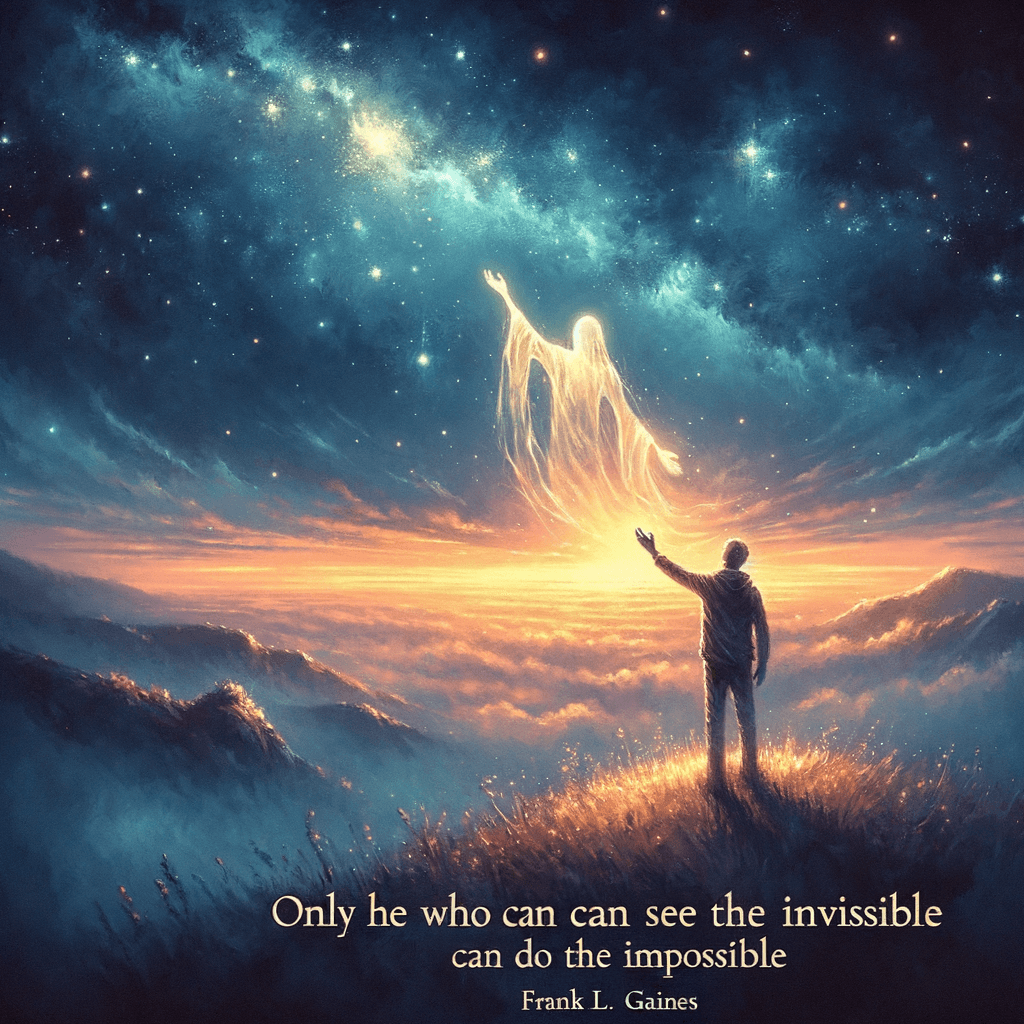
Only he who can see the invisible can do the impossible. — Frank L. Gaines
—What lingers after this line?
Vision and Imagination
This quote underscores the importance of having a vision that transcends the visible and tangible. It suggests that those who can envision what others cannot are often the ones who accomplish extraordinary feats.
Belief in Possibilities
It emphasizes a strong belief in possibilities. To achieve the impossible, one must be able to conceive of ideas and outcomes that are not currently evident or accepted by the mainstream.
Overcoming Limitations
The quote implies that limitations are often self-imposed. By seeing beyond the visible, individuals can challenge and overcome the boundaries set by conventional thinking.
Innovative Thinking
This idea promotes creative and innovative thinking, suggesting that many breakthroughs in science, technology, and art come from those who envision what was previously unimaginable.
Historical Inspiration
Frank L. Gaines was an American author and educator whose works often reflected the themes of ambition and the power of vision in pursuing one's goals, which aligns with broader movements in American thought during his time.
One-minute reflection
What's one small action this suggests?
Related Quotes
6 selectedYour limitation—it's only your imagination. — Unknown
Unknown
This quote suggests that the limitations you perceive in yourself and your abilities are often created by your own mind. It encourages individuals to realize that most of their constraints are not real but imagined.
Read full interpretation →Vision without execution is just hallucination. — Thomas Edison
Thomas Edison
This quote emphasizes that having a vision or idea is not enough. Implementation or execution is crucial to bring that vision into reality.
Read full interpretation →Anxiety is just the imagination working overtime, and most of that overtime is completely unpaid. — Alain de Botton
Alain de Botton
At first glance, Alain de Botton’s remark frames anxiety with disarming humor: the mind behaves like an overworked employee, generating scenarios, rehearsing disasters, and collecting no reward for the effort. By calling...
Read full interpretation →Creativity is not the finding of a thing, but the making something out of it after it is found. — James Russell Lowell
James Lowell
James Russell Lowell’s line shifts attention away from the romantic myth of the sudden genius who invents from nothing. Instead, he argues that creativity truly begins after the initial encounter—after an idea, object, p...
Read full interpretation →In art, the hand can never execute anything higher than the heart can imagine. — Ralph Waldo Emerson
Ralph Waldo Emerson
Emerson’s line shifts attention from technique to inner vision. At first glance, he seems to be speaking about painting or sculpture, yet his deeper claim is that craftsmanship cannot surpass the emotional and imaginativ...
Read full interpretation →Drawing is vision on paper. — Andrew Loomis
Andrew Loomis
At first glance, Andrew Loomis’s remark condenses the whole art of drawing into a single elegant idea: drawing is not merely the movement of a hand, but the translation of perception into form. In this sense, the page be...
Read full interpretation →More From Author
More from Frank L. Gaines →