
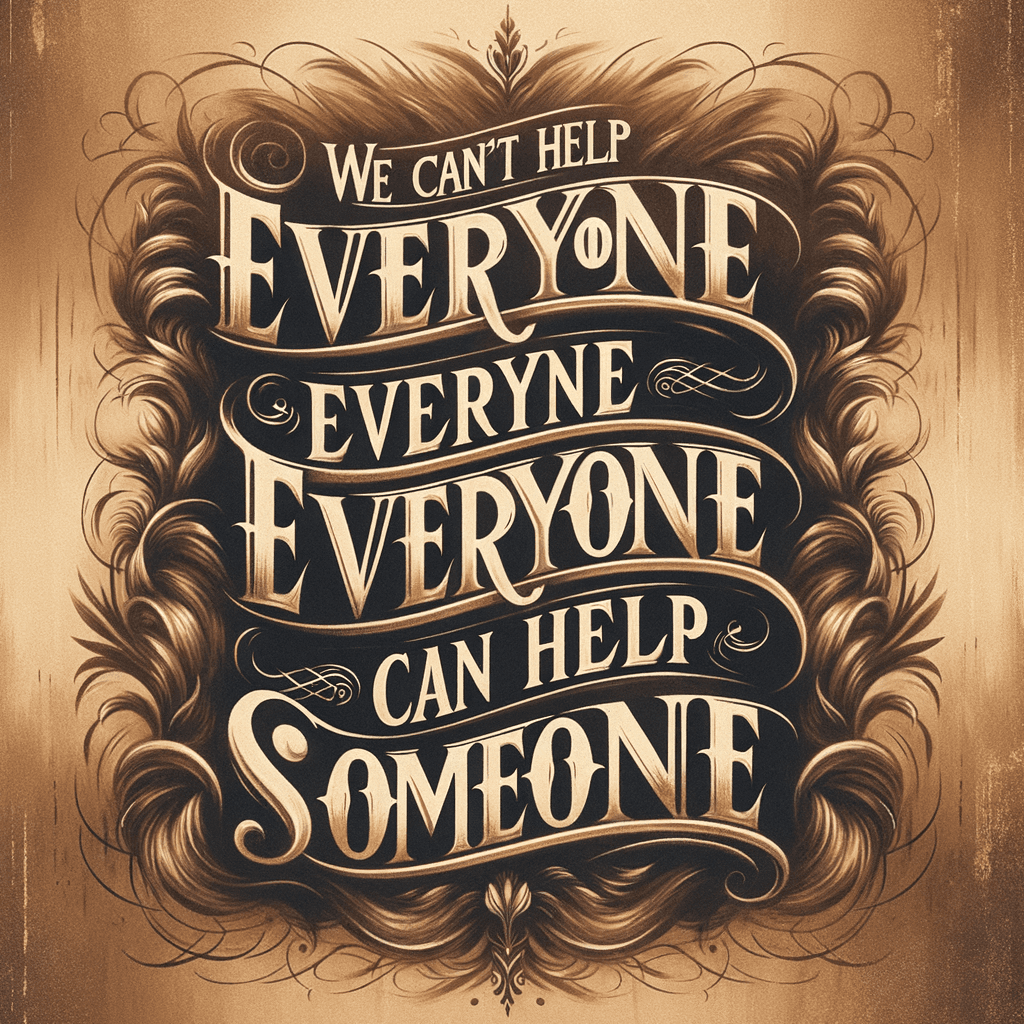
We can’t help everyone, but everyone can help someone. — Ronald Reagan
—What lingers after this line?
Social Responsibility
This quote emphasizes the idea that while we may not have the capacity to assist every individual in need, each person has the ability to make a positive impact on at least one other person.
Collective Effort
It underscores the importance of collective action. Even small contributions can accumulate to create a significant difference in the lives of others, highlighting the power of community.
Empowerment
The statement encourages individuals to take initiative and recognize their potential to effect change, fostering a sense of empowerment and personal agency.
Pragmatism in Charity
Reagan's quote suggests a realistic approach to altruism. It acknowledges limitations but encourages focused efforts, making help more attainable and manageable.
Inspirational Leadership
As a former president, Ronald Reagan's message serves to inspire others in positions of power to promote kindness and proactive assistance within society, reinforcing the idea that leadership involves helping others.
One-minute reflection
What does this quote ask you to notice today?
Related Quotes
6 selectedThe things that you do for yourself are gone when you are gone, but the things that you do for others remain as your legacy. — Kalu K. Ndukwe Kalu
Kalu K. Ndukwe Kalu
At its heart, Kalu K. Ndukwe Kalu’s quote redirects attention from personal gain to shared impact.
Read full interpretation →The most important aspect of gratitude is that it spurs action—that it compels us to go outside ourselves to express our gratitude in a way that makes a difference in someone else's life. — Rebecca Solnit
Rebecca Solnit
Rebecca Solnit shifts gratitude away from being a private sentiment and turns it into a moral impulse. In her view, thankfulness matters most not when it remains an inward glow, but when it pushes us outward toward other...
Read full interpretation →One of the deep secrets of life is that all that is really worth the doing is what we do for others. — Lewis Carroll
Lewis Carroll
Lewis Carroll’s line turns attention away from achievement for its own sake and toward a quieter measure of value: whether our actions help someone beyond ourselves. At first glance, this may sound like simple moral advi...
Read full interpretation →The only thing to do with good advice is to pass it on. It is never of any use to oneself. — Oscar Wilde
Oscar Wilde
Oscar Wilde’s line turns a familiar moral expectation on its head: instead of treating advice as a tool for self-improvement, he treats it as a social commodity best circulated outward. The joke lands because it exposes...
Read full interpretation →Measure success by the lives you lift, not the titles you earn — Kahlil Gibran
Kahlil Gibran
Gibran’s line shifts the measure of achievement away from what can be printed on a business card and toward what can be felt in other people’s lives. Titles are visible, quickly understood, and easy to compare, which is...
Read full interpretation →Your hands can translate hope into something visible — begin with one act. — Alice Walker
Alice Walker
Alice Walker’s line reframes hope as something more than an inner mood or private wish. By saying your hands can “translate” it, she treats hope like a language that becomes meaningful only when expressed in the physical...
Read full interpretation →More From Author
More from Ronald Reagan →There are no great limits to growth because there are no limits of human intelligence, imagination, and wonder. — Ronald Reagan
This quote emphasizes that there are no strict boundaries to human progress because our intelligence, imagination, and sense of wonder constantly push us forward. It celebrates the innate potential within people to grow...
Read full interpretation →There are no limits to what we can accomplish if we don’t care who gets the credit. — Ronald Reagan
This quote highlights the importance of collaboration and teamwork. When individuals focus on the collective goal rather than personal recognition, they can achieve far greater success.
Read full interpretation →