
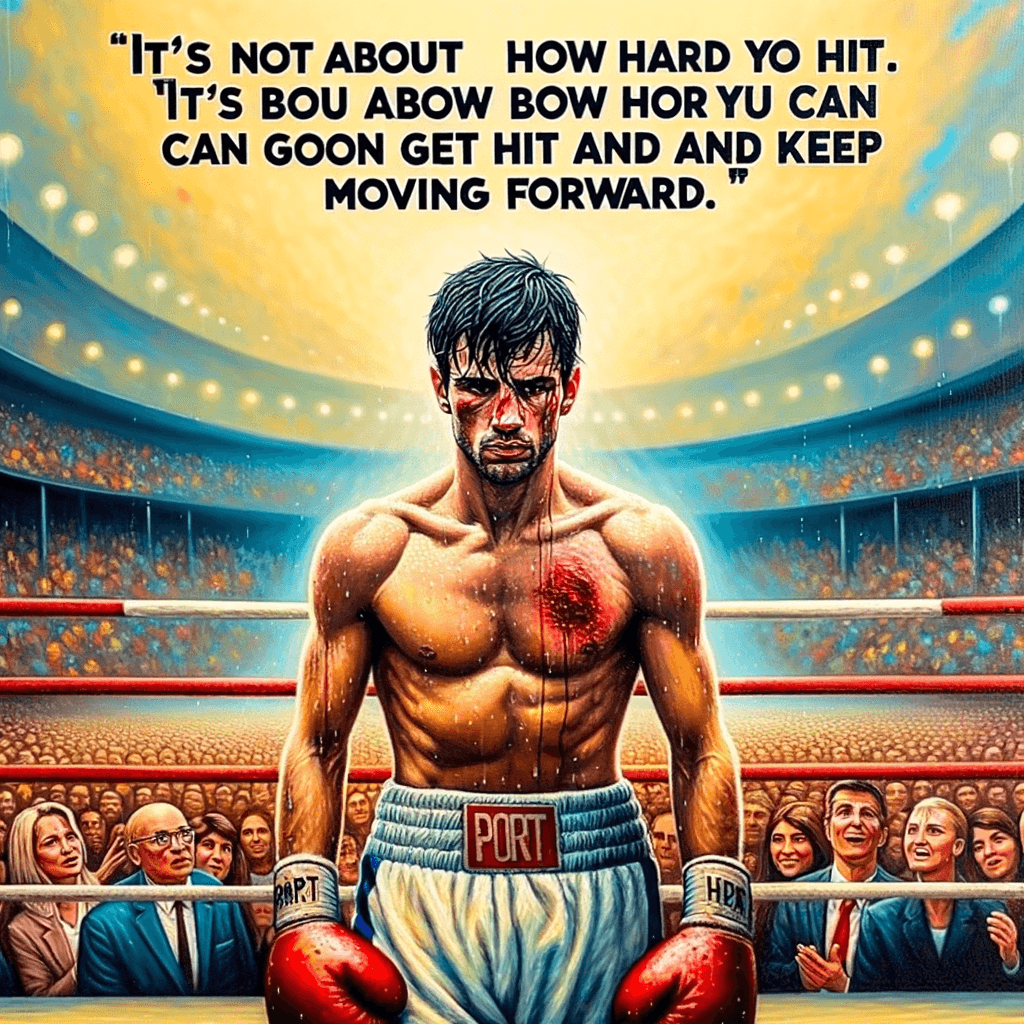
It's not about how hard you hit. It's about how hard you can get hit and keep moving forward. — Rocky Balboa
—What lingers after this line?
Definition of Strength
This quote shifts the focus from being strong in attack to being resilient in adversity. It suggests that true strength lies in one's ability to withstand challenges and keep going despite setbacks.
Mental Toughness
It highlights the importance of mental toughness. The ability to endure hardships and keep moving forward is a key trait for achieving success, much like a boxer who must withstand punches yet continue to fight.
Perseverance
The emphasis on moving forward reflects the concept of perseverance. It encourages individuals to push through difficult times and keep striving towards their goals, no matter how many times they may get knocked down.
Life Lessons from Sports
The quote draws from the world of sports, where physical and emotional resilience are crucial. It serves as a metaphor for life's challenges, suggesting that just like in boxing, life will test you, but resilience is key.
Cultural Impact of Rocky Balboa
Rocky Balboa, a fictional character created by Sylvester Stallone, embodies the underdog spirit and resilience. The character has become an icon in popular culture, symbolizing the struggle and triumph of the human spirit.
One-minute reflection
Why might this line matter today, not tomorrow?
Related Quotes
6 selectedIf we are facing in the right direction, all we have to do is keep walking. — Thích Nhất Hạnh
Thich Nhat Hanh
Thích Nhất Hạnh’s words begin with a simple but profound premise: progress depends first on direction, not speed. If a person is turned toward compassion, clarity, healing, or truth, then each modest step becomes meaning...
Read full interpretation →Don't fight the challenges. Just find a new way to stand. — Germany Kent
Germany Kent
Germany Kent’s words begin with a quiet reversal of instinct: instead of treating every challenge as an enemy to defeat, she invites us to reconsider our posture toward difficulty. The emphasis is not on surrender, but o...
Read full interpretation →Do the best one can. Do it over again. Then still improve, even if ever so slightly, those retouches. — Marguerite Yourcenar
Marguerite Yourcenar
Yourcenar’s words begin with a simple demand: do the best one can. Yet she immediately refuses to let effort become an excuse for stopping.
Read full interpretation →Every champion was once a contender that refused to give up. — Rocky Balboa
Rocky Balboa
The quote highlights the importance of resilience. Champions often face numerous challenges and setbacks, but their refusal to give up is what ultimately leads them to success.
Read full interpretation →Optimist: someone who figures that taking a step backward after taking a step forward is not a disaster, it's more like a cha-cha. — Robert Brault
Robert Brault
Robert Brault’s line begins with a witty redefinition: an optimist is not someone who denies backward motion, but someone who interprets it differently. Instead of treating a setback as proof of failure, the optimist see...
Read full interpretation →A mind grows by staying with difficulty long enough for the experience to change it. — Mary Catherine Bateson
Mary Catherine Bateson
Mary Catherine Bateson’s observation begins with a quiet but demanding truth: the mind does not grow merely by encountering difficulty, but by remaining with it. Challenge becomes transformative only when we resist the u...
Read full interpretation →More From Author
More from Rocky Balboa →