
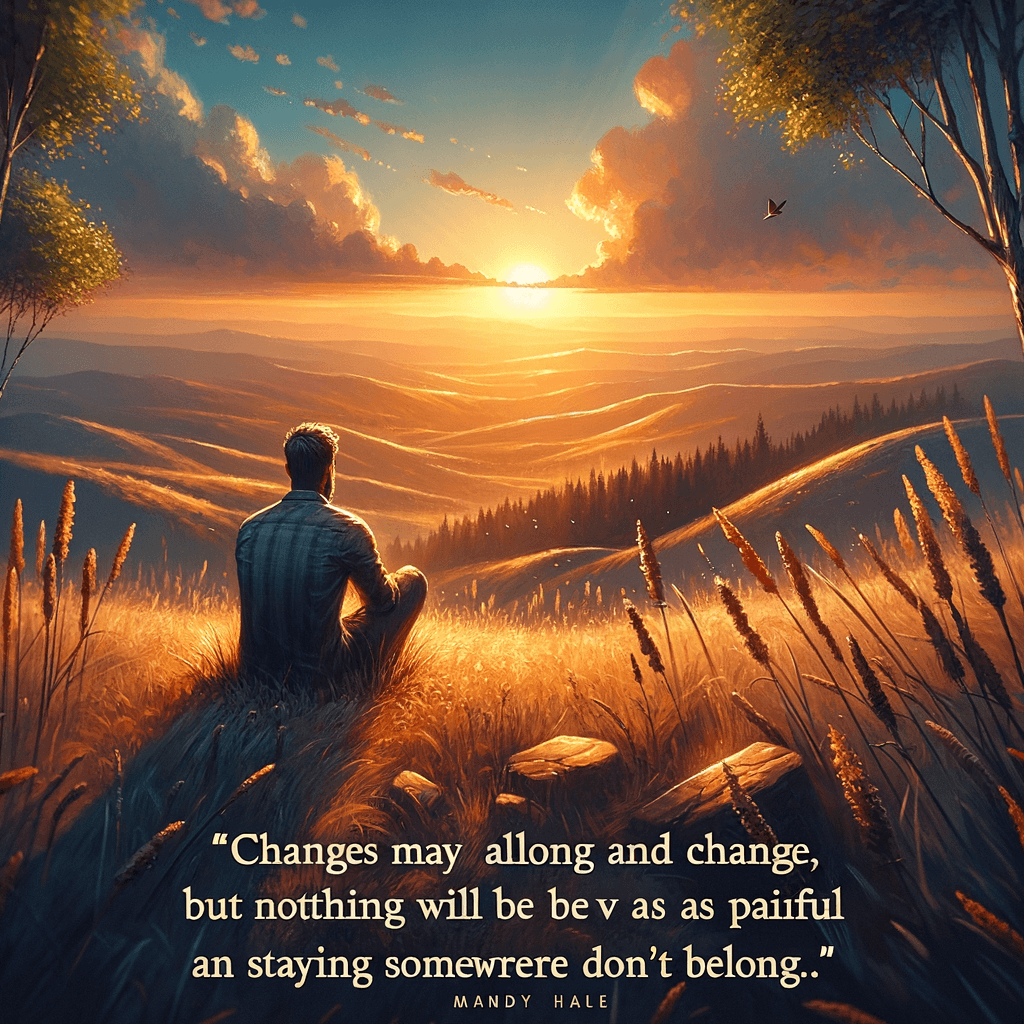
Changes may come along and change may be painful, but nothing will be as painful as staying stuck somewhere you don't belong. — Mandy Hale
—What lingers after this line?
The Nature of Change
This quote acknowledges that change can be difficult and often comes with discomfort. However, it suggests that embracing change is essential for personal growth and fulfillment.
Stagnation vs. Growth
Hale emphasizes that remaining in a situation where one does not feel they belong is ultimately more painful than the challenges that come with making a change.
Courage to Move Forward
The quote encourages individuals to have the courage to leave behind environments or relationships that are unfulfilling, highlighting the importance of pursuing one’s true path.
Belonging and Identity
It emphasizes the significance of belonging and how finding the right place or community contributes to one’s sense of identity and happiness.
Author's Perspective
Mandy Hale is a writer and speaker who often discusses themes of self-empowerment, relationships, and personal growth, making her insights particularly relevant to those navigating life changes.
One-minute reflection
Where does this idea show up in your life right now?
Related Quotes
6 selectedGrowth feels uncomfortable because you are evolving. — Unknown (Wait, skip: Use) Growth is painful, change is painful, but nothing is as painful as staying stuck where you do not belong. — Mandy Hale
Mandy Hale
Mandy Hale’s line frames pain not as a single experience, but as a comparison between two kinds of suffering. On one side is the pain of growth and change—the strain of leaving habits, roles, or relationships that once f...
Read full interpretation →Changes can be scary, but you know what’s scarier? Allowing your fear to stop you from growing, evolving, and progressing. — Mandy Hale
Mandy Hale
The quote highlights how fear, especially fear of change, can become a significant barrier that prevents individuals from experiencing personal growth, evolution, and progress in life.
Read full interpretation →Consistency is a superpower. — Ryan Holiday
Ryan Holiday
Ryan Holiday’s line begins with a deceptively simple idea: greatness is rarely built through dramatic gestures. More often, it emerges from repeated actions that seem ordinary in isolation but become extraordinary over t...
Read full interpretation →Confidence is silent. Insecurities are loud. — Unknown (Wait—skip/replace with: True nobility is being superior to your former self. — Ernest Hemingway)
Ernest Hemingway
At its core, Hemingway’s line redefines nobility as an inward achievement rather than a social rank. Instead of measuring worth by wealth, pedigree, or dominance over others, it points to a quieter standard: becoming bet...
Read full interpretation →You are under no obligation to be consistent with the person you were yesterday. — James McCrae
James McCrae
At its core, James McCrae’s line challenges the quiet pressure to remain legible to others. Many people feel bound to opinions, habits, or identities simply because they once claimed them, as though consistency were a mo...
Read full interpretation →Growth often looks like slowing down, reassessing, and rebuilding with intention. — Erin Gregory
Erin Gregory
At first glance, growth is often imagined as constant acceleration—more output, faster decisions, visible momentum. Erin Gregory’s quote gently overturns that assumption by suggesting that real development may appear qui...
Read full interpretation →More From Author
More from Mandy Hale →You don't always need a plan. Sometimes you just need to breathe, trust, let go and see what happens. — Mandy Hale
Mandy Hale’s quote begins by challenging a modern reflex: the belief that every meaningful step must be mapped in advance. Instead, she proposes that there are moments when planning becomes a form of fear, disguising anx...
Read full interpretation →You can love them, forgive them, want good things for them... but still move on without them. — Mandy Hale
Mandy Hale’s quote begins with a gentle but powerful distinction: love does not always require ongoing closeness. You can care deeply for someone, wish them healing, and even hold gratitude for what they meant in your li...
Read full interpretation →Growth feels uncomfortable because you are evolving. — Unknown (Wait, skip: Use) Growth is painful, change is painful, but nothing is as painful as staying stuck where you do not belong. — Mandy Hale
Mandy Hale’s line frames pain not as a single experience, but as a comparison between two kinds of suffering. On one side is the pain of growth and change—the strain of leaving habits, roles, or relationships that once f...
Read full interpretation →It is not selfish to love yourself, to take care of yourself, and to make your happiness a priority. It's necessary. — Mandy Hale
Mandy Hale’s quote immediately challenges a common moral suspicion: that caring for oneself must come at the expense of others. Instead, she reframes self-love, self-care, and personal happiness as necessities rather tha...
Read full interpretation →