
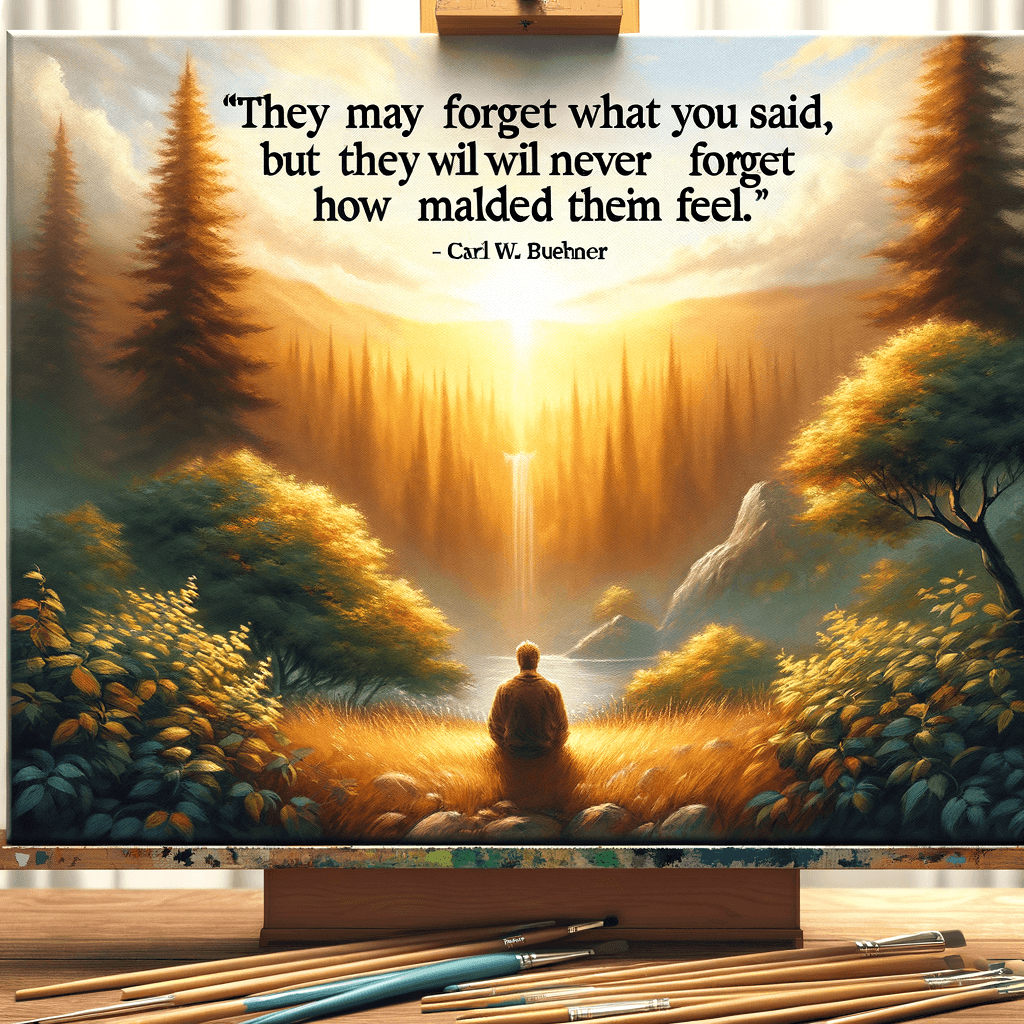
They may forget what you said, but they will never forget how you made them feel. — Carl W. Buehner
—What lingers after this line?
Emotional Resonance
This quote highlights the importance of emotional connections in human interactions. While words may fade from memory, the feelings evoked during those interactions often leave a lasting imprint.
The Power of Empathy
It emphasizes the need for empathy and understanding in communication. How we make others feel can significantly influence our relationships and their perceptions of us.
Memorable Experiences
The quote suggests that actions and emotional support contribute to memorable experiences. Creating positive emotions can be more impactful than merely providing information or advice.
Influence and Legacy
The way we make others feel can shape our legacy. It reminds us that our influence on others goes beyond mere words and into the realm of emotional well-being.
Psychological Insight
Carl W. Buehner's quote reflects a deep understanding of human psychology, affirming that emotional experiences can be more powerful than intellectual discussions in forming our lasting impressions.
Recommended Reading
As an Amazon Associate, we earn from qualifying purchases.
One-minute reflection
Where does this idea show up in your life right now?
Related Quotes
6 selectedPeople may not remember what you did, but they will remember how you made them feel. — Maya Angelou
Maya Angelou
This quote highlights that people are more likely to remember the emotions you evoke in them rather than specific actions or words. Emotional experiences leave a lasting imprint on the human mind.
Read full interpretation →True milestones are not found in our public achievements, but in the quiet, transformative moments of connection we share with those we hold dear. — Chimamanda Ngozi Adichie
Chimamanda Ngozi Adichie
At first glance, Adichie’s quote gently overturns a common modern assumption: that the most important markers of a life are public victories, titles, or visible accomplishments. Instead, she redirects our attention towar...
Read full interpretation →The need to be known by another person is older and deeper and stronger than any algorithm ever built. — David Brooks
David Brooks
At its core, David Brooks’s statement points to a need that predates technology by millennia: the desire to be truly known by another human being. This is not merely a wish for attention or approval, but for recognition...
Read full interpretation →The older I get, the more convinced I am that the space between people who are trying their best to understand each other is hallowed ground. — Fred Rogers
Fred Rogers
Fred Rogers frames understanding not as a finished achievement but as a shared attempt, and that distinction matters. By calling the space between people “hallowed ground,” he suggests that dignity arises whenever two in...
Read full interpretation →Connection is not a luxury, but a necessity for our survival—we are built to mirror one another's joy and soften one another's sorrows. — Sarah Aspinall
Sarah Aspinall
At its core, Sarah Aspinall’s quote rejects the idea that connection is merely a pleasant extra in life. Instead, it presents companionship, empathy, and shared feeling as part of our basic design.
Read full interpretation →Do not go through life without ever knowing the warmth of another soul's genuine interest in your existence. We are built for this connection. — Thich Nhat Hanh
Thich Nhat Hanh
Thich Nhat Hanh’s words gently warn against a life lived in emotional isolation. At their core, they suggest that being truly seen by another person is not a luxury but a vital human need.
Read full interpretation →More From Author
More from Carl W. Buehner →