We Are All in the Gutter, but Some of Us Are Looking at the Stars - Oscar Wilde
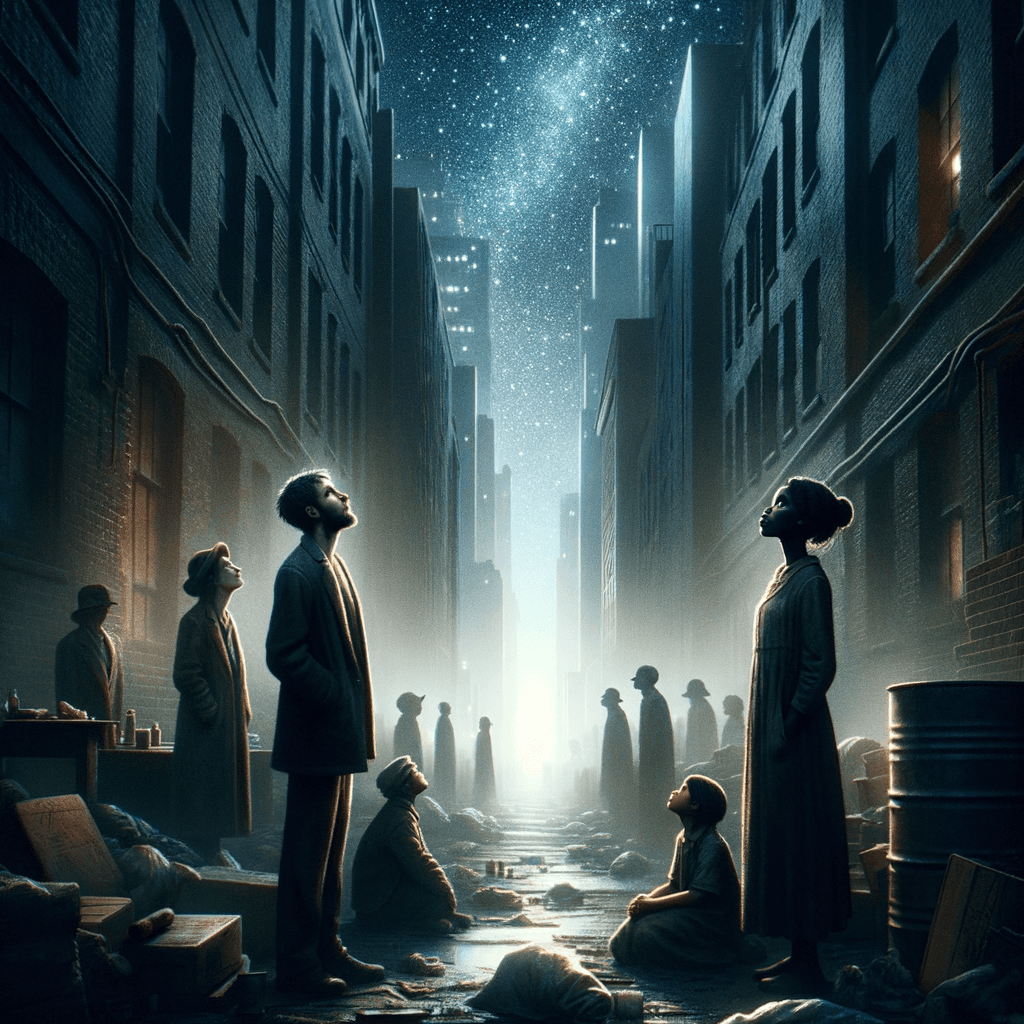
We are all in the gutter, but some of us are looking at the stars. — Oscar Wilde
—What lingers after this line?
Hope and Aspiration
This quote signifies the idea that despite being in dire or challenging circumstances ('the gutter'), one can still aspire to achieve greatness or find beauty ('looking at the stars').
Perspective on Life
It highlights the importance of perspective. While some may be consumed by their immediate problems, others choose to focus on their dreams and the possibilities beyond their current situation.
Resilience and Optimism
The quote reflects resilience, showcasing the ability to remain optimistic even in difficult times. It suggests a mindset that directs attention toward positive outcomes rather than dwelling on negativity.
Social Commentary
Wilde's words also serve as a commentary on society. It implies that while many may face hardships, a select few can transcend their circumstances through vision and ambition.
Historical Context
Oscar Wilde, an Irish poet and playwright, was known for his sharp wit and criticism of Victorian society. This quote encapsulates his belief in the potential for transcendence through art and creativity amidst societal struggles.
Recommended Reading
As an Amazon Associate, we earn from qualifying purchases.
One-minute reflection
Why might this line matter today, not tomorrow?
Related Quotes
6 selectedIn the depths of despair, one often finds the most beautiful hope.
Unknown
This quote highlights the human capacity to find hope during the darkest times. Even when faced with extreme challenges and despair, individuals can discover a profound sense of hope that can inspire them to move forward...
Read full interpretation →In the heart of the night, each star is a hope.
Unknown
This quote uses stars as a metaphor for hope. Just as stars light up the night sky, hope illuminates our darkest moments, bringing light and direction when everything seems bleak.
Read full interpretation →Some years ask you to survive before they ask you to dream. — Maggie Smith
Maggie Smith.
At its core, Maggie Smith’s line recognizes a painful truth: not every season of life is built for possibility. Some years demand endurance first, asking us to pay attention to basic emotional, financial, or physical sur...
Read full interpretation →There is hope, even when your brain tells you there isn't. — John Green
John Green
John Green’s line begins by acknowledging a familiar conflict: the mind can deliver convincing arguments for despair, yet hope can still exist alongside them. Rather than treating hope as a naïve feeling, he frames it as...
Read full interpretation →No one should fear shadows. It simply means there's a light shining somewhere nearby. — Gabriel García Márquez
Gabriel García Márquez
Gabriel García Márquez turns a common source of unease into a quiet reassurance: shadows are not threats in themselves, but evidence. When we fear shadows, we often respond to what is vague, enlarged, or half-seen—our mi...
Read full interpretation →To be truly radical is to make hope possible rather than despair convincing. — Raymond Williams
Raymond Williams
Raymond Williams reframes radicalism as something more constructive than mere opposition. Rather than treating the “radical” as the person who shocks, condemns, or burns everything down, he points to a deeper root: chang...
Read full interpretation →More From Author
More from Oscar Wilde →Everything in moderation, including moderation. — Oscar Wilde
Oscar Wilde’s line, “Everything in moderation, including moderation,” works by first borrowing a familiar moral rule and then twisting it into a paradox. If moderation is always good, then we should practice it without e...
Read full interpretation →I am so clever that sometimes I don't understand a single word of what I am saying. — Oscar Wilde
Oscar Wilde’s line works first as a comic confession: he portrays himself as so dazzlingly intelligent that his own speech becomes unintelligible even to him. Yet the humor also hints at self-awareness, because Wilde is...
Read full interpretation →Work is the refuge of people who have nothing better to do. — Oscar Wilde
Oscar Wilde’s line—“Work is the refuge of people who have nothing better to do”—lands as a polished insult, aimed less at labor itself than at the way people hide behind it. Rather than offering advice about employment,...
Read full interpretation →A man who pays his bills on time is soon forgotten. — Oscar Wilde
Oscar Wilde’s line turns a mundane virtue—paying bills on time—into a joke about how little applause ordinary responsibility receives. The implication isn’t that punctual payment is wrong, but that it’s socially invisibl...
Read full interpretation →