
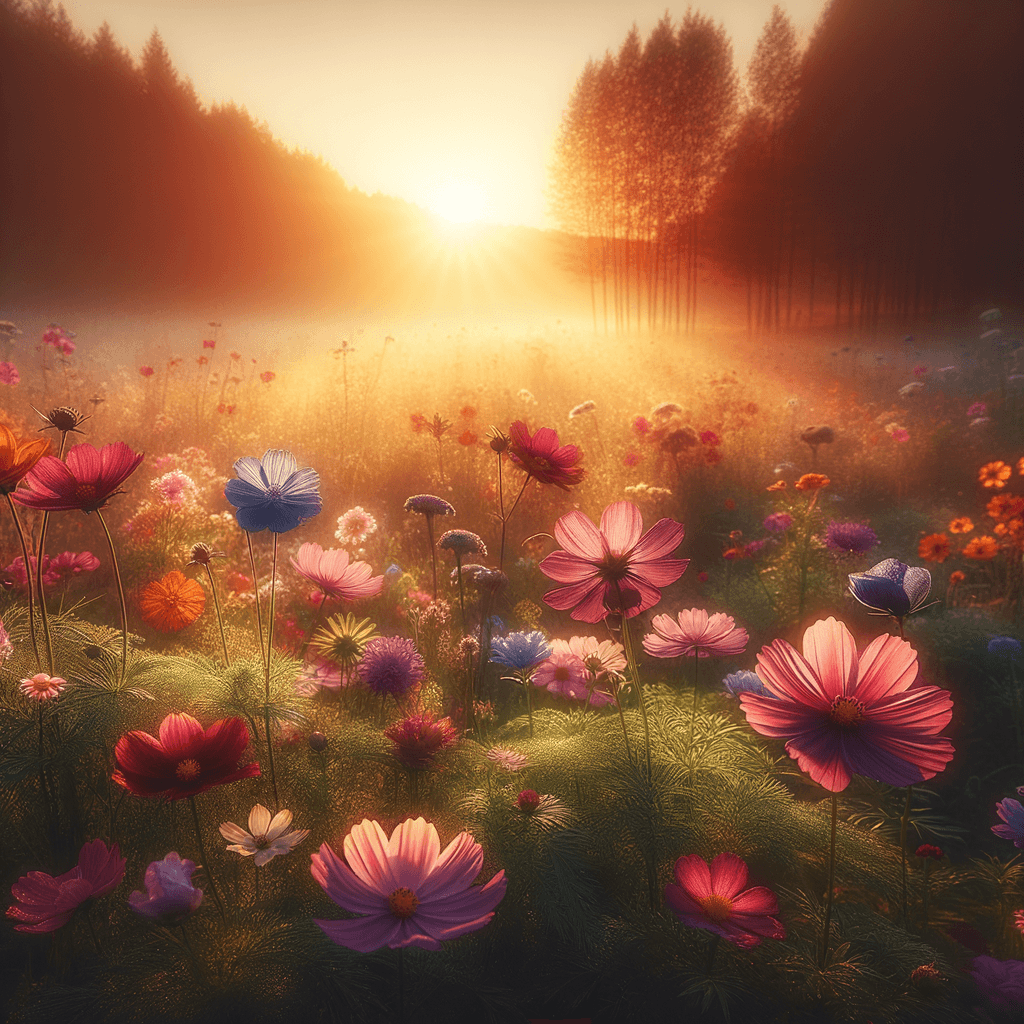
A flower does not think of competing with the flower next to it. It just blooms. — Zen Shin
—What lingers after this line?
Self-Expression and Growth
This quote highlights the idea of focusing on one's own growth and self-expression rather than comparing oneself to others. Like a flower, individuals should aim to fully embrace their own uniqueness and potential.
Releasing the Need for Competition
It emphasizes the futility of constant competition and urges people to appreciate their own journey instead of measuring their worth against others.
Mindfulness and Contentment
Inspired by Zen philosophy, this quote reminds us to live in the moment and find contentment in being who we are, without letting external judgments or comparisons affect our peace.
Harmony in Diversity
Flowers in a garden coexist in harmony, supporting the idea that diversity is a source of beauty and strength. In life, this reflects the importance of unity and mutual respect instead of rivalry.
Philosophical Perspective
This quote aligns with Zen Buddhism’s teachings, which advocate for simplicity, inner peace, and detachment from distractions like envy or competition.
One-minute reflection
What's one small action this suggests?
Related Quotes
6 selectedChildren do not need us to shape them. They need us to respond to who they are. — Naomi Aldort
Naomi Aldort
Naomi Aldort’s statement begins by rejecting a familiar adult impulse: the desire to mold children into predetermined forms. Instead, she proposes a quieter and more demanding task—paying attention to the person already...
Read full interpretation →If the family were a fruit, it would be an orange, a circle of sections, held together but separable—each segment distinct. — Letty Cottin Pogrebin
Letty Cottin Pogrebin
At first glance, Letty Cottin Pogrebin’s image feels simple, yet it captures family structure with unusual precision. By comparing a family to an orange, she evokes something whole, rounded, and naturally unified.
Read full interpretation →You're born an original—don't die a copy. — John Mason
John Mason
At its core, John Mason’s line is a sharp reminder that every person begins life with a distinct combination of temperament, talent, and perspective. To be “born an original” suggests that individuality is not something...
Read full interpretation →We are not here to fit into a mold, but to break the ones that keep our most honest work hidden. — Virginia Woolf
Virginia Woolf
At its core, Virginia Woolf’s statement rejects the quiet pressure to adapt ourselves to preexisting expectations. To “fit into a mold” suggests becoming legible, acceptable, and predictable at the cost of what is most i...
Read full interpretation →The individual has always had to struggle to keep from being overwhelmed by the tribe. But no price is too high to pay for the privilege of owning yourself. — Rudyard Kipling
Rudyard Kipling
Kipling’s statement begins with a stark observation: individuality is rarely effortless. From the start, he frames human life as a struggle between the person and the collective, where the ‘tribe’ represents not only com...
Read full interpretation →Your weirdness is the source of your character and creative powers. Weird is who we are, the best parts, not perfect, not trying—just yourself. — James Victore
James Victore
At its core, James Victore’s quote reframes “weird” from an insult into a declaration of identity. Rather than treating unusual traits as flaws to be corrected, he presents them as the very source of character and creati...
Read full interpretation →More From Author
More from Zen Shin →