
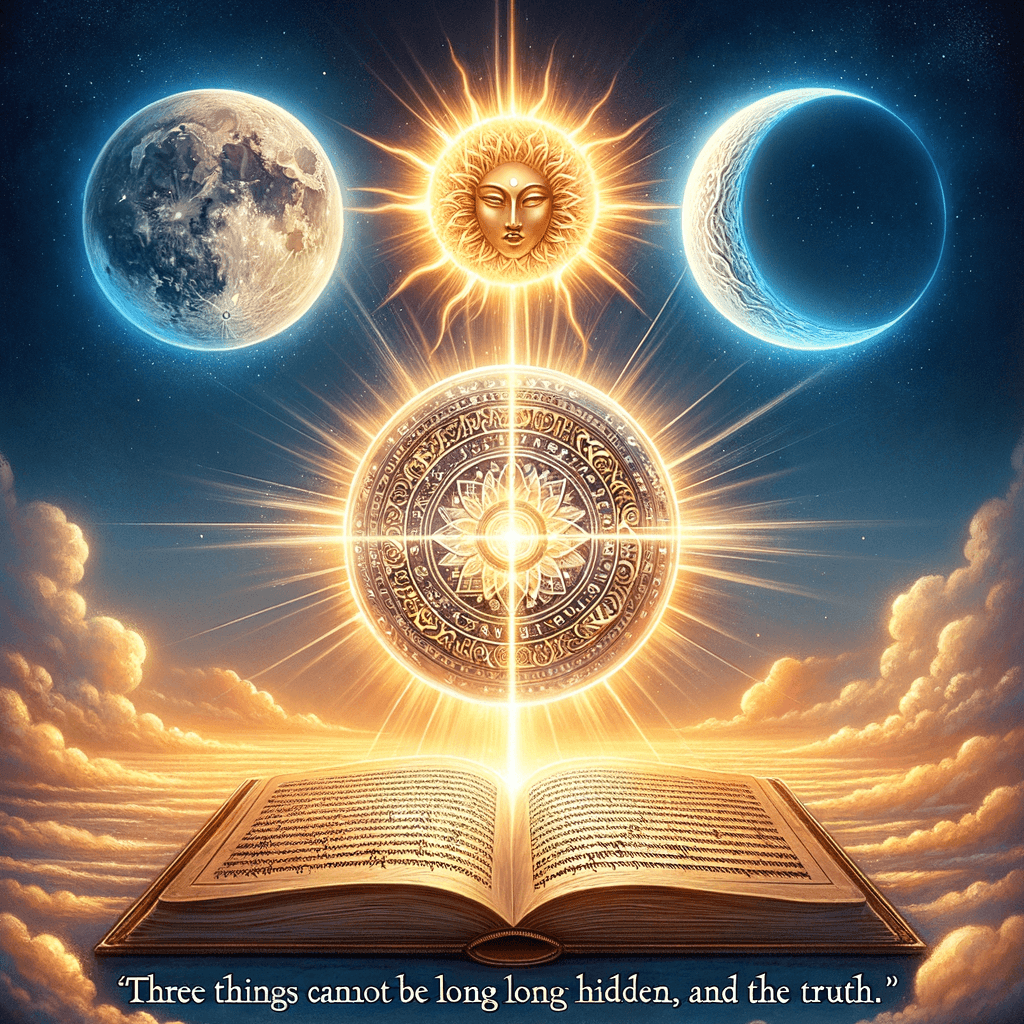
Three things cannot be long hidden: the sun, the moon, and the truth. — Buddha
—What lingers after this line?
Inevitability of Truth
This quote implies that just as the sun and the moon are visible in the sky at different times, the truth, no matter how much one tries to conceal it, will eventually come to light.
Nature's Certainties
The comparison of the truth to celestial bodies like the sun and the moon highlights that some things in life are absolutely certain and unchangeable. Truth, like these celestial bodies, is a constant.
Moral Guidance
Buddha's words serve as moral guidance, encouraging honesty and integrity. It suggests that living truthfully is the best path because deceit and falsehoods will eventually be exposed.
Philosophical Insight
The quote offers a philosophical insight into the natural order and the essence of reality. It recognizes the inherent power and inevitability of truth, portraying it as a fundamental aspect of existence.
Historical Context
Attributed to Buddha, this quote reflects Buddhist teachings that emphasize the pursuit of truth and wisdom. It is consistent with the broader themes of enlightenment and self-realization in Buddhist philosophy.
One-minute reflection
Why might this line matter today, not tomorrow?
Related Quotes
6 selectedThere are only two mistakes one can make along the road to truth... not going all the way, and not starting. — Buddha
Buddha
The quote frames truth not as a possession but as a journey—something approached through motion, effort, and direction. By calling it a “road,” the saying implies distance between our current understanding and clearer in...
Read full interpretation →The most precious jewel is insight. — Buddha
Buddha
Buddha’s observation that insight is the most precious jewel invites us to rethink conventional values. Whereas society often prizes material wealth—gold, gems, and possessions—Buddha places intellectual and spiritual cl...
Read full interpretation →When you realize how perfect everything is you will tilt your head back and laugh at the sky. — Buddha
Buddha
Buddha’s sage observation invites us to recognize a profound truth: when we truly see the perfection woven into the tapestry of existence, a deep and spontaneous joy emerges. This realization moves beyond a mere intellec...
Read full interpretation →The shadows: some hide, others reveal. — Antonio Porchia
Antonio Porchia
Antonio Porchia’s line begins with a quiet reversal: shadows are not merely places where things disappear. Some do hide, as we instinctively assume, but others reveal by outlining what light alone cannot show.
Read full interpretation →The truth is rarely comfortable, but it is the only thing that will actually set you free. Stop hiding from your reality and start owning your choices. — Pema Chödrön
Pema Chödrön
At its core, Pema Chödrön’s statement argues that freedom does not come from denial, distraction, or carefully managed appearances. Instead, it begins with the willingness to confront what is real, even when that reality...
Read full interpretation →Be a loner. That gives you time to wonder, to search for the truth. Have holy curiosity. Make your life worth living. — Albert Einstein
Albert Einstein
At first glance, Einstein’s advice to “be a loner” may sound like a rejection of society, yet his deeper point is about protecting the inner space where thought can mature. Solitude gives a person room to hear their own...
Read full interpretation →More From Author
More from Buddha →To keep the body in good health is a duty, otherwise we shall not be able to keep our mind strong and clear. — Buddha
At its core, this saying presents physical care not as vanity or indulgence, but as a duty. The body is treated as the necessary ground on which mental clarity stands, so neglecting it becomes more than a personal lapse—...
Read full interpretation →However many holy words you read, however many you speak, what good will they do you if you do not act upon them? — Buddha
Buddha’s question cuts through spiritual comfort by shifting attention from what we consume—holy texts and pious speech—to what we embody. Reading and reciting can feel like progress because they are visible and repeatab...
Read full interpretation →Better than a thousand hollow words, is one word that brings peace. — Buddha
Buddha’s saying begins with a simple comparison: quantity versus consequence. A thousand words can impress, distract, or even manipulate, yet still remain “hollow” if they do not reduce suffering or clarify the mind.
Read full interpretation →The way is not in the sky. The way is in the heart. — Buddha
Buddha’s line redirects spiritual seeking away from distant, external places—“the sky”—and toward the intimate terrain of lived experience. Instead of imagining truth as something hidden in the heavens or guarded by spec...
Read full interpretation →