
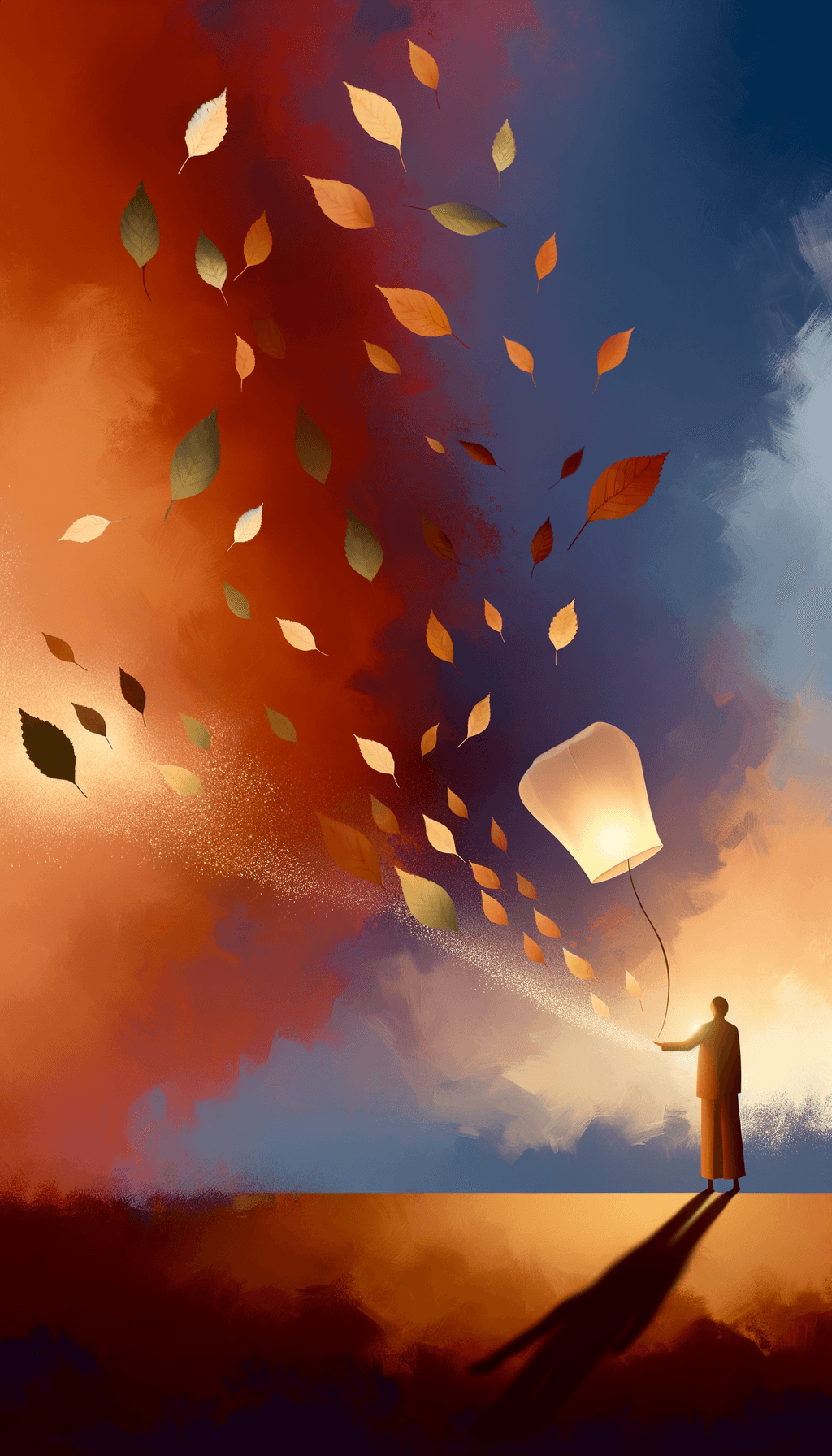
The art of living lies in a fine mingling of letting go and holding on. — Henry Havelock Ellis
—What lingers after this line?
Balance in Life
This quote highlights the importance of balance in life. It suggests that true wisdom comes from knowing when to relinquish control and when to persist, finding harmony in both actions.
Personal Growth
Letting go allows for new opportunities and self-discovery, while holding on provides stability and continuity. A successful life is shaped by understanding when to embrace change and when to remain steadfast.
Emotional Resilience
Navigating life effectively requires emotional resilience. Letting go of past burdens while holding onto meaningful relationships and values helps maintain emotional well-being.
Adaptability and Strength
This quote suggests that adaptability is key to success. Being too rigid or too passive can hinder progress, so a blend of persistence and flexibility is necessary for overcoming challenges.
Philosophical Outlook
Henry Havelock Ellis, a British psychologist and writer, often explored themes of human development and emotional well-being. His perspective encourages a balanced approach to life, combining acceptance with determination.
One-minute reflection
What feeling does this quote bring up for you?
Related Quotes
6 selectedA mind grows by staying with difficulty long enough for the experience to change it. — Mary Catherine Bateson
Mary Catherine Bateson
Mary Catherine Bateson’s observation begins with a quiet but demanding truth: the mind does not grow merely by encountering difficulty, but by remaining with it. Challenge becomes transformative only when we resist the u...
Read full interpretation →When you are friends with your storm, you dance, instead of getting blown away. — Michael Bassey Johnson
Michael Bassey Johnson
Michael Bassey Johnson’s line begins with a striking reversal: the storm is not merely an enemy to survive, but a force one can learn to understand. In this sense, the storm may represent grief, fear, conflict, uncertain...
Read full interpretation →Just because your light flickers does not mean it is about to go out. — Yohancé Salimu
Yohancé Salimu
At first glance, Yohancé Salimu’s line separates appearance from reality. A flicker suggests instability, fatigue, or interruption, yet it does not automatically signal extinction.
Read full interpretation →When something in your life dies—whether it be a job, a hobby, or a dream—I encourage you not to focus on what could have been but instead to look for the new life and the new opportunities that result. — Ryan Hall
Ryan Hall
Ryan Hall frames loss as a kind of death, and that metaphor immediately broadens the quote beyond grief in the literal sense. A job can end, a cherished hobby can fade, and a long-held dream can collapse; yet in each cas...
Read full interpretation →Dreams are made of sturdy stuff. — William Carlos Williams
William Carlos Williams
At first glance, William Carlos Williams’s line reverses a familiar assumption: dreams are often treated as airy, fleeting, and insubstantial, yet he insists they are made of “sturdy stuff.” In that compact phrase, he gi...
Read full interpretation →Confidence is not absence of fear; it is the quiet recognition that you have survived every hard day so far. — Michelle Obama
Michelle Obama
At first glance, confidence is often mistaken for boldness without hesitation, yet Michelle Obama’s words gently overturn that myth. She frames confidence not as the absence of fear, but as a steadier inner knowledge: yo...
Read full interpretation →More From Author
More from Henry Havelock Ellis →