
When You Realize That Nothing Is Lacking, The Whole World Belongs To You - Lao Tzu
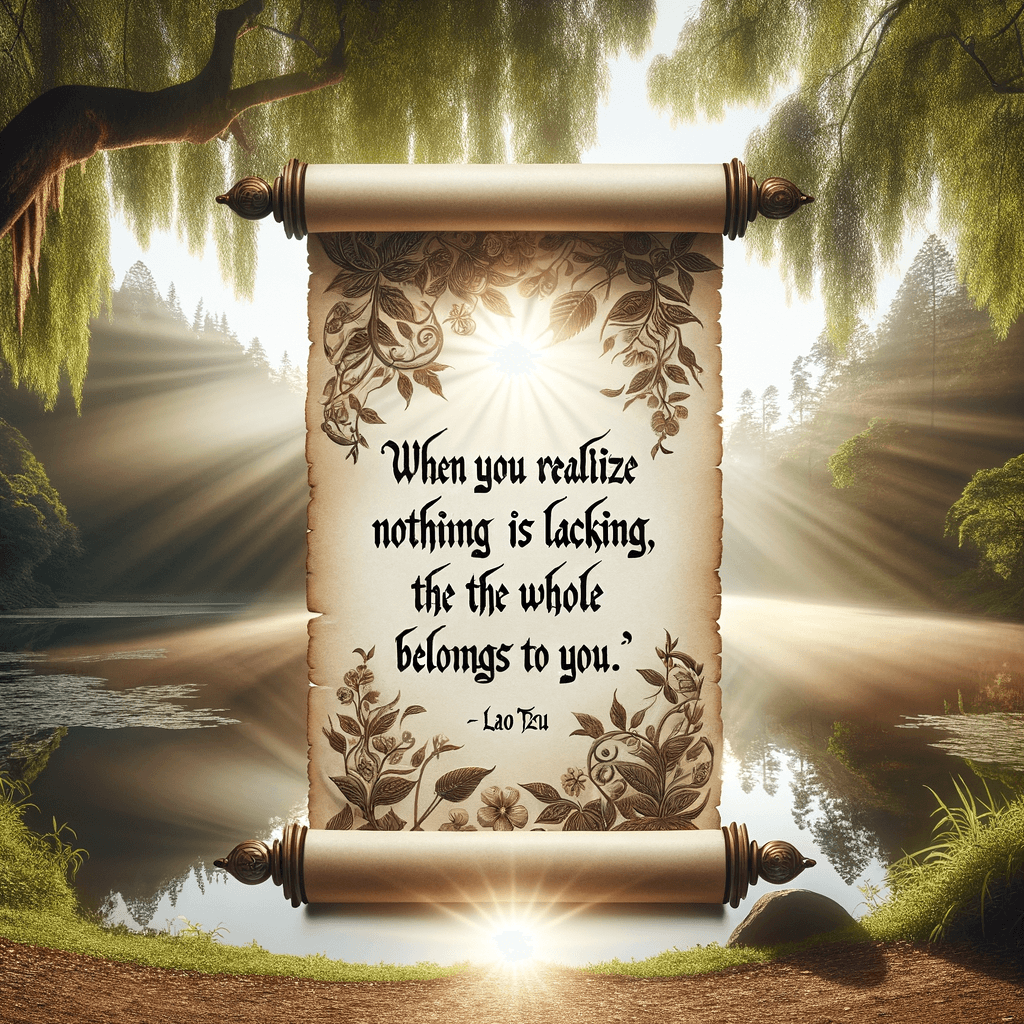
When you realize that nothing is lacking, the whole world belongs to you. - Lao Tzu
—What lingers after this line?
Contentment and Satisfaction
This quote highlights the idea that true satisfaction and contentment come from within. When you perceive that you lack nothing, you achieve a state of inner peace and fulfillment.
Mindset and Perception
Lao Tzu emphasizes that it's our mindset and perception that shape our reality. By realizing that we have everything we need, we feel a sense of abundance and ownership over our own lives.
Philosophical Perspective
The quote reflects Taoist philosophy, which values simplicity, humility, and the understanding that true wealth is not material but spiritual and psychological.
Freedom from Desire
Lao Tzu suggests that releasing desires and recognizing sufficiency in what we have liberates us from feelings of envy, jealousy, and inadequacy, allowing us to feel a greater connection to the world.
Gratitude and Abundance
Appreciating what we have fosters a sense of gratitude, leading to a richer, more abundant experience of life, where we feel as though the whole world is ours to enjoy.
Historical Context
Lao Tzu, an ancient Chinese philosopher and writer, founded Taoism. His teachings often focus on living harmoniously and understanding the natural order of the universe, reflecting the values and beliefs of ancient Chinese culture.
Recommended Reading
As an Amazon Associate, we earn from qualifying purchases.
One-minute reflection
Where does this idea show up in your life right now?
Related Quotes
6 selectedTo desire nothing is to be serene. — Laozi
Lao Tzu
Laozi’s assertion that ‘to desire nothing is to be serene’ invites us to consider the burdens imposed by desire. In the *Tao Te Ching* (c.
Read full interpretation →By not exalting the worthy, the people are not contentious; By not valuing rare treasures, the people do not steal; By not displaying what is desirable, the hearts of the people remain calm. Therefore, the Sage governs by emptying their minds and filling their bellies, Weakening their ambitions and strengthening their bones. He always keeps the people free from knowledge and desire, And ensures that the clever dare not act. Practice non-action, And there is nothing that cannot be governed. - Laozi
Lao Tzu
This passage, commonly aligned with Tao Te Ching, chapter 3, sketches a governing philosophy that cools desire rather than inflaming it. By not exalting the worthy or parading rare treasures, the ruler removes the fuel o...
Read full interpretation →The best fighter is never angry. — Lao Tzu
Lao Tzu
Lao Tzu’s observation that 'the best fighter is never angry' underscores a profound principle: true strength arises from inner calm rather than rage. While anger may seem to fuel action, Lao Tzu, writing in the foundatio...
Read full interpretation →Happiness is what's there when you remove the sense that something is missing in your life. — Naval Ravikant
Naval Ravikant
Naval Ravikant frames happiness as what remains once a particular mental noise is turned off: the persistent feeling that life is incomplete. In this view, happiness isn’t primarily a prize earned by stacking achievement...
Read full interpretation →A real sign of progress is when we stop trying to outrun our past and start learning how to sit with it, breathe through it, and let it go. — Yung Pueblo
Yung Pueblo
Yung Pueblo reframes progress as something quieter than achievement or constant motion. Instead of measuring growth by how far we’ve run from painful memories, he points to a more intimate metric: our ability to remain p...
Read full interpretation →The secret to happiness is: low expectations. — Zadie Smith
Zadie Smith
Zadie Smith’s line lands like a small insult to our motivational age: instead of “dream bigger,” she suggests “expect less.” Yet the provocation is purposeful. By calling low expectations a “secret,” she hints that happi...
Read full interpretation →More From Author
More from Lao Tzu →Nature does not hurry, yet everything is accomplished. — Lao Tzu
Lao Tzu’s line reframes success as something compatible with calm. Instead of praising speed, it points to a different kind of effectiveness—one that unfolds without strain, panic, or constant forcing.
Read full interpretation →Nature does not hurry, yet everything is accomplished. — Lao Tzu
Lao Tzu’s line points to a simple but demanding truth: completion does not require haste. In nature, processes unfold at their own pace—seeds germinate when conditions are right, rivers carve canyons over ages, and seaso...
Read full interpretation →To a mind that is still, the whole universe surrenders. — Lao Tzu
Lao Tzu’s line suggests that mastery does not begin with force, argument, or speed, but with inner stillness. When the mind stops chasing every thought and reaction, experience becomes clearer, as if the world itself is...
Read full interpretation →Nature does not hurry, yet everything is accomplished. — Lao Tzu
Lao Tzu’s line captures a paradox that feels true the moment you notice it: nature rarely appears rushed, yet outcomes reliably arrive. Seasons turn, seedlings become trees, rivers carve canyons—without the frantic urgen...
Read full interpretation →