
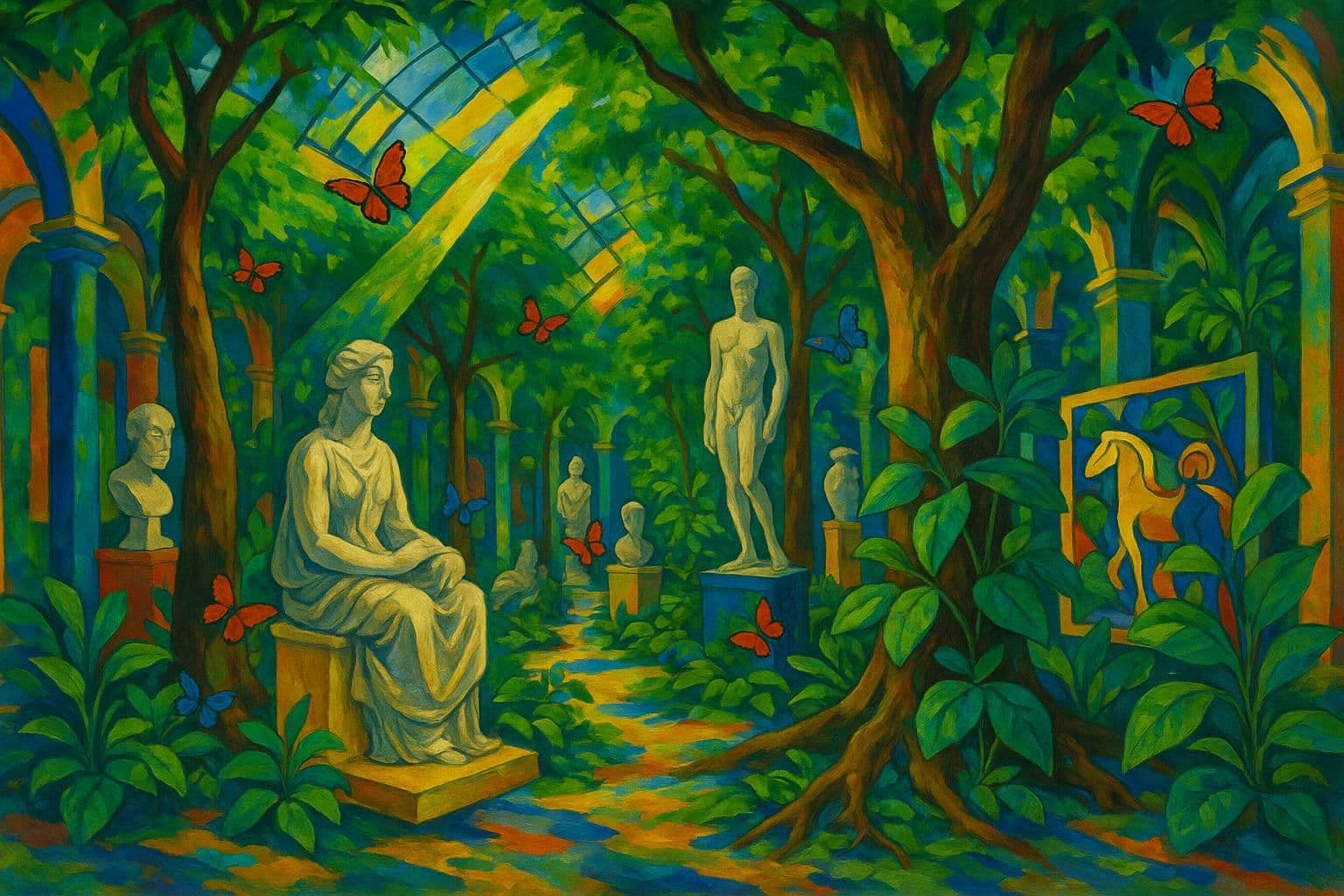
Give me a museum and I’ll fill it. — Pablo Picasso
—What lingers after this line?
Boundless Creative Confidence
Picasso’s assertion reveals a profound self-belief in his artistic productivity. He implies that his ideas and output are limitless, echoing his prolific career—he reportedly created more than 20,000 artworks in his lifetime. His 1939 exhibition at New York’s Museum of Modern Art (*Picasso: Forty Years of His Art*) demonstrated his vast range across styles, subjects, and media.
Challenging Traditional Curation
Traditionally, museums select works from many artists to represent a broad narrative. Picasso’s quote disrupts this convention by proposing a single artist as sufficient to fill an entire institution, much like the Musée Picasso in Paris, dedicated exclusively to his oeuvre since 1985.
Ego and Artistic Identity
The line also hints at Picasso's well-known ego and his view of the artist’s role in society. Like Michelangelo, who filled the Sistine Chapel ceiling with his vision, Picasso saw himself as someone whose creativity was monumental enough to occupy whole cultural spaces.
Artistic Innovation and Experimentation
Picasso’s career was marked by relentless experimentation—from Blue Period melancholy to Cubist abstraction. This versatility allowed him to ‘fill’ not just space, but categories. For example, *Les Demoiselles d’Avignon* (1907) stands as a radical departure from tradition, inspiring new museum displays and academic debate.
Value of Artistic Legacy
Picasso’s words also forecast the enduring relevance of his art. Decades after his death, his works continue to fill galleries and inspire retrospectives, underlining the lasting impact he foresaw. The 2015 exhibition *Picasso Sculpture* at MoMA demonstrated how even a subset of his work could command major international attention.
One-minute reflection
Where does this idea show up in your life right now?
Related Quotes
6 selectedTurn scarcity into a classroom; scarcity teaches creative abundance. — Paulo Coelho
Paulo Coelho
Coelho reframes scarcity from a sentence into a syllabus: when resources tighten, life becomes a classroom that forces attention, prioritization, and ingenuity. Instead of seeing lack as only deprivation, he suggests we...
Read full interpretation →Art is the lie that enables us to realize the truth. - Pablo Picasso
Pablo Picasso
This quote suggests that art, though it may present an altered reality or an illusion, helps us to understand deeper truths about the world and ourselves. It acknowledges the transformative power of art in revealing hidd...
Read full interpretation →Art is the lie that enables us to realize the truth. - Pablo Picasso
Pablo Picasso
This quote introduces a paradoxical idea that art, while being a form of deception or illusion, helps us understand deeper truths about life, humanity, and the world.
Read full interpretation →Everything you can imagine is real. — Pablo Picasso
Pablo Picasso
This quote highlights the extraordinary power of human imagination. It suggests that the act of imagining something gives it a form of reality, even if only in the mental or creative realm.
Read full interpretation →Art is the lie that enables us to realize the truth. - Pablo Picasso
Pablo Picasso
This quote highlights the function of art in society, suggesting that art provides a unique means to understand and interpret deeper truths that might not be immediately apparent in reality.
Read full interpretation →Action is the foundational key to all success. — Pablo Picasso
Pablo Picasso
This quote emphasizes that taking action is crucial for achieving success. Without action, plans, dreams, and ideas remain unfulfilled.
Read full interpretation →More From Author
More from Pablo Picasso →It is not the language of painters but the language of nature which one should listen to. — Pablo Picasso
At first glance, Picasso’s remark challenges the authority of artistic convention. By contrasting ‘the language of painters’ with ‘the language of nature,’ he suggests that art should not merely imitate established techn...
Read full interpretation →The chief enemy of creativity is good sense. — Pablo Picasso
At first glance, Picasso’s claim sounds like a provocation against reason itself. Yet his point is subtler: ‘good sense’ often means the habits, rules, and social expectations that keep people from taking imaginative ris...
Read full interpretation →The artist is a receptacle for emotions that come from all over the place: from the sky, from the earth, from a scrap of paper, from a passing shape, from a spider's web. — Pablo Picasso
At the heart of Picasso’s remark is a striking redefinition of creativity: the artist is not merely a maker, but a receiver. Rather than inventing emotion from nothing, the artist absorbs impressions that drift in from t...
Read full interpretation →Computers are useless. They can only give you answers. — Pablo Picasso
Pablo Picasso’s jab—“Computers are useless. They can only give you answers.”—is less a literal dismissal than a provocation about what humans value.
Read full interpretation →