
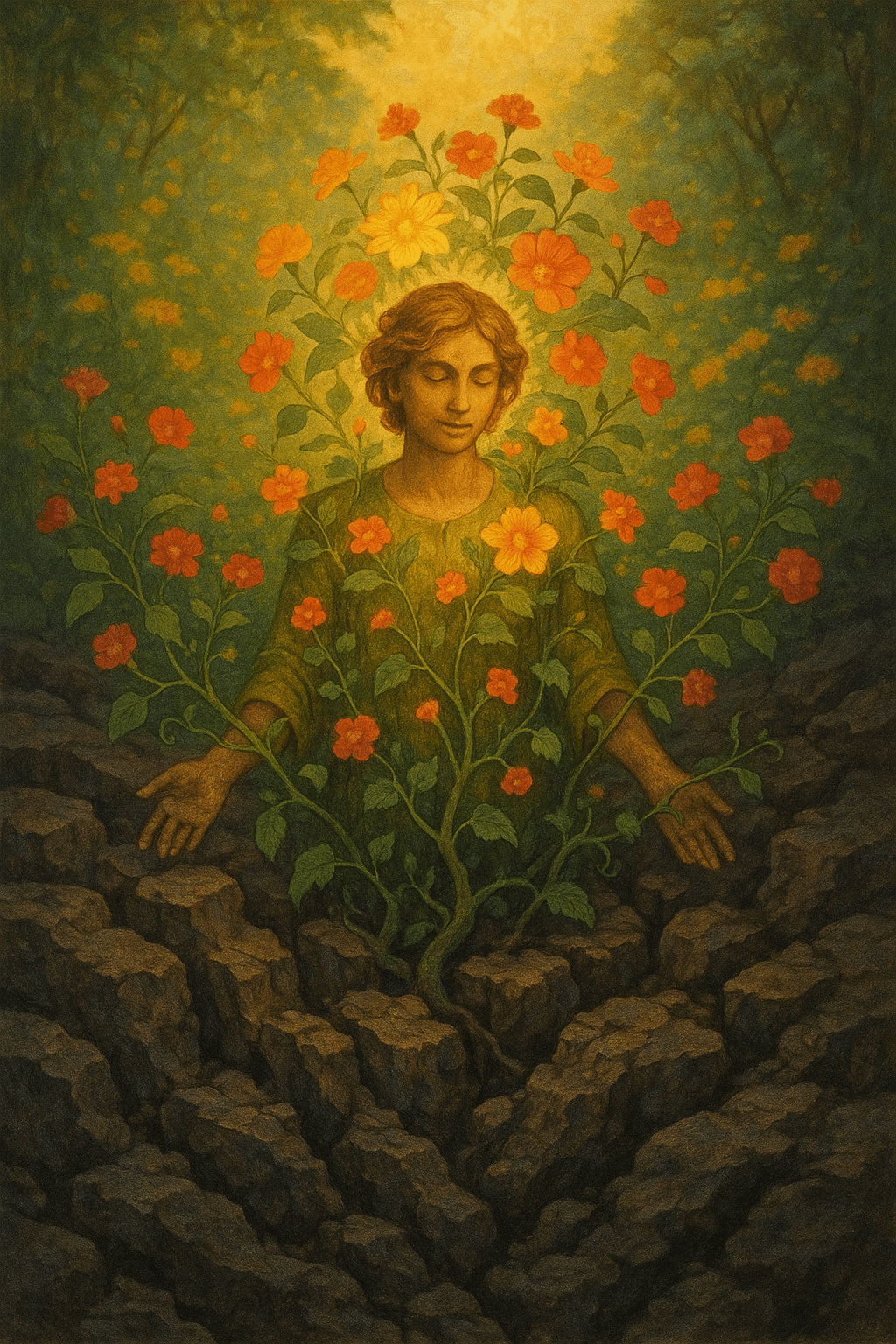
Struggle is the gardener that makes the soul bloom. — Rumi
—What lingers after this line?
Rumi’s Metaphor of Growth Through Hardship
Rumi, the celebrated 13th-century Sufi poet, often explored themes of transformation in his writings. By likening struggle to a gardener, he suggests adversity is not a mere obstacle but a nurturing force. Just as a gardener tends, prunes, and sometimes uproots to encourage healthy blooms, difficulties in life cultivate resilience and beauty within the soul.
Historical Perspectives on Adversity
This idea echoes through philosophical history: in Stoicism, Epictetus (c. 100 AD) argued that hardship is essential for developing virtue. Similarly, Friedrich Nietzsche later wrote, 'What does not kill me, makes me stronger.' Both thinkers, like Rumi, emphasize that genuine strength and character emerge from enduring challenges, rather than avoiding them.
Transformation and Self-Discovery
Building upon this, struggle acts as a catalyst for self-discovery. Psychological research shows that individuals often find deeper meaning and personal growth after facing significant hardships, a phenomenon known as post-traumatic growth (Tedeschi & Calhoun, 1996). Much as a seed breaks open before it sprouts, the soul too may need adversity to reveal its fullest expression.
Spiritual Resonances in Rumi’s Teachings
From a spiritual perspective, Rumi’s metaphor aligns with Sufi concepts of purification and divine love. He believed that suffering strips away the ego, clearing the way for compassion and wisdom to flourish. For example, Rumi’s own heartbreak after Shams of Tabriz’s departure is often credited with inspiring his most profound poetry and spiritual insights.
Embracing Struggle for Personal Renewal
Ultimately, recognizing struggle as a nurturing gardener transforms one’s outlook on difficulties. Rather than dreading challenges, individuals can view them as opportunities for renewal and blossoming. This mindset, championed by Rumi, invites us to embrace our struggles with grace, trusting that each hardship has the potential to cultivate a more resilient and radiant spirit.
Recommended Reading
As an Amazon Associate, we earn from qualifying purchases.
One-minute reflection
What's one small action this suggests?
Related Quotes
6 selectedIt is your reaction to adversity, not adversity itself that determines how your life's story will develop. — Dieter F. Uchtdorf
Dieter F. Uchtdorf
At its heart, Dieter F. Uchtdorf’s statement shifts attention away from hardship itself and toward human agency.
Read full interpretation →If you never let yourself struggle, you never let yourself grow strong. Resilience is not the absence of difficulty; it is the integration of it. — Annie Wright
Annie Wright
At its core, Annie Wright’s quote argues that strength is not formed in comfort but in contact with resistance. If a person is never tested, their capacities remain largely theoretical, much like an unused muscle that ne...
Read full interpretation →Whatever challenge you might find yourself in, has a solution. It is very much possible that it is not an obvious one. — Anonymous (skipped) → You have power over your mind – not outside events. Realise this, and you will find strength. — Marcus Aurelius
Marcus Aurelius
Taken together, these two quotations form a single philosophy of endurance: every challenge contains the possibility of a solution, even when that solution is difficult to see. The anonymous saying begins with hope, insi...
Read full interpretation →No matter how difficult the past, you can always begin again today. — Jack Kornfield
Jack Kornfield
Jack Kornfield’s words offer a quiet but powerful assurance: the past may shape us, yet it does not have to imprison us. By saying we can begin again today, he shifts attention from what cannot be changed to what can sti...
Read full interpretation →Do not consider painful what is good for you. — Euripides
Euripides
At its heart, Euripides’ line urges a change in judgment rather than a denial of discomfort. He does not claim that what helps us will always feel pleasant; instead, he asks us not to treat beneficial suffering as someth...
Read full interpretation →The capacity to remain clear-eyed in the midst of chaos is the greatest skill you can cultivate for the modern world. — Matt Norman
Matt Norman
Matt Norman’s statement frames clarity not as a passive gift but as a discipline deliberately cultivated under pressure. In a world saturated with crises, notifications, and competing demands, the ability to see things a...
Read full interpretation →More From Author
More from Rumi →Confidence is silent. Insecurities are loud. Do not feel the need to broadcast your worth to a world that doesn't understand your path. — Rumi
At its core, this saying contrasts two very different emotional states: confidence, which rests quietly within, and insecurity, which seeks constant outward expression. The point is not that confident people never speak,...
Read full interpretation →There is a channel between voice and presence, a way where information flows. In disciplined silence the channel opens. — Rumi
Rumi’s line begins with a subtle distinction: voice is not the same as presence. Voice suggests expression, language, and outward communication, while presence points to something deeper—an inner reality felt before it i...
Read full interpretation →Everything that is made beautiful and fair and lovely is made for the eye of one who sees. — Rumi
At first glance, Rumi’s line suggests that beauty is not merely a fixed property lodged inside an object. Instead, what is beautiful and fair becomes meaningful in relation to a perceiving soul.
Read full interpretation →Patience with small details makes perfect a large work, like the universe. — Rumi
Rumi’s line begins with a humble insight: greatness is rarely born all at once. Instead, large works become whole through steady attention to what seems minor at first glance.
Read full interpretation →