
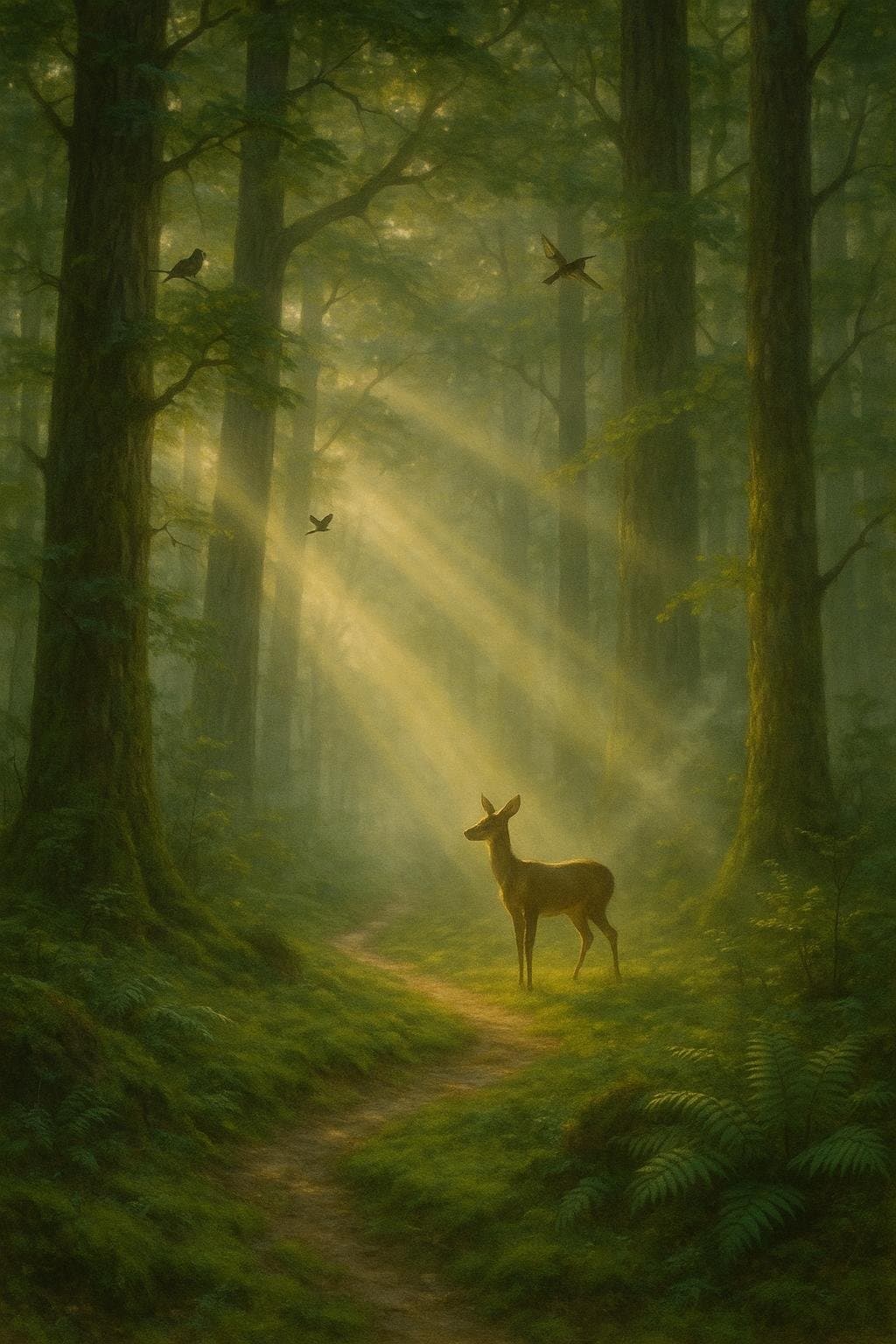
The forest is not silent; it teaches patience. — Bashō
—What lingers after this line?
Bashō’s Insight: Nature as a Teacher
The renowned Japanese poet Matsuo Bashō, known for his deep reverence for the natural world, expresses in this quote that the forest is far from mute. Instead, he sees it as a living presence that communicates vital wisdom to those willing to listen. Bashō’s haiku and prose frequently explore the concept of learning from nature, highlighting that every rustle and whisper carries meaning for the attentive observer.
Beyond Silence: Unseen Activity in the Woods
Contrary to popular belief, forests are dynamic ecosystems teeming with life and subtle sound. From the gentle sway of branches to the distant calls of birds, the forest’s quiet hum invites us to attune our senses. This abundance of subtle noise draws us inward, fostering a contemplative state. In this sense, Bashō’s words remind us that the absence of human commotion reveals a different form of communication—one that requires patience to discern.
Patience: Nature’s Pace and Human Lessons
Transitioning from silence to patience, the forest exemplifies natural cycles unfolding at their own rhythm. Seeds germinate, trees grow over decades, and animals move in harmony with the seasons. Such gradual processes teach us the value of waiting and persistence. As in Bashō’s journeys detailed in 'The Narrow Road to the Deep North' (1689), immersion in the wild fosters patience, encouraging us to surrender urgency in favor of steady observation and trust in gradual growth.
Cultural Perspectives on Nature’s Guidance
Many cultures have recognized the forest’s transformative power. Indigenous traditions often regard woodlands as sites of instruction and healing, where patience is needed to interpret subtle signs. Similarly, Japanese aesthetics like ‘wabi-sabi’ value the imperfect and transitory, a philosophy reflected in forest landscapes. Bashō’s poetic legacy thus connects individual mindfulness with a broader cultural appreciation for the quiet, slow wisdom of nature.
Modern Relevance: Practicing Patience in a Fast World
Bringing Bashō’s insight to the present, our fast-paced lives rarely allow for forest-like patience. Yet, practices like forest bathing (‘shinrin-yoku’) are gaining popularity as a means to reset one’s rhythm, learning from the natural world’s steadiness. By attuning ourselves to the forest’s subtle lessons, as Bashō suggests, we can cultivate resilience, tranquility, and a deeper capacity for patience amid everyday noise.
One-minute reflection
Where does this idea show up in your life right now?
Related Quotes
6 selectedRoses do not bloom hurriedly; for beauty, like any masterpiece, takes time to blossom. — Matshona Dhliwayo
Matshona Dhliwayo
At its heart, Matshona Dhliwayo’s quote reminds us that true beauty cannot be forced. A rose does not rush toward bloom, nor does it apologize for the time required to unfold.
Read full interpretation →There is no road too long to the man who advances deliberately and without undue haste; there are no honors too distant to the man who prepares himself for them with patience. — Jean de La Bruyère
Jean de La Bruyère
At its core, La Bruyère’s line praises steady movement over restless speed. A long road feels intimidating only when seen all at once; once it is broken into deliberate steps, distance loses much of its power.
Read full interpretation →The ultimate mysteries are opened only to those who have immense patience. — Osho
Osho
Osho’s statement begins with a simple but demanding premise: the deepest truths do not yield to force. In this view, mystery is not a puzzle to be solved quickly but a reality that unfolds on its own terms.
Read full interpretation →Do you have the patience to wait until your mud settles and the water is clear? — Lao Tzu
Lao Tzu
Lao Tzu’s question frames patience not as passive delay but as an active kind of wisdom. The image of muddy water settling on its own suggests that confusion often clears not through force, but through restraint.
Read full interpretation →The wise do things slowly, because they love it. — David Fell
David Fell
At first glance, David Fell’s line seems to praise caution, yet it reaches further than mere hesitation. To do something slowly, in this view, is not to be indecisive but to be fully present.
Read full interpretation →A farmer is helpless to grow grain; all he can do is provide the right conditions for the growing of grain. — Richard J. Foster
Richard J. Foster
At first glance, Foster’s farming metaphor shifts attention away from control and toward humility. A farmer cannot command a seed to sprout, just as a person cannot force true growth—whether spiritual, personal, or relat...
Read full interpretation →More From Author
More from Bashō →Do not seek to follow in the footsteps of the ancients; seek what they sought. — Matsuo Bashō
Bashō’s counsel draws a sharp line between copying a master’s outward style and inheriting a master’s inward purpose. “Footsteps” implies visible technique—preferred subjects, established forms, and recognizable manneris...
Read full interpretation →From the smallest flame grows the mightiest blaze. — Bashō
Bashō’s proverb elegantly underscores how grand outcomes often originate from the humblest beginnings. Just as an impressive blaze starts with a meager spark, so too do remarkable achievements frequently grow from simple...
Read full interpretation →Impermanence is the essence of beauty in this world. — Bashō
Bashō, the celebrated Japanese haiku master, distills a deep truth: the fleeting nature of things is what gives them their beauty. His poetry—whether describing the transient bloom of cherry blossoms or the brief cry of...
Read full interpretation →