
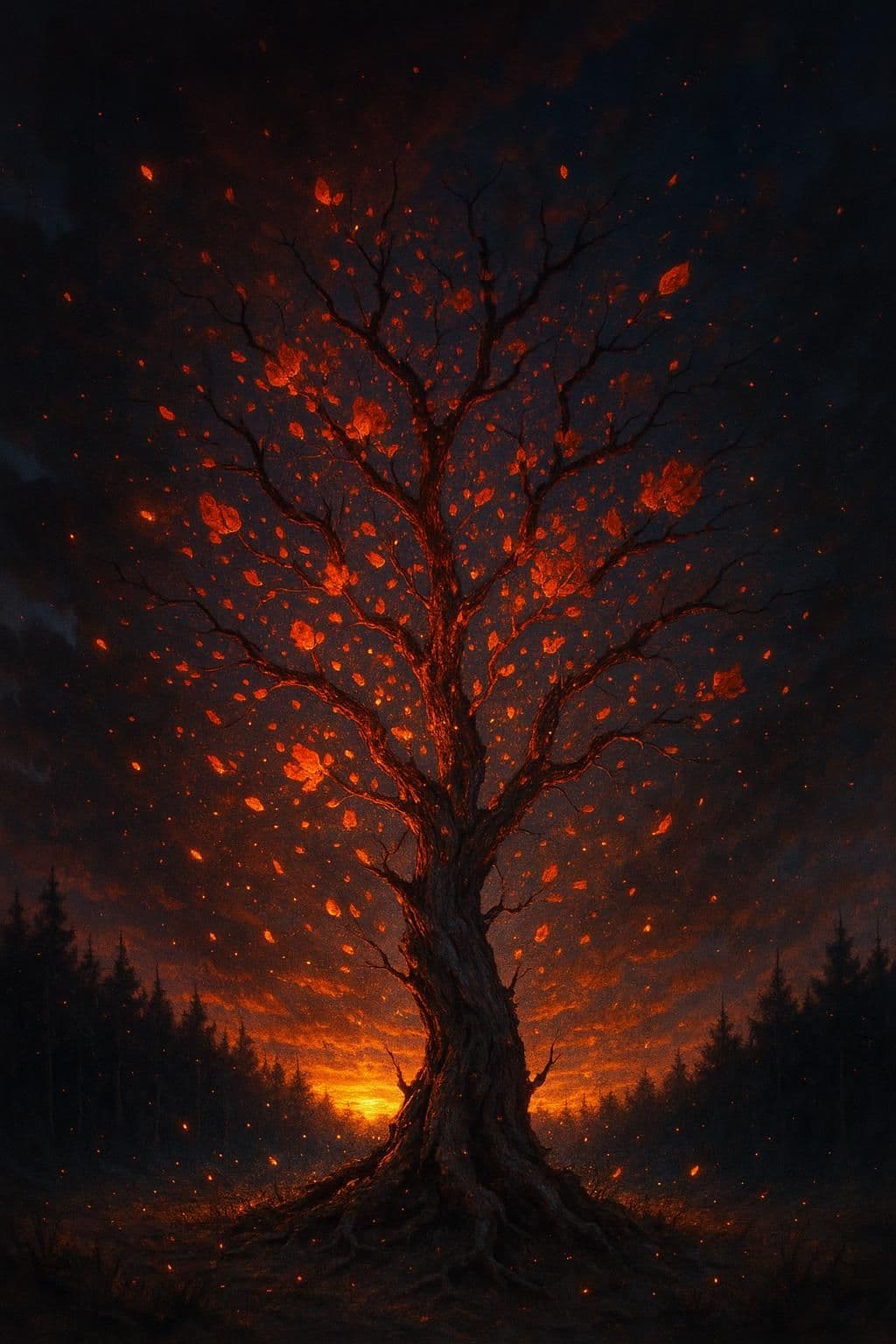
Do not go gentle into that good night. Rage, rage against the dying of the light. — Dylan Thomas
—What lingers after this line?
The Imperative of Resistance
Dylan Thomas's renowned line compels its readers not to surrender passively to mortality or adversity. Rather, he urges a spirited resistance—a refusal to yield quietly to the inevitability of death or decline. The imagery of 'that good night' as a metaphor for the end of life transforms the poem into a universal call to confront challenges with fervor and determination.
Exploring the Symbolism of Light and Darkness
Transitioning from the theme of resistance, Thomas’s use of 'the dying of the light' and 'that good night' powerfully encapsulates human mortality. Throughout literary history, light has often symbolized life, knowledge, and hope, while darkness suggests oblivion or despair. The poet’s exhortation to ‘rage’ against darkness is a metaphorical battle to cling to purpose, vibrancy, and awareness for as long as possible.
Personal Grief and Universal Resonance
Delving deeper, Thomas wrote this poem as his father was gravely ill, imbuing the lines with personal anguish and urgency. Yet, the poem’s emotional force transcends individual loss, resonating with anyone facing the inexorable passage of time. By framing his plea in universal terms, Thomas bridges private grief and the collective existential struggle against impermanence.
Echoes in Literature and Philosophy
Literary and philosophical traditions frequently revisit the theme of resisting fate. Sophocles’s 'Antigone' (c. 441 BC) grapples with defiance against unjust decrees, while Nietzsche’s idea of life-affirmation extols heroic persistence amid adversity. Thomas’s poem fits within this lineage, echoing the steadfast courage found in works that valorize individual agency against overwhelming odds.
A Call to Live With Intensity
Ultimately, Thomas’s rallying cry is not merely about death, but about living passionately and purposefully. His injunction to ‘rage’ encourages us to embrace experience fully, to challenge complacency, and to fight for meaning until the very end. In this way, Thomas’s verses become both an elegy and a manifesto for living with undiminished spirit, even in the twilight hours.
One-minute reflection
What feeling does this quote bring up for you?
Related Quotes
6 selectedDo not go gentle into that good night. Rage, rage against the dying of the light. — Dylan Thomas
Dylan Thomas
Dylan Thomas’s iconic invocation, ‘Do not go gentle into that good night,’ is more than a poetic phrase—it is an urgent appeal to resist the inevitability of death. Through commanding repetition, Thomas urges readers not...
Read full interpretation →Do not go gentle into that good night. Rage, rage against the dying of the light. — Dylan Thomas
Dylan Thomas
Dylan Thomas’s exhortation strikes at the heart of human defiance: when faced with the inevitable approach of death, he implores us not to succumb passively. The 'good night' symbolizes life’s end, while 'rage against th...
Read full interpretation →Consistency is contrary to nature, contrary to life. The only completely consistent people are the dead. — Aldous Huxley
Aldous Huxley
At its core, Huxley’s remark argues that life is inseparable from movement, revision, and contradiction. A living person responds to new experiences, changing relationships, and shifting knowledge; therefore, complete co...
Read full interpretation →Whatever your main struggle is, it is insignificant in the face of your death; it is petty and unimportant and has no meaning at all. — Brad Blanton
Brad Blanton
At first glance, Brad Blanton’s statement sounds severe, yet its force comes from using death as the ultimate scale of value. When every ambition, resentment, and anxiety is placed beside the certainty of mortality, many...
Read full interpretation →You could leave life right now. Let that determine what you do, say, and think. — Marcus Aurelius
Marcus Aurelius
Marcus Aurelius compresses an entire philosophy into a single jolt: you could die at any moment, so let that fact govern your actions, words, and thoughts. In his Meditations (c.
Read full interpretation →You go naked until you die. — Nikki Giovanni
Nikki Giovanni
Nikki Giovanni’s line lands with the bluntness of a fact we rarely face head-on: from our first breath to our last, we ultimately own very little. Although clothing, titles, and accomplishments feel like armor, the quote...
Read full interpretation →More From Author
More from Dylan Thomas →The moment a man begins to talk about technique, that's proof that he is fresh out of ideas. — Dylan Thomas
Dylan Thomas’s remark begins with a sharp suspicion: when an artist talks too much about technique, the living impulse behind the work may already be gone. Technique, in this sense, becomes a substitute language, a way o...
Read full interpretation →The best craftsmanship always leaves holes and gaps... so that something that is not in the poem can creep, crawl, flash or thunder in. — Dylan Thomas
At first glance, Dylan Thomas seems to praise incompleteness, yet his point is more subtle: the finest art is not sealed shut. By leaving “holes and gaps,” a poem makes room for forces beyond the writer’s direct control—...
Read full interpretation →Do not go gentle into that good night. Rage, rage against the dying of the light. — Dylan Thomas
Dylan Thomas’s iconic invocation, ‘Do not go gentle into that good night,’ is more than a poetic phrase—it is an urgent appeal to resist the inevitability of death. Through commanding repetition, Thomas urges readers not...
Read full interpretation →Do not go gentle into that good night. Rage, rage against the dying of the light. — Dylan Thomas
Dylan Thomas’s exhortation strikes at the heart of human defiance: when faced with the inevitable approach of death, he implores us not to succumb passively. The 'good night' symbolizes life’s end, while 'rage against th...
Read full interpretation →