
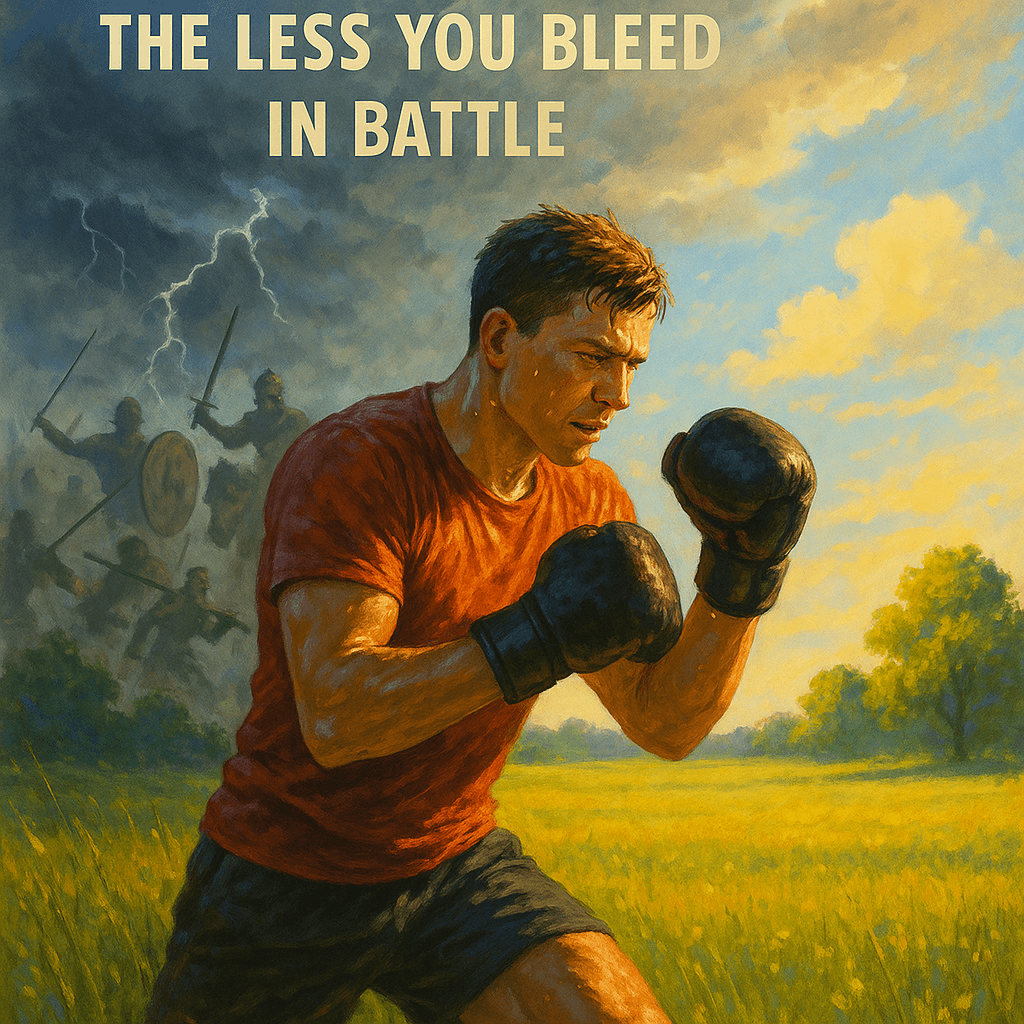
The more you sweat in practice, the less you bleed in battle. — Richard Marcinko
—What lingers after this line?
The Principle of Rigorous Preparation
Richard Marcinko’s adage emphasizes a fundamental truth that transcends military contexts: preparation fosters resilience. By urging us to embrace exhaustive training, he underscores how confronting difficulty in controlled settings readies us for the unexpected pressures of real-world challenges. This concept highlights a universal value—the more effort we invest before the decisive moment, the better poised we are for success.
From Battlefield to Boardroom
Transitioning from its military roots, the idea readily applies to fields as varied as business and sports. In corporate settings, leaders cultivate crisis simulations—akin to strategic drills—so teams can respond swiftly under pressure. This echoes Marcinko’s lesson: whether meeting tight deadlines or managing high-stakes negotiations, those who practice with intensity perform more capably when it counts.
Ancient Wisdom Revisited
This philosophy recalls ancient teachings; for instance, Greek historian Thucydides quoted Athenian soldiers: 'their drills were bloodless battles, and their battles, bloody drills.' Such wisdom suggests that humanity has long recognized the protective value of diligent preparation, linking Marcinko’s words to a timeless tradition of readiness.
Transforming Adversity Into Growth
Furthermore, embracing hardship during practice transforms adversity into a tool for growth. By confronting one’s weaknesses in a low-risk environment, individuals develop not just skill but also adaptability. Psychologist Anders Ericsson’s research on deliberate practice affirms this notion: the most successful performers consistently stretch their limits in training, reducing the risk of failure in real application.
Building Confidence and Camaraderie
Ultimately, this principle does more than protect us from future harm—it forges confidence and fosters unity. Shared struggle in preparation strengthens bonds among teams, whether on the playing field or the battlefield. In this way, Marcinko’s insight reminds us that the sweat of preparation not only conserves future strength but also forges the trust and assurance essential for collective triumph.
One-minute reflection
Why might this line matter today, not tomorrow?
Related Quotes
6 selectedYou cannot out-train poor recovery. — Andrew Huberman
Andrew Huberman
Andrew Huberman’s statement cuts through a common fitness illusion: more training does not automatically mean more progress. Exercise creates stress and signals the body to adapt, but the actual rebuilding happens afterw...
Read full interpretation →The art of life is more like the wrestler's art than the dancer's; stand ready and firm to meet sudden and unexpected onsets. — Marcus Aurelius
Marcus Aurelius
Marcus Aurelius contrasts two arts to clarify what living well demands. A dancer suggests elegance, rhythm, and practiced beauty; a wrestler, by contrast, suggests balance under pressure, resistance, and constant readine...
Read full interpretation →Better remain silent, better not even think, if you are not prepared to act. — Annie Besant
Annie Besant
Annie Besant’s line shocks on purpose: it sounds anti-intellectual, yet it is really a demand for integrity. By saying it is “better remain silent” and “better not even think” without readiness to act, she targets the co...
Read full interpretation →Do not wait to be ready; take action now, and you will become ready as you go. — Unknown
Unknown
This quote emphasizes the urgency of taking action rather than waiting for the perfect moment. It suggests that waiting for an ideal time can lead to unnecessary delays and procrastination.
Read full interpretation →The secret of success is to be ready when your opportunity comes. — Benjamin Disraeli
Benjamin Disraeli
This quote suggests that success is not just about luck but about being prepared to seize opportunities when they arise. Those who take the time to prepare themselves are more likely to succeed.
Read full interpretation →Hope is not a strategy. Luck is not a factor. Fear is not an option. — James Cameron
James Cameron
This quote emphasizes that successful outcomes require concrete strategies rather than relying on mere hope. Effective planning and action are essential to achieving goals.
Read full interpretation →More From Author
More from Richard Marcinko →