
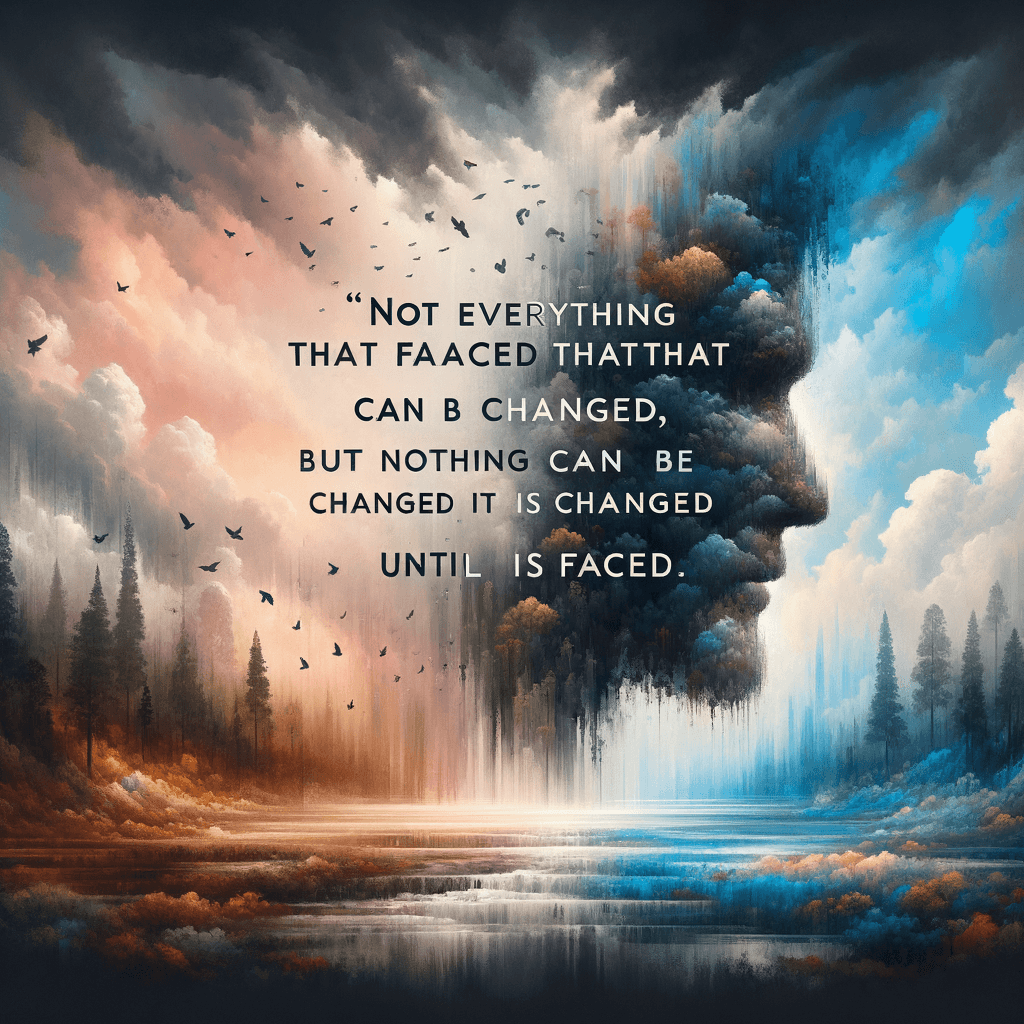
Not everything that is faced can be changed, but nothing can be changed until it is faced. - James Baldwin
—What lingers after this line?
Reality of Challenges
This quote acknowledges the reality that not all problems and challenges can be resolved. Some situations might be beyond one’s control or ability to change.
Necessity of Confrontation
It emphasizes the importance of facing issues directly. Change is impossible without first confronting the situation, even if the possibility of success is uncertain.
Courage and Initiative
Baldwin highlights the need for courage and initiative. Challenging circumstances require the bravery to address them head-on, regardless of the outcome.
Persistence and Effort
The quote encourages persistent effort. Even though facing difficulties doesn’t guarantee change, it remains a necessary step towards any potential progress.
Personal Growth and Learning
Facing issues, whether they are resolved or not, contributes to personal growth and learning. Encountering and understanding problems can foster resilience and insight.
Historical Context
James Baldwin, an African-American novelist, playwright, and activist, often addressed social and personal struggles in his works. His perspective reflects the larger context of civil rights and social change in 20th-century America.
One-minute reflection
Why might this line matter today, not tomorrow?
Related Quotes
6 selectedBoldness plants the seeds of transformation. — James Baldwin
James Baldwin
James Baldwin’s declaration that ‘boldness plants the seeds of transformation’ immediately prompts us to consider the role of courage in effecting meaningful change. Rather than viewing transformation as a product of gra...
Read full interpretation →The old skin has to be shed before the new one can come. — Joseph Campbell
Joseph Campbell
Joseph Campbell’s image of old skin being shed before new skin can appear turns personal growth into something vivid and bodily. At its core, the quote suggests that renewal is not simply about adding better habits or br...
Read full interpretation →If seeds in the black earth can turn into such beautiful roses, what might not the heart of man become in its long journey toward the stars? — G.K. Chesterton
G. K. Chesterton
Chesterton begins with a striking contrast: black earth, dark and ordinary, somehow gives rise to roses of astonishing beauty. From that image, he invites us to see human nature in the same light.
Read full interpretation →A blazing fire makes flame and brightness out of everything that is thrown into it. — Marcus Aurelius
Marcus Aurelius
Marcus Aurelius compresses a central Stoic lesson into a vivid image: a strong fire does not merely endure what is cast into it, but transforms it into more flame and light. In that sense, adversity is not just something...
Read full interpretation →It doesn't happen all at once. You become. It takes a long time. — Margery Williams
Margery Williams
Margery Williams’s line from The Velveteen Rabbit (1922) begins with a gentle refusal of sudden change. ‘It doesn’t happen all at once’ suggests that becoming—whether becoming real, mature, or fully oneself—is not an eve...
Read full interpretation →To create is to destroy the old version of yourself that no longer fits the new truth you have found. — Martha Graham
Martha Graham
Martha Graham’s statement presents creativity not as decoration, but as a radical act of inner change. To create something genuine, she suggests, a person must let go of an earlier self—the habits, beliefs, and identitie...
Read full interpretation →More From Author
More from James Baldwin →Perhaps home is not a place but simply an irrevocable condition. — James Baldwin
At first glance, Baldwin overturns a familiar assumption: home is usually imagined as a house, a street, or a homeland on a map. Yet his phrase suggests something deeper and less movable, a condition that lives within a...
Read full interpretation →Rarely are we more exposed than when we are being kind. — James Baldwin
At first glance, Baldwin’s line appears simple, yet it quickly reveals a harder truth: kindness is never merely polite behavior. When we are kind, we lower our defenses and allow another person to see what we value, what...
Read full interpretation →People who shut their eyes to reality simply invite their own destruction. — James Baldwin
James Baldwin frames denial not as a harmless coping mechanism but as a decision with consequences. By “shut[ting] their eyes,” he points to willful blindness—choosing comfort over truth—and suggests that reality does no...
Read full interpretation →People who cannot suffer can never grow up, can never discover who they are. — James Baldwin
James Baldwin’s claim binds two ideas we often separate: maturity and suffering. To “grow up,” in his sense, is not simply to age or acquire skills; it is to undergo experiences that test the stories we tell about oursel...
Read full interpretation →